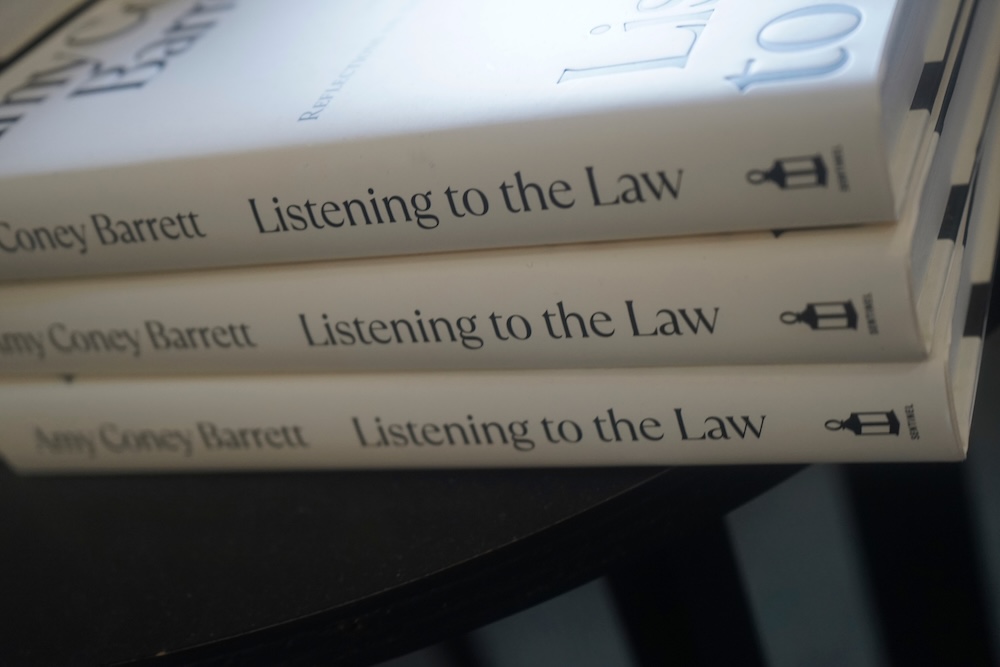
Many Americans wonder if any jurist on the U.S. Supreme Court will ever be able to fill the shoes of the late, great Justice Antonin Scalia, who passed in 2016. President Trump has—so far—appointed three avowedly originalist justices with the potential to do so. In her new book, Listening to the Law: Reflections on the Court and Constitution, Associate Justice Amy Coney Barrett demonstrates that she has the intellect and judicial philosophy necessary to establish herself as a force on the Court in her own right.
Barrett’s nomination to the U.S. Supreme Court by President Trump in 2020 was a dramatic moment, for several reasons. The vacancy she would be filling was created by the death of liberal icon Ruth Bader Ginsburg, affectionately nicknamed “The Notorious RBG.” Barrett’s nomination, on September 26, was only 38 days before the hotly contested 2020 presidential election. Democrats were still mad about Senate Republicans’ refusal in 2016 to schedule a confirmation hearing for Merrick Garland, President Obama’s stillborn nominee to replace Justice Scalia. (As President Biden’s uber-partisan attorney general, Garland proved the wisdom of Sen. Mitch McConnell’s resolve.)
The payback confirmation hearing for Brett Kavanaugh in 2018—nominated by President Trump to succeed the pivotal Justice Anthony Kennedy, who was retiring—was the nastiest in memory, combining the worst elements of the gauntlets unleashed on Robert Bork and Clarence Thomas. The nation was expecting comparable fireworks for the relatively unknown Barrett, a former Notre Dame law professor who had served for less than three years on the U.S. Court of Appeals for the Seventh Circuit, with her chambers in South Bend, Indiana—not exactly in the national spotlight.
Yet the charming and unflappable Barrett dazzled the Senate Judiciary Committee—and the nation—with a masterful performance at her confirmation hearing, resulting in her being confirmed by a vote of 52 to 48 to become the only non–Ivy League law school graduate on the Court. She was smart, poised, and likable.
Conservatives were ecstatic. President Trump’s third appointment, an orthodox Catholic who attended and then taught at Notre Dame Law School (after clerking for Justice Scalia), would bolster the Court’s conservative majority and realistically create the possibility of overturning Roe v. Wade—which finally came to pass in 2022 with the Dobbs decision.
Listening to the Law is an unusual book—neither a polemic nor a vainglorious self-tribute. It was conceived, in Barrett’s words, as “a book about the Court, seen through the lens of my own experience.” Because, as she notes, the Court cannot be separated from the Constitution, “which is both its birth certificate and life work,” she added a tutorial on “the Constitution and its impact, and my own approach to judging.” Written in the first person, the book resonates with Barrett’s distinctive voice, which exudes the clarity of an acclaimed classroom teacher; the patience of a multitasking mother of seven; the calmness of a devout Catholic; the humility of being raised in a large, tight-knit family; and the sure-footed confidence of a veteran legal scholar.
The book leads the reader on Barrett’s journey from childhood in New Orleans to her work in the “marble palace” housing the Supreme Court. At a time when the Court is under attack from both the left and the right, we sorely need more instruction on basic civics, and Barrett delivers, providing thorough and insightful explanations of “the miracle at Philadelphia” in 1787, the Constitution that emerged, the ratification debates, and the resulting concepts of judicial review, separation of powers, federalism, the Bill of Rights, the amendment process, stare decisis, and so forth. Likewise, Barrett’s description of the Court, its colorful history, and its internal operations (especially the role of clerks) is elegantly written, well-researched, and informative.
One theme of Listening to the Law is Barrett’s reverence for the written word. As a lifelong reader, in college she not surprisingly majored in English and considered pursuing a career as an English professor. “I didn’t grow up wanting to be a lawyer,” she admits. Before applying to graduate school, however, she had an epiphany. Law, like literature, relies on words but has real-world consequences: “Law governs the relationship of the government to its citizens and its citizens to one another.” Barrett chose law school instead and went on to be a star student, graduating first in her class.
Barrett’s reverence for the written word is reflected in the title of her book and her commitment to “textualism,” the interpretive methodology championed by her former boss, Justice Scalia, that gives primacy to the statutory text. (The constitutional counterpart to textualism is originalism.) In both cases, words matter.
A revealing insight into Barrett’s judicial philosophy comes early on when she relates an anecdote involving “a favorite aunt,” a political liberal who complained to Barrett that the Court’s opinions (including her own) were often driven by “legalities.” The aunt lamented: “Amy, I thought the Court was supposed to be about doing justice.” Many political liberals embrace such a view, which used to be known as advocating “the living Constitution.” Barrett’s anecdote provokes an extended reflection on the appropriate role of judges in a democratic republic.
Barrett explains that
we judges don’t dispense justice solely as we see it; instead, we’re constrained by law adopted through the democratic process. … It’s a unique role created and defined by the Constitution. … In our system, a judge must abide by the rules set by the American people, both in the Constitution and legislation. … Frankly, that takes self-discipline. … My office doesn’t entitle me to align the legal system with my moral or policy views. … If I decide a case based on my judgment about what the law should be, I’m cheating. … As Justice Scalia rightly observed, “The judge who always likes the results he reaches is a bad judge.” … Just as it’s a problem when a judge likes all the results she reaches, so too is it a problem if the judge wants others to like the results that she reaches.
Barrett provides a telling real-life example: Before she was a judge, writing as a Catholic legal scholar she expressed a moral objection to capital punishment; as a justice on the Court, however, she voted to uphold the death sentence imposed on Dzhokhar Tsarnaev, one of the Boston Marathon bombers. As a judge, she followed the law, not her conscience, despite her moral reservations. And she expects other judges to do the same: “Whatever the source of the [judge’s moral] conviction, it cannot affect the outcome of the case.”
These sentiments could not have been better expressed by Scalia or Bork. And this is before the book turns to a more detailed—and therefore “academic”—explication of constitutional history and judicial philosophy in Parts Two and Three, respectively. The anecdote is personal; the history lesson and discourse on constitutional law are not.
In short, Barrett has the proper conception of the judicial role. Boldly expressing these sentiments (while also “walking the walk”) so early in one’s career on the Court is akin to lashing oneself to the mast to resist the Sirens’ songs that have tempted other jurists to succumb to Beltway flattery—sometimes referred to the as “Greenhouse Effect.” At the age of 53, and with five terms under her belt, Barrett could easily serve on the Court for another 20–30 years. (Fittingly, the literary-minded Barrett uses the same reference to Odysseus and the Sirens to convey the role of a written Constitution to restrain the temptations of pure democracy.)
To return to this essay’s opening thought, many wonder what Justice Barrett’s judicial legacy will be. She is not as pugnacious as Justice Scalia, nor as quirky as Justice Gorsuch, nor as unconventional as Justice Thomas. She is her own woman, comfortable in her skin. Because of her faith, her appointment by President Trump, and her willingness to overrule Roe v. Wade in Dobbs, she will always be reviled by the left (as demonstrated by some unfairly harsh reviews of her book). At the same time, she faces criticism from the right anytime she deviates from the so-called conservative bloc (Thomas, Alito, Gorsuch, Kavanaugh, and sometimes Roberts), which isn’t often.
I counsel patience. She will easily surpass the inconstant Sandra Day O’Connor, the former legislator whom President Reagan appointed as the first female justice on the Court. (Some may regard this as a low bar.) Barrett’s intellect, temperament, and judicial philosophy—all on display throughout Listening to the Law—bode well for the future as Barrett gains seniority and has a greater opportunity to pen majority decisions in consequential cases.
One prominent decision that Barrett wrote last term, Trump v. Casa (2025), dealing with the authority of district court judges to issue nationwide (or “universal”) injunctions, should quiet any doubters. The Court is often split 6-to-3, with the Democrat-appointed justices (Obama picks Elena Kagan and Sonia Sotomayor, and Biden’s sole-appointee, Ketanji Brown Jackson) dissenting from the conservative majority. Trump v. Casa was such a decision.
Justices can disagree with each other in good faith; even originalist justices sometimes reach different conclusions. In Trump v. Casa, however, Justice Jackson resorted to ad hominem arguments, rank hyperbole, and unseemly political rhetoric in her solo dissent. Jackson called the 6-to-3 majority opinion (written by Barrett) “an existential threat to the rule of law” and “also profoundly dangerous.” Jackson would allow every federal district judge in America (numbering over 600) to issue nationwide injunctions hamstringing the executive branch. Ignoring the limits of judicial authority set forth in Article III of the Constitution, Jackson insisted that “courts must have the power to order everyone (including the Executive) to follow the law—full stop.”
In the course of her intemperate harangue, Jackson accused the majority of relying on “a mind-numbingly technical query,” dismissing the Court’s precedents as mere “legalese” serving as a “smokescreen” for the Court’s “creation of a zone of lawlessness” that will “disproportionately impact the poor, the uneducated, and the unpopular.” (Recall Barrett’s indignant response to her aunt’s invocation of a similar objection.) Jackson’s overheated diatribe continued in this fashion for 22 printed pages, containing such bizarre (and jejune) statements as this:
A Martian arriving here from another planet would see these circumstances and surely wonder: “what good is the Constitution, then?”… “Those things Americans call constitutional rights seem hardly worth the paper they are written on!” (Emphasis in the original.)
Needless to say, Jackson’s ill-informed and injudicious dissent did not sit well with Barrett, who acidly responded that Jackson
chooses a startling line of attack that is tethered neither to these [conventional legal] sources nor, frankly, to any doctrine whatsoever. Waving away attention to the limits on judicial power as a “mind-numbingly technical query,” she offers a vision of the judicial role that would make even the most ardent defender of judicial supremacy blush. … We will not dwell on Justice Jackson’s argument, which is at odds with more than two centuries’ worth of precedent, not to mention the Constitution itself. We observe only this: Justice Jackson decries an imperial Executive while embracing an imperial Judiciary. (Emphasis added.)
Ouch. Coming from the supremely courteous Barrett, and appearing in the text of a Supreme Court decision (not a footnote), this is a brutal rebuke. Barrett can effectively channel Scalia, in her own fashion. Accordingly, I cautiously predict that she will “listen to,” and follow, the law.
It need hardly be said that the Supreme Court and its processes are poorly understood, but Listening to the Law de-mystifies them in a candid and non-tendentious manner. Barrett’s spare prose style (her target, she quips, “is more Hemingway than Dostoyevsky”) doesn’t distract from the erudite content, which is supported by ample endnotes and an index. I greatly enjoyed the book and highly recommend it to both lawyers and non-lawyers. Listening to the Law is one of the best overviews I have read about the Court and constitutional decision-making. It’s also an illuminating portrait of Barrett as a person and a justice. She seems to exude the self-discipline necessary to faithfully apply the law. Time will tell, but I remain confident that Barrett will make Scalia (and us) proud.