For the past decade or so, we have become more accustomed to speak of a “crisis” of liberalism. No doubt that is one reason why Notre Dame Press has chosen to re-release David Walsh’s The Growth of the Liberal Soul. Originally published in 1997, the book serves well to remind us that the crisis is not new and that our recognition of it need not prompt an attempt to usher in a glorious “post-liberal” future.
For one, Walsh, professor of political science at Catholic University of America, recognizes that politics is a bounded activity. We are not free to write our future however we please but must operate with the resources we have at hand. For us, that means we operate within a liberal framework (broadly defined), and the response to crisis must come by reimagining and reviving certain elements of that tradition.
Moreover, even if we could move on from the liberal tradition, he argues, we shouldn’t, even if we agree with its critics about the spiritual and moral vacuity of present-day liberalism. Liberalism’s moral decadence today is a result of an overextension of a great spiritual and moral achievement—namely, the recognition of the value of the individual human being.
Addressing the crisis of liberalism, therefore, requires an imaginative rediscovery of the tradition itself. The titular “growth” comes from this reawakening to the truth in liberal practices, which has never been (and may never be) understood in its fullness but gestures toward the unity of individual freedom and the ethical life.
The Liberal Tradition
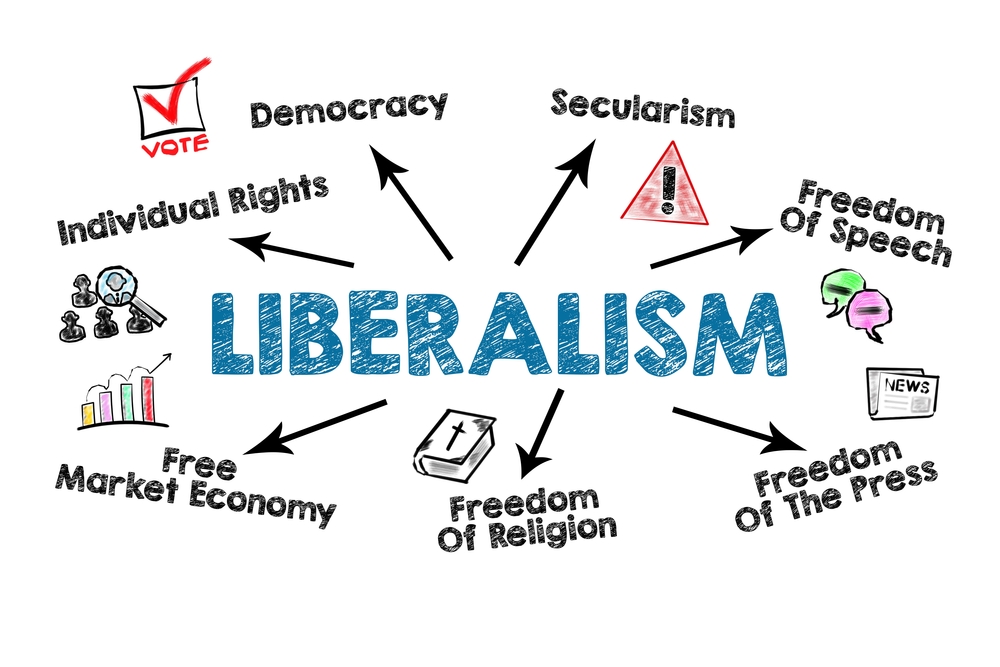
Walsh unambiguously treats liberalism as a tradition of thought, accepting the conditionality that such a characterization implies. This is an important distinction, as the present-day liberalism wars often hinge on (perhaps intentionally) imprecise, ideological, and flippant definitions of what “liberalism” means, such that it may sometimes seem preferable not to use the term at all.
Walsh accepts a degree of indeterminacy about the essence of liberalism that results from the “historicity of truth.” He does not see a need to make “liberal convictions intellectually coherent” but to identify their “existential impulse” and thus “render the liberal order spiritually transparent.” Accordingly, he approaches the liberal tradition as the ongoing experience of Western societies grappling with the problem of order in the modern world: “We may … define liberal politics as the effort to salvage order within a social context where the underlying cultural consensus has fractured.”
This approach to studying liberalism as an active tradition draws openly and heavily from Michael Oakeshott, who Walsh says provides “the theoretically most profound account of liberal political order currently available.” Like Oakeshott, Walsh is interested in concrete moral practices and our ongoing, though always incomplete, reflections on them.
Accordingly, he approaches the history of liberal thought as a continual dialectical attempt to understand what exactly undergirds our modern political practices. The middle chapters of the book walk through the development of liberal ideas, starting with Richard Hooker’s engagement with emerging religious pluralism and proceeding through Hobbes, Locke, Montesquieu, Rousseau, Hegel, Mill, and Tocqueville. This section of the book will be of interest even independent of Walsh’s broader argument for its idiosyncratic but credible interpretations of the modern canon of political thought.
None of these thinkers offers the complete, authoritative depiction of liberal order, nor do they provide intellectually unassailable justifications for it. All offer, to use Oakeshottean terms, abridgements that capture certain aspects of the modern experience, and many have stinging critiques of certain elements of liberal life that lead to new insights into its meaning and limits. They all, however, revolve around a center of gravity that often did not need to be articulated explicitly because it had already been implicitly introduced by both classical philosophy and Christianity: the moral worth of the individual.
The historical survey of the tradition qualifies for the reader what should and should not count as a “crisis” of liberalism. First, the lack of cultural unanimity on important questions does not constitute a crisis, as liberal politics was born from precisely this reality.
Likewise, the inability of even the most eloquent defenders of liberalism to provide a compelling, incontestable account of its foundations should not be considered a crisis. For this, he argues, has also been with liberalism from the beginning, a failure shared by all of liberalism’s alternatives.
Crisis has emerged, by Walsh’s account, only when liberal self-understanding has inadvertently cut off the tradition’s vital impulse: its recognition of human worth.
Between Foundationalism and Nihilism
Walsh’s account of liberalism hinges on a difficult in-between state. To a certain extent, the liberal tradition recognizes that the good life cannot be imposed on anyone; that personal openness to the transcendent through religion or philosophy does not provide obvious, immanent answers to how we should live and act in the here and now; and that an attempt to identify with precision the ultimate foundations of the liberal order may very well overturn the order itself, as underlying cultural consensus on those foundations is not present in the modern world. In short, liberal theory is compelled not to raise its gaze too high lest it disrupt the arrangements of the imperfect order that exists here and now.
That tendency, however, has led to a nagging fear that the liberal order has nothing to justify it; that at bottom, it is nihilism. If that is the case, then its emphasis on individual freedom cannot claim any moral weight.
Thus, a liberal order cannot sustain itself without at least some openness to transcendence—to the notion that the human being is an inexhaustible source of value and an end in him- or herself. That insight is the product of both classical philosophy and Christianity, which are the unseen foundations of liberal practice.
This difficult balance has led to a significant irony of contemporary liberal thought exemplified by John Rawls and Richard Rorty: the simultaneous tendencies to banish, on the one hand, any trace of the divine or transcendent from liberal theory and, on the other hand, to treat liberal theory itself as borderline sacred. “Having learned from Nietzsche no longer to believe in truth, they are nevertheless believers in the liberal truth.”
This sort of liberalism, however, is a house of cards, ready to fall with a stiff breeze. It takes itself for granted and has thus given up on the attempt to understand itself, which is the very nature of a tradition.
We begin to realize that there is no liberal tradition apart from the ongoing struggle by liberal societies and thinkers to render an account of the reasons for who they are. Perhaps this is the deepest layer of the contemporary moment of danger—that so many seem to have become unwilling to continue the quest in light of its inconclusiveness.
The delicate liberal balance was easier to maintain when Christian assumptions were widespread and could be depended upon without being directly appealed to. This accounted for liberalism’s remarkable durability despite its theoretical weaknesses. Once those underpinnings were gone, however, we found ourselves increasingly unable to answer the challenge of Dostoevsky’s Grand Inquisitor, who demands a justification for human liberty that cannot be adequately undertaken with material arguments alone.
A Liberal Faith?
Ultimately, the present crisis calls for a “meditative expansion of limits” that aims to recognize more fully the spiritual assumptions implicit in the liberal tradition. This first means that we acknowledge the incompleteness of the liberal order, which is “incapable of standing on its own feet”—and realize that such limitation is not deadly.
It is not of the nature of a political tradition to be entirely self-justifying. Those of us who live within it must explore its intimations to see what sustains it. And there, Walsh believes, liberalism points beyond itself and beyond the material realm as a tradition that relies on an ultimate cosmic significance to every individual.
Walsh’s regular use of that word “intimations” brings us back to Oakeshott, for whom politics was precisely “the pursuit of intimations.” On this question of a transcendent significance of the liberal tradition, Walsh breaks with Oakeshott, who elsewhere is a steady guide. Like Oakeshott, he rejects a teleocratic politics that stifles both freedom and the moral life by attempting to choose our end for us. Thus, his emphasis on transcendence should not be confused with an attempt to find a definite guide to political action in either religion or philosophy. (In a particularly Oakeshottean turn of phrase, he says we should not expect a “scenic overlook … above the moral struggle itself.”) Where he diverges from Oakeshott is in his faith that there is a telos in the adventure of freedom itself. By living the life of freedom and responsibility we can discover its sources beyond ourselves, even if they are not capable of rational articulation.
The liberal political tradition, for Walsh, can be seen as the earthly, secular side of Christianity’s conferral of dignity on the human being as the imago Dei. He even calls it Christianity’s “highest political expression.” For the present reviewer, at least, such language is generally cause for alarm bells—for concern that an author is sacralizing politics in such a way that it takes the place of the religion it appeals to.
Walsh is attune to the danger but sees it as avoidable: “So long as the liberal convictions have not become a substitute religion, then there is nothing derivative about their status as a secular reflection of Christianity. It is only when the line between the two is blurred and politics masquerades as religion that an artificial hybrid results.”
Yet he does not elaborate in much detail what it means to blur that line, and he sometimes speaks in language that reveals just how difficult it might be to police. There is a certain faith in liberalism that is required to make the leap from its immanent virtues to its spiritual meaning. Like religious faith, for instance, he argues we cannot understand it unless we first live it. And his depiction of the dialectical progress of liberalism has something of the character of an ongoing revelation.
Insofar as we have faith that the winding road of liberal political experience is progressively—if sporadically—revealing new truths and opening our soul to transcendent realities, whither our need for that other polis in the great Christian tradition?
Walsh’s liberalism draws from Christianity the basic dignity of the human being: “The liberal faith is at its root the Christian faith that the value of a human being cannot be quantified.” That is undoubtedly part of the Christian story. But there is simultaneously that message of basic human indignity, by way of original sin, which makes necessary the divine coming to the immanent, rather than the other way around. Focusing too ardently on the former can certainly run the risk of conflating the political and moral good that the liberal order provides with mankind’s ultimate redemption.
Regardless of the merits or demerits of such concerns, the reissue of The Growth of the Liberal Soul is a welcome addition to the raging debate over liberalism. It challenges many of the simplistic characterizations of our political tradition, looking not just to the ideas of this or that theorist but to the totality of our political experience and our attempts to understand it. It recognizes that most criticisms of the liberal tradition have been leveled many times before, and often by friendly critics. And perhaps most importantly, it reminds us that if we are to face the crisis of our tradition, we must pull from the “remnants of the tradition that are still viable.” And that means approaching our political inheritance in the spirit of repair and restoration.



![Hegseth Demands Fitness Requirements, Says 'Fat Troops' 'Not Who We Are' [WATCH]](https://teamredvictory.com/wp-content/uploads/2025/09/Hegseth-Demands-Fitness-Requirements-Says-Fat-Troops-Not-Who-We-350x250.jpg)