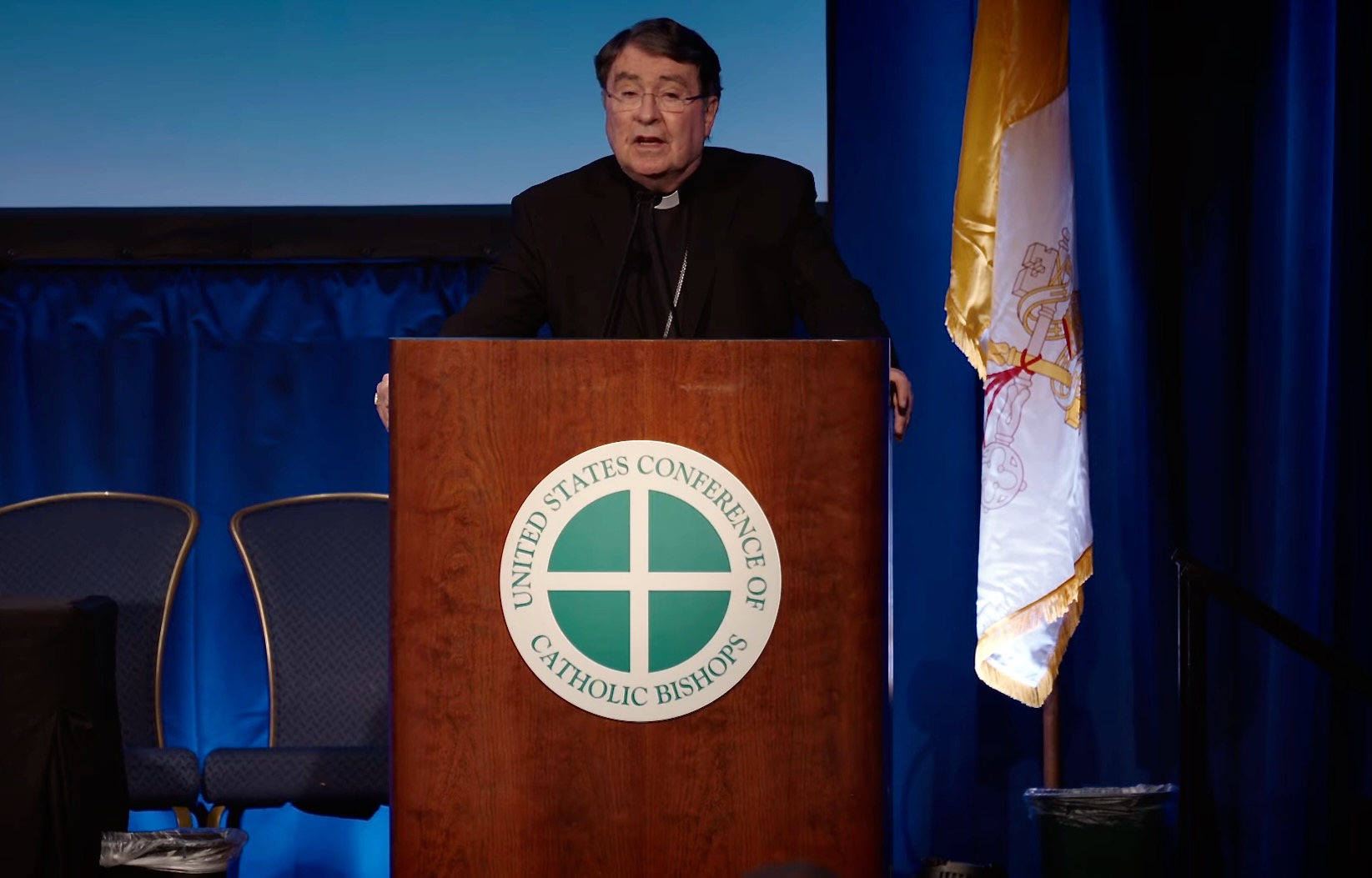
In his address to the U.S. bishops at their annual meeting in Baltimore last week, Cardinal Christophe Pierre, the papal nuncio to the United States, argued – nearly to the point of obsession – that Vatican II has to be regarded as the guide to the present and future of the Church. And the Council, he made clear, as interpreted recently by Pope Francis. (“Pope Leo also is convinced of this.”) It was a bold, if doubtful, claim, given the well-documented ability of theologians to disagree. Even the more progressive among them might find reasons to dispute any such attempt to “control the narrative.” Indeed, the Cardinal went further into even more difficult terrain, claiming – Rome must have cleared all this ahead of time – that “We now inhabit the world that the Council foresaw.” It’s telling – more on this below – that Pierre felt he had to push this so strongly at the American bishops, the implication being that he knows they’re not so very much in agreement.
Now, most committed Catholics today often tend to pay too much attention to such passing statements coming from the pope or the curia. (Mea culpa. . .) And, sadly, sometimes “cancel” others just like the social media maniacs. The most important thing happening any given day on the surface of the Earth, however, may not be some large-scale political or ecclesial matter, but a priest helping someone to die reconciled to God and family. Or perhaps a humble, unknown person, entering into the way of becoming a human being as God intended us to be, one who will really make a difference in the world, which is to say, a saint.
Still, lesser truths also matter because truth is one of the divine names. As any fair observer might tell the Cardinal, no one in the 1960s – let alone the bishops gathered in Rome – had any clear idea of the world we currently “inhabit.” It does no favor to the real achievements of the Council Fathers back then, or to our confused Church today, to make claims that probably none of them would have made for themselves. It’s not merely a question of our brave new world of smartphones, the Internet, and AI, though those are already significant and threatening enough. We live in unprecedented conditions about the value of human life and the nature of human societies, over and above the older problems of sin and unbelief.
In the 1960s, to take a crucial example, Paul Ehrlich published a widely influential book, The Population Bomb, which confidently predicted:
The battle to feed all of humanity is over. In the 1970s hundreds of millions of people will starve to death in spite of any crash programs embarked upon now. At this late date nothing can prevent a substantial increase in the world death rate.
This never happened, of course, but many (including even some in the Church) who believed they were “following the Science” urged adoption of radical programs designed to reduce the birth rate (contraception looked good at the time for multiple reasons) and, allegedly, protect the planet – from people.
We still hear echoes of all that, even now, about whether it’s moral to have children given the human impact on the Earth. And Paul Ehrlich, to the astonishment of many of us, has in recent years continued to be invited as an “expert” participant in conferences by entities like the Pontifical Academy for the Social Sciences.

Today, by contrast, unforeseen by anyone at the time of the Council, every developed country in the world stands at a demographic cliff. People, particularly in the West, are not having enough children to replace themselves. And the various systems that depend on numbers of workers – Social Security, prominently among them – face uncertain futures. This is, incidentally, one of the factors driving the opening of borders to massive immigration, which may or may not help the situation, depending on whether immigrants add to their new homelands or add to the rolls of dependents – to say nothing of a social disruption – as is happening with massive Muslim immigration to the UK, France, Germany, and elsewhere.
A cynic might argue, too, that perhaps the U.S. bishops are hoping that immigration, especially from mostly Christian Latin America, may refill the pews.
Beyond all this, however, it’s worth noting that Cardinal Pierre felt the need to push Vatican II, Francis-style, to our bishops. The American bishops, despite a few odd exceptions, are, by a large majority, still much in the line of John Paul II and Benedict XVI. And though one could wish for more evangelical energy from them, as a group they’re basically committed to holding the line on life issues, marriage, family, and religious liberty. They cannot be said of every bishops’ conference, including notably the Italians and Germans.
Meanwhile, Pope Leo – at least so far – seems to have taken his cues from figures like Chicago’s Cardinal Cupich, who represent a clear minority among the American hierarchy. The pope has even spoken of “problems” among the American bishops.
And he’s right, though perhaps not in the way he means. Poor Bishop Strickland, for example, the ousted bishop of Tyler, Texas, rose during one session last week and pointed out that Fr. James Martin S.J. had recently received into the Church and given Communion to a prominent NY male media figure “married” to another man. He rightly called for the bishops to respond, as almost two dozen did publicly when Cardinal Cupich tried to give a lifetime award to abortion and “gay marriage” promoter Senator Dick Durbin because he was “good” on immigration. And they did respond – by ignoring him.
Several good things came out of the Baltimore meeting. Oklahoma City Archbishop Paul Coakley was elected president. As our friend Phil Lawler has documented, several news organizations have called him a “conservative culture warrior,” which he should wear as a badge of honor, because he’s strongly pro-life, as is Portland Archbishop Sample, elected to head the Committee on Religious Liberty.
Bishop Daniel Flores of Brownsville was elected vice-president. Flores is basically a solid citizen – at least that’s what one hears – though he was put into the difficult position of American point man on synodality. He also has expressed some bizarre views on immigration, saying back in 2017 that rounding up illegals was “formal co-operation with an intrinsic evil,” like driving a person to an abortion clinic.
This is simply wrong. Abortion is a malum in se, an intrinsic evil. Enforcing immigration law is not, and on the contrary – properly conducted – is a social good. There are instances of wrongdoing by ICE agents or others, of course, and those should be addressed. And there is far too much harsh talk about illegals in general these days. But none of that discredits border enforcement any more than occasional police brutality means that policing as such is wrong. One hopes that Bishop Flores was just speaking in an emotional moment.
Indeed, our American hierarchy needs some richer moral language about immigration. You may like what the current administration is trying to do, or not. Still, what’s going on is not only a matter of respecting “human dignity” or calling support for immigration a part of the culture of life. As I’ve said publicly for years now, America bears some moral responsibility towards people it has allowed into the country and particularly if they have been living here quietly for some years. Recent illegals, it seems to me, especially the considerable criminal element, are something else again.
What should be done about these different classes of people needs to be settled by democratic means. Taking sides pre-emptively in that discussion, with only fig-leaf concessions about the right of a country to control its borders, is not something that our bishops or our American-born pope should be doing. There are several competing moral dimensions in play. The Catholic Church, with its sophisticated modern social doctrine, should be sensitive to all of them. Nothing else is likely to work.
And besides, this is really the world we are living in now, not one allegedly foreseen 60 years ago.

![Hegseth Demands Fitness Requirements, Says 'Fat Troops' 'Not Who We Are' [WATCH]](https://teamredvictory.com/wp-content/uploads/2025/09/Hegseth-Demands-Fitness-Requirements-Says-Fat-Troops-Not-Who-We-350x250.jpg)