In The Gay Science (1882), German philosopher Friedrich Nietzsche famously proclaimed the death of God. Recognizing the enormous implications of secularization and the uprooting of Christianity’s “fundamental concept” (faith in God) and the resulting moral confusion, he exclaimed: “God is dead! God remains dead! And we killed him! How do we console ourselves, murderers of murderers?” (book III, section 125).
While it certainly did not emerge with Nietzsche, this notion that faith in God could no longer be the foundation for morality in modern society provided the basis for the gradual secularization of the West. For decades throughout the 20th century, the share of Christians in the population of countries such as the United States, Canada, Britain, and France declined steadily, while the share of people identifying as irreligious rose. In the U.S., their share rose from 5% in 1990 to 30% in 2019. This general trend mostly reflects changes in people’s beliefs: According to Stephanie Kramer of Pew, quoted by The Economist, loss of faith has been the main driver of secularism’s proliferation in the West during the past few decades, much more so than demographic factors such as aging, migration, or fertility. For a while, it appeared that Nietzsche’s recognition was correct. God, if not dead, was no longer needed in the life of an increasing number of Westerners.
Yet, as the late Pope Francis remarked in a meditation at Rome’s Chapel of the Domus Sanctae Marthae in 2017, the Christian God is one of surprises. For the first time in half a century, it appears that the seemingly inexorable advance of secularism in the West has begun to slow down since 2020, according to a recent Pew study of 14 Western countries. In France and Britain, the share of irreligious people appears to have stabilized, while in seven other countries it has slowed markedly, from a 14-point surge between 2015 and 2020 to a 3-point rise over the past five years. In all these places, this coincides with a stabilization of the share of Christians in the global population: In the United States, it has now plateaued at around 62%, compared with about 43% in France and 39% in Britain. Taken together, these two facts show the continuous importance of personal trajectories, such as conversions and returns to faith, in these evolutions. What’s more is that these findings on the slowdown of the secularist surge are consistent across several large annual surveys, as pointed out by The Economist.
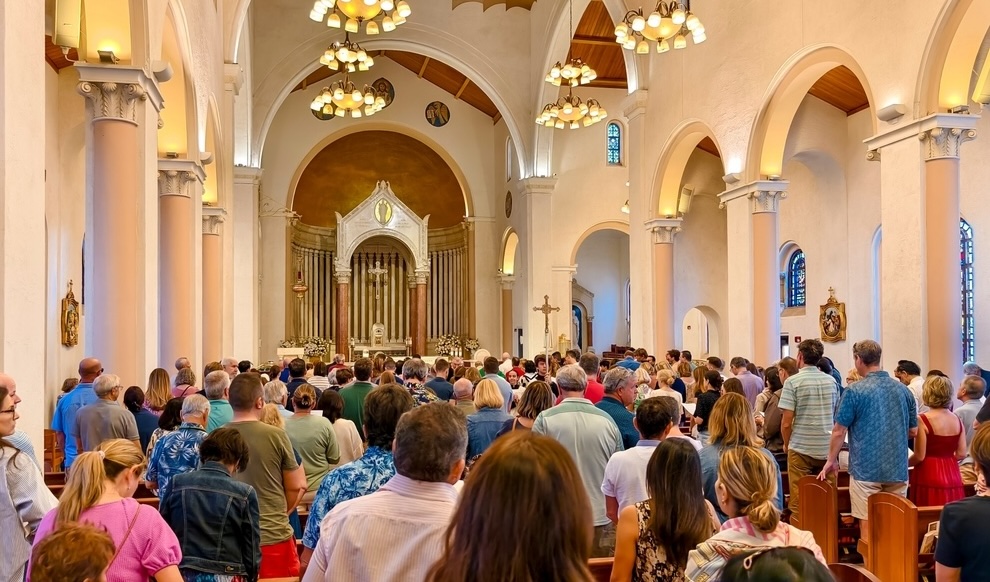
The most surprising trend in this general movement is the resurgence of faith among the young, especially Gen Z men (18-to-34-year-olds). In an interview last year, the late Charlie Kirk observed with unhidden enthusiasm that “young men are going back to church.” Recent data from several major European countries prove him right: In Britain, a study ordered by Bible Society showed that over a fifth (21%) of 18-to-24-year-old men attended church monthly in 2024, compared to only 12% of their female counterparts. Similarly, in the United States, an AEI study from last year showed that Gen Z women are both more likely to leave the church and to be irreligious than their male peers. The main reason invoked by AEI is the tendency of young women to harbor more liberal views than males their age, especially on issues with which churches are often perceived to be out of touch. Here, too, shifts in convictions and worldview are the main factor explaining this partial overturning of women’s long record as the more devout sex.
Despite these clear discrepancies, the increased popularity of the Christian faith among the young is not limited to men. In Britain, there has been a substantial increase in the number of believing men and women since 2018, and the share of Gen Zers identifying as irreligious has been falling since that time, too. Similarly, in Sweden, baptisms of young adults into the country’s national church have more than doubled since 2019, while active withdrawals have witnessed a steady decline. Meanwhile, in the U.S., the share of young people identifying as Christian rose by 6 points, from 45% to 51% across three surveys.
But the most telling example of this renewal is to be found in France. This year, the number of teenagers baptized in the Catholic Church was more than double what it was in 2023, at about 7,400. In 2020, that number was only 1,200. Adult baptisms have witnessed a similar trend, reaching a 20-year record of 10,384, more than double the 4,500 of 2020, marking a 45% increase since 2024. For the first time since the French Conference of Bishops began recording these figures 20 years ago, 18-to-25-year-olds represented a majority (4,500) of adult baptisms occurring in the Church’s eldest daughter.
Several factors are invoked to explain Christianity’s recrudescence among the youth. According to The Economist, the most plausible explanation for this value change is the disruption resulting from the COVID pandemic, which heavily affected younger age cohorts around the data’s inflection point. Increased social isolation and economic uncertainty led many young people to turn to religion as a means of finding community and meaning. Bible Society rightfully reminds us that younger generations are more prone to poor mental health, with 58% of 18-to-24-year-olds in the sample saying they frequently feel anxious or depressed, double the figure for respondents over 55. They are also less likely to socialize in person and more likely to feel isolated than older generations at the same age, marking a clear generational effect. The study shows that churchgoing largely proves to be an efficient solution to these problems: 80% of 18-to-34-year-old churchgoers described their life as meaningful, and 84% were hopeful about their future, compared with 52% and 56% of non-churchgoers in the same age range. Young churchgoers were also less prone to feeling anxious and depressed than non-churchgoers, with 44% compared to 56%, and 63% felt close to people in their local area against only 25% of non-churchgoers.
“How do we console ourselves?” wondered Nietzsche some 143 years ago. For an increasing number of young Westerners, the answer appears to be: “By bringing God back from the dead.”
Within this broad movement of renewed openness to faith, the case of Britain is perhaps the most interesting. In its report on the conclusions of the 2024 YouGov opinion poll, titled “The Quiet Revival,” Bible Society remarks that the striking discrepancy between the “declinist” narrative and the data is mainly explained by what it describes as a shift from identification to practice, especially among the young. Indeed, as the study reminds, the share of people identifying as Christian has still witnessed a rapid decline in the long term and is significantly lower among 18-to-34-year-olds (29%) than within the population in general (39%). According to the report, this, too, comes down to ideational factors: “default” or “cultural” Christianity is losing ground among younger generations in favor of a transition from a “passive label” to a “clear commitment.” In other words, younger people are becoming more Christian primarily in the sense that they practice their faith and see in practice a key criterion for self-identification.
For example, 12% of adult respondents declared attending church monthly, compared to 16% of 18-to-24-year-olds, up from just 4% in 2018. They are now the second most likely age group to be in church at least once a month. In addition, 66% of churchgoers in that age category read the Bible at least weekly in 2024, up from 54% in 2018. In addition, 18-to-24-year-olds are also most likely to pray regularly, and more than 51% have engaged in some spiritual practice over the past six months, compared with 42% for older categories. All in all, the share of nonpracticing Christians has gone from 32% to 27% over the past six years.
Another noteworthy conclusion of the report is that British churchgoers are not only more numerous but also more Catholic: The drop in the share of Anglicans from 41% to 34% of the population since 2018 was accompanied by a rise in the share of Catholics from 23% to 31%. This makes Catholicism the second largest Christian denomination among this category in Albion, only 3 points behind the Church of England. But the results are even more unexpected among young believers: Catholicism is now the most popular denomination among 18-to-34-year-olds, representing 41% of churchgoers, while only one in five are Anglican, down from 30% in 2018. This is far from evident in a country where being Christian has historically more often meant an alliance with Canterbury than Rome, contrary to, say, France, where a positive correlation between the recrudescence of baptisms and conversions to Catholicism is far more obvious and explicable. All this might yet again speak of the extent to which the specificities of young people’s quest for meaning and tradition are a critical driver of the “quiet revival” of God, faith, and practice in the land of Charles III.
In Britain and elsewhere, it remains to be seen whether these encouraging trends merely mean that secularization has reached a plateau or if it marks the beginning of a lasting trend reversal, what some would call a “re-Christianization” of the West. What seems certain, however, is that more people are seeking God and opening themselves to hearing His voice in their lives. And that is already something worth rejoicing about.