
In recent months, we have heard a great deal about traditional liturgies being canceled in certain dioceses. Of course, this is nothing new. The tenacity of certain bishops, however, in eliminating not only these liturgies but also the groups devoted to preserving and transmitting the Catholic liturgical treasure cannot fail to worry us.
First, it must be said that the core of the heated debate surrounding the right of the Traditional Latin Mass to exist is not liturgical in nature. A certain vision of the evolution and state of the world over the past centuries – marked dramatically by the collapse of Catholic monarchies and by revolutions, Marxism-Leninism, Nazism, and the two World Wars – has generated the idea of a complete “readjustment” (i.e., aggiornamento) of the traditional categories of Christian theology and morality, as well as of divine worship.
The premise of this vision is sensitivity and understanding of modern man, who is allegedly no longer capable of receiving the Gospel as transmitted through the traditional means that the Church has employed for nearly two millennia. Hence, the “updating” of the entire Christian religion would be a necessity imposed by new historical conditions. Regardless of how it is phrased, this is the main argument of the “reformers” – often accompanied by the claim that “We no longer live in the Middle Ages!”
The second reason for the changes, systematically denounced by the lovers of Tradition and the defenders of continuity and immutability in divine worship, concerns the theological core expressed in the liturgical and sacramental forms, which were directed against the Protestant tsunami by the Council of Trent (1545–1563).
Critics insistently claim that these forms no longer meet the new needs. Fundamental notions such as “sacrifice,” “symbol,” “penance,” “reparation,” and the like have been bracketed under the influence of a confused ecclesiology. Thus, it is no longer clear whether the Catholic Church is still the one true Church founded by Our Lord Jesus Christ – the only community in which salvation is possible.
This, of course, leads us to the third reason for the liturgical reforms: the ecumenical one, which represents a notable departure from the teachings and ecclesiological style that existed before the Second Vatican Council. In this case, the goal is not so much to adapt to the sensitivity and understanding of modern man as to adapt to the requirements of dialogue with other Christian denominations – a dialogue in which openness and the desire to minimize differences (unfortunately, at the cost of diluting traditional teachings) are dominant.
Thus, although any form of communicatio in sacris with members of other denominations was strictly forbidden to Catholics before the Council, today joint prayers and meetings like those of Assisi and Abu Dhabi have become the norm, while the voices of the few Cardinals and bishops who raise concerns are quickly silenced.
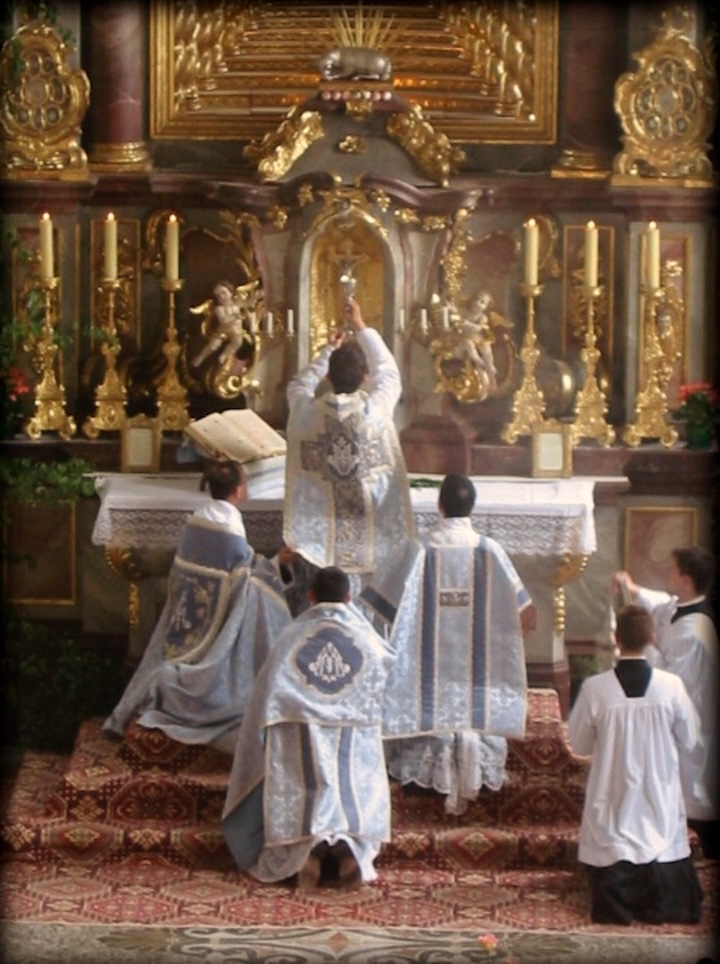
In such a context, the Liturgy of the Ages – characterized by its monarchical and hierarchical principle, and by the sacredness and reverence faithfully preserved by the clergy and the faithful devoted to Tradition – remains the target of those convinced that it represents an outdated, sclerotic form, incapable of overcoming the current crisis.
In the excellent volume edited by Joseph Shaw, The Latin Mass and the Intellectuals, even the hierarchs charged with overseeing the activity of the Ecclesia Dei Commission (suppressed by Pope Francis in 2019, with its responsibilities transferred to the Congregation for the Doctrine of the Faith) believed its purpose was “to phase the old Mass out.” For example, Cardinal Antonio Innocenti stated at a bishops’ meeting that “this was a temporary Commission which is to work itself out of existence.” And Cardinal Dario Castrillón Hoyos attempted to publish, under the commission’s authority, a document imposing innovations such as the reception of Communion in the hand, female altar servers, the use of the reformed lectionary, and the revised calendar of saints.
The attitude of all these critics rests on the same premise: that given the unstoppable evolution of history, liturgical reforms imposed from above are the only solutions to the great crisis facing modern man. The Novus Ordo liturgy alone responds to this crisis; therefore, those who oppose the reform can only be, at best, nostalgic “museum curators,” or at worst, “backwardists” who stand in the way of progress.
Either way, they must disappear. After all, who could oppose the new values inspired by the Holy Spirit: ecumenism, interreligious dialogue, feminism, ecology, global governance, the encouragement of immigration, etc.?
So we may ask: what would be the truly pastoral solution to the current situation? To begin with, would it not be truly pastoral for Catholic hierarchs to show tolerance toward these “backwardists”? Why not grant the right to exist to all priestly fraternities and lay associations that ask for nothing more than the possibility of proving the continued fruitfulness of the worship that all the saints of our Church lived for thousands of years?
What better proof of true shepherds’ love for the more “backward” sheep of the flock could there be? If dialogue with other religions and other Christian denominations is so desirable, why should dialogue with traditionalist theologians and thinkers not be as well?
I believe that Catholics of good faith recognize the legitimacy of such questions and of the answers that follow from them. Yet, if this pastoral vision is lacking, the critics may indeed be right: this is not merely about changing the Liturgy. It is about changing its theological foundations.
And the crisis is not, first and foremost, that of modern man, but of the faith of those who believe that the eternal Truth revealed to us by Our Lord Jesus Christ can be modified according to the fashions of the times.






![WHAT POLICY? Crockett Trips Through MS NOW Softball Question on Her Agenda if Elected to Senate [WATCH]](https://teamredvictory.com/wp-content/uploads/2025/12/WHAT-POLICY-Crockett-Trips-Through-MS-NOW-Softball-Question-on-350x250.png)