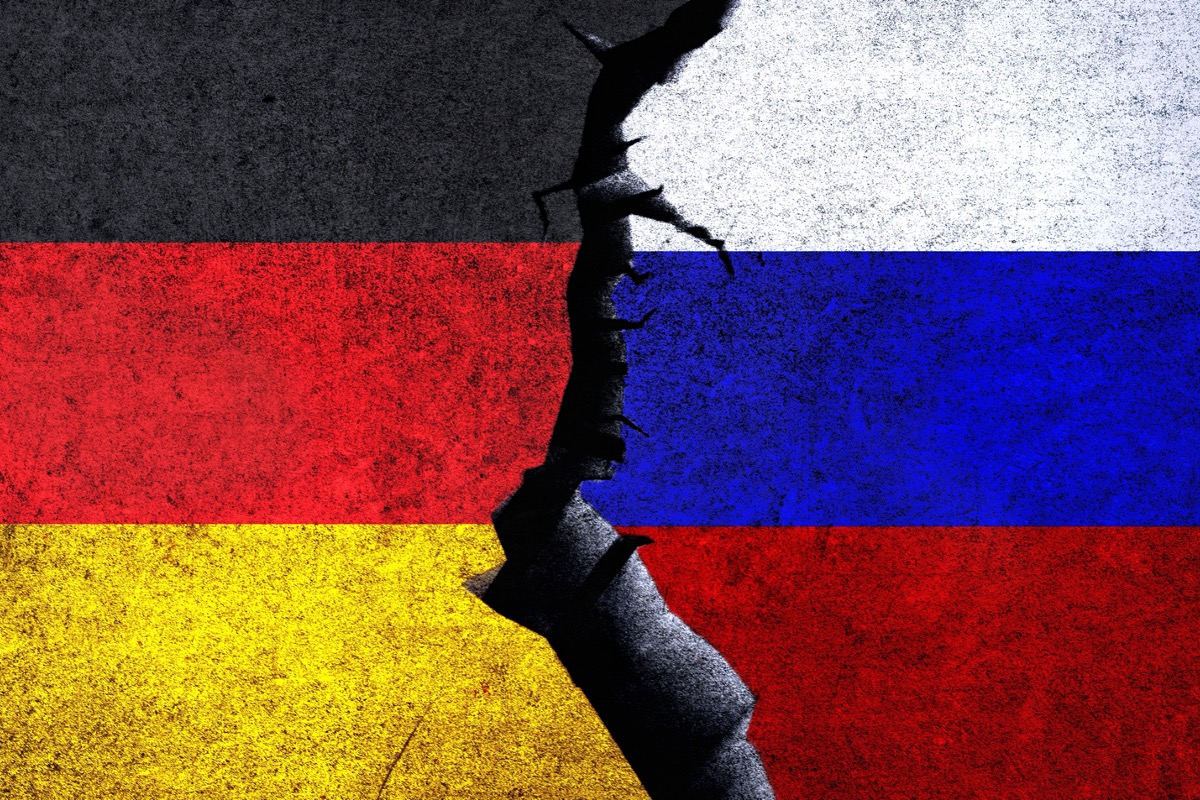
American, Russian, and Ukrainian delegations have been discussing a peace proposal drawn up by U.S. officials to end the war in Eastern Europe. And while it appears that the Trump administration is operating in good faith, that may not be the case for Europe’s top leaders.
A recent Wall Street Journal report, “Germany’s Secret Plan for War With Russia,” bolsters the suspicion and allegation that Western Europe, and Germany in particular, prefers a wider war with Russia over peaceful compromise. Germany’s plan includes dragging the U.S. into its hypothetical war, mainly via its membership in the North Atlantic Treaty Organization (NATO).
This may explain why European leaders are vehemently opposed to Ukraine conceding territory it has already lost, territory that Russia, as a victor, will not abandon — territory Ukraine cannot win back without help from other nations. The Germans are “racing to implement” a “secret plan for a war with Russia,” according to the Journal report. The plan “details how as many as 800,000 German, U.S. and other NATO troops would be ferried eastward toward the front line. It maps the ports, rivers, railways and roads they would travel, and how they would be supplied and protected on the way.” Its authors dub it an “all-of-society” approach to war.
This aligns with Europe’s military buildup over the last year. As we reported back in May, many nations on the Continent — Germany especially but also a coalition of Nordic countries — have been boosting defense spending and training. But their rearmament may be about more than just self-defense. You can read our report on that here.
Operation Plan Germany
Operation Plan Germany, according to the Journal, is a 1,200-page classified document “drafted behind the nondescript walls of the Julius Leber Barracks.” The article presents the plan as having two main objectives: beating Russia in an all-out war or (best-case scenario) being so prepared for war that it would prevent one.
This fall, defense contractor Rheinmetall set up a temporary camp in the east German countryside that accommodated 500 soldiers. (Rheinmetall, by the way, just signed a €260 million deal to resupply German and NATO troops.) During the camp’s 14-day meeting, participants played out war situations and learned that “the land couldn’t accommodate all the vehicles” because “it consisted of noncontiguous plots, forcing Rheinmetall to bus soldiers to and fro.” This is one of the many lessons that “are continuously incorporated” into the plan. This is also a reason why “Berlin aims to spend €166 billion by 2029 on infrastructure.”
In a hypothetical war with Russia, “Germany would no longer be a front line state but a staging ground,” according to the Journal. That’s why the administration of German Chancellor Friedrich Merz has been working to prepare the entire country for war. Per the Journal:
While the new Merz government was trumpeting a €500 billion defense spending plan and a return to conscription this year, the bundeswehr was working under the radar, briefing hospitals, the police and disaster relief agencies, striking agreements with states and the autobahn operator and drawing transit routes for military convoys.
In late September, a military exercise dubbed Red Storm Bravo took place in the northern city-state of Hamburg to rehearse cooperation between the bundeswehr and the police, firefighters and civil protection units.
Leaders Against Peace
Since taking office, Merz has been blatantly open to escalation. The German leader has endorsed the idea that Ukraine should be allowed to launch Western-issued long-range weapons deep into Russia. (President Donald Trump toyed with this a few backs as well, but nothing came of it.) At the 2025 NATO summit, Merz said, “We are already in conflict with Russia.” And just before he was officially inaugurated, he said that it was “time to explore nuclear cooperation between France, the U.K. and Germany.” The context was the Trump administration’s indications that it was reducing its military footprint in Europe.
The Journal article cites “analysts” who appear to have one main agenda: diminishing the current peace negotiations. In the article, they parrot the idea that should a peace agreement emerge from this week’s negotiations, it would only “free up time and resources for Russia to prepare an attack against NATO members in Europe.” The notion that Russia, after taking three years to grind out a sliver of a much smaller Ukraine and taken a big hit to its economy thanks to thousands of Western-leveled sanctions, plans to roll through Europe is irrational. This narrative is more likely propaganda designed to set the stage for escalation sought by the European globalists.
Anti-Russia Machinations
Despite it aligning with Kremlin propaganda, the notion that planners in the the U.S.-led Anglo-sphere have had it out for Russia has a lot of support. In 1992, shortly after the official collapse of the Soviet empire, then-Defense Secretary Dick Cheney, one of the most destructive neocons in U.S. history, said he wanted the rest of Russia dismembered, not just the Soviet Union. Then in 1997, President Jimmy Carter’s national security advisor, Zbigniew Brzezinski, wrote in the Council on Foreign Relations’ mouthpiece Foreign Affairs that Russia should be broken up into three confederations. This aligns with the highly credible accusation that the West, mainly the U.S., instigated the 2014 Maidan Revolution in Ukraine.
A number of American experts who’ve worked with or in the U.S. government, including Mike Benz, formerly with the State Department, and Jeffrey Sachs, who has a long career of working as an economic advisor with the U.S. to various European countries, allege that, in this case, the Russians are telling the truth: The 2014 Maidan Revolution was indeed a regime-change operation orchestrated by U.S. intelligence agencies.
Among his many points of support, Sachs cites a leaked January 2014 phone call between then-Assistant Secretary of State Victoria Nuland and then-U.S. Ambassador to Ukraine Geoffrey Pyatt. During the call, which happened weeks before the violent insurrection in Kiev, Nuland and Pyatt planned the government that would succeed soon-to-be-overthrown Ukrainian President Viktor Yanukovych. And, as former Congressman Ron Paul recently pointed out, “US Senators, including John McCain and Lindsey Graham, were on the main square of a foreign capital demanding that the people overthrow their duly elected government.”
The Heartland Theory
Some trace the Anglo-American internationalists’ anti-Russia hysteria back to the Mackinder “Heartland” theory. Halford Mackinder was a British parliamentarian who believed that if the Anglo powers wanted to continue their global supremacy in the coming century, the Eurasion powers would have to be prevented from forming an alliance or becoming too powerful. Mackinder is considered the father of modern geopolitics, and geography served as the foundation for his theory.
Colin Dueck, author of Age of Iron: On Conservative Nationalism, described why Eastern Europe matters in the context of the Mackinder doctrine:
Mackinder asked his readers to envision continental Europe, continental Asia, and continental Africa as a single “World Island,” possessing most of the world’s population and industrial potential. The core of this world island he called the Heartland, inaccessible to sea power—essentially, Russia, Mongolia, Tibet, and Central Asia, including parts of China and Iran. If the world island were ever united under a single political entity, with a base in the Heartland, then it would possess overwhelming economic and military advantages over the outer crescent of geographically insular maritime powers, such as Great Britain, Japan, and the United States. Mackinder’s recommendation was for these maritime powers to encourage the creation of geopolitical buffer zones, for example in Eastern Europe.
Some believe what we’ve been watching is a multi-decade neocon project to encircle Russia with NATO bases in order to trigger a reaction that would lead to a war that would result in the West’s victory and Russia’s dismemberment. As former Congressman Paul said, “the real villains here are the US neocons and their European counterparts who knew it was suicidal for Ukraine to take on Russia but pushed Ukraine to keep fighting anyway.” He agrees that Russia is justified in perceiving NATO’s decades’ long eastward encroachment as a threat. And he, too, believes the U.S. instigated the Maidan Revolution to place a Western-controlled puppet in Kiev.
Get US Out! of NATO — Before It’s Too Late
As negotiations this week threaten peace, NATO members are preparing for war. They have urged Washington to reconsider its recent troop reduction, particularly in Romania. Ukraine’s head of state, Volodymyr Zelensky, posted an update Monday about the Netherlands’ decision to provide money for more U.S. weapons. Zelensky also met with French, U.K., and Finnish heads of state.
All this makes our decades-long call for the U.S. to exit NATO even more pressing. The Europeans appear to favor more war over a peace compromise. And if they get their way, that will almost assuredly mean that American boys and girls will be sent to die on the other side of the globe for the globalists’ interests.
Legislation to get the United States out of NATO has already been introduced. The American people only need to apply enough pressure to push it through — though it will take a lot of effort. Visit our “Get US Out! of NATO” page here for more on that.


![Hegseth Demands Fitness Requirements, Says 'Fat Troops' 'Not Who We Are' [WATCH]](https://teamredvictory.com/wp-content/uploads/2025/09/Hegseth-Demands-Fitness-Requirements-Says-Fat-Troops-Not-Who-We-350x250.jpg)