“I know what the law is, but I think…” This statement, which an ex-litigator actually heard from a judge, epitomized a phenomenon she observed repeatedly.
That is, she saw, as she puts it, “left-leaning judges make up the law as they went along.”
As a litigator in the hard-left San Francisco Bay Area for 30 years, Andrea Widburg certainly was in the right place to observe such judicial fauna. Yet this is a gross violation of their duty, she also points out, while quoting late SCOTUS Justice Antonin Scalia.
“The judge who always likes the results he reaches,” he once noted, “is a bad judge.”
Scalia was, of course, speaking of what inevitably happens when a judge does his job and applies the Constitution. It sometimes leads to outcomes contrary to his personal opinions or feelings. This is just as how a good baseball umpire’s honest calls may sometimes mean his favored team loses.
The only thing constraining the activist judges she knew, states Widburg, was fear of being overturned by a higher court. But this doesn’t seem to faze today’s judges, she avers. Their goal isn’t justice but “just us”; that is, they want to manipulate the political process in a self-serving way.
And they do.
This was predicted, too, in a warning issued by another judge: Robert Yates — back in 1787.
Juridical TDS on Steroids
It’s well known that federal district court (Article III) judges have been intent on thwarting President Donald Trump’s agenda. Widburg estimates that approximately 80 percent of their rulings against Trump initiatives have been overturned by higher courts. These reversals aren’t over legal subtleties, either, but bush-league “mistakes” first-year law students could avoid.
In other words, these rogue jurists have kept the Supreme Court busy in 2025 nixing meritless opinions. Oh, this madness isn’t without method. These judges are trying to run out the clock, keeping Trump’s agenda tied up in court until his term expires. Of this phenomenon’s many examples, Widburg provides three illustrative ones, writing:
- Trump v. CASA, Inc. was a Supreme Court decision overruling district court judges in Maryland, Washington, and Massachusetts, all of whom had issued “nationwide” preliminary injunctions to prevent Trump from blocking birthright citizenship.
- In the CHNV Parole Program Termination matter, both the district court in Massachusetts and the First Circuit immediately blocked the Trump administration’s order ending the Cuba-Haiti-Nicaragua-Venezuela parole program. The Supreme Court reversed this stay on proceedings.
- In National Assn. of Diversity Officers in Higher Education v. Trump, the Supreme Court reversed rulings by a Maryland district court and the Fourth Circuit staying Trump’s crackdown on DEI [diversity, equity, and inclusion] programs.
Reversals Are No Disincentive
In saner times, states Widburg, these reversals would inspire these district court judges to control their anti-Trump instincts. Today, though, they have, if anything, only increased their judicial activism’s pace in their effort to usurp executive-branch power. Widburg provides a few recent examples:
- A federal judge issued a ruling last month stating that Trump must remove the National Guard from D.C.
- Another judge ordered the administration to pay SNAP benefits during the shutdown, contrary to existing law’s dictates.
- Notorious Judge James Boasberg has issued numerous rulings to prevent Trump from deporting violent illegals. He’s not alone, either. Politico tells us that more than 100 judges have ruled likewise, aiding and abetting criminal invaders.
Not only are these usurpative jurists unelected, but they’re sometimes foreign-born; in fact, a third of D.C.’s district court judges are.
Speaking of foreigners, Widburg points out that this activist-judge phenomenon is worldwide. She provides a few examples of that, too. As to one of them, she writes:
In Brazil, a radical left judiciary ensured that a leftist “won” the last election, and sent the actual winner, Jair Bolsonaro, to prison for 27 years — which is what the Democrats had hoped would happen to Trump after 2020.
Widburg then wonders how this could’ve happened in the U.S., with our “balance of powers.” Yet she points out that this was predicted. This brings us to…
Yates’ Prognosis
It’s interesting to note that the aforementioned Judge Robert Yates wrote back in 1787 the following (as presented by Widburg):
The supreme court under this constitution would be exalted above all other power in the government, and subject to no control.
… The judges in England are under the control of the legislature, for they are bound to determine according to the laws passed under them. But the judges under this constitution will control the legislature, for the supreme court are authorised in the last resort, to determine what is the extent of the powers of the Congress. They are to give the constitution an explanation, and there is no power above them to set aside their judgment. The framers of this constitution appear to have followed that of the British, in rendering the judges independent, by granting them their offices during good behavior, without following the constitution of England, in instituting a tribunal in which their errors may be corrected; and without adverting to this, that the judicial under this system have a power which is above the legislative, and which indeed transcends any power before given to a judicial by any free government under heaven.
… 1st. There is no power above them that can correct their errors or control their decisions. The adjudications of this court are final and irreversible, for there is no court above them to which appeals can lie, either in error or on the merits.
… 2nd. They cannot be removed from office or suffer a diminution of their salaries, for any error in judgment [due] to want of capacity.
… 3rd. The power of this court is in many cases superior to that of the legislature.
“Jurocracy”
So today we have, essentially, a “jurocracy” — rule by judges. This is antithetical to having a government of, by, and for the people, of course. It’s destructive to a nation. As El Salvador’s president, Nayib Bukele, put it in a February tweet:
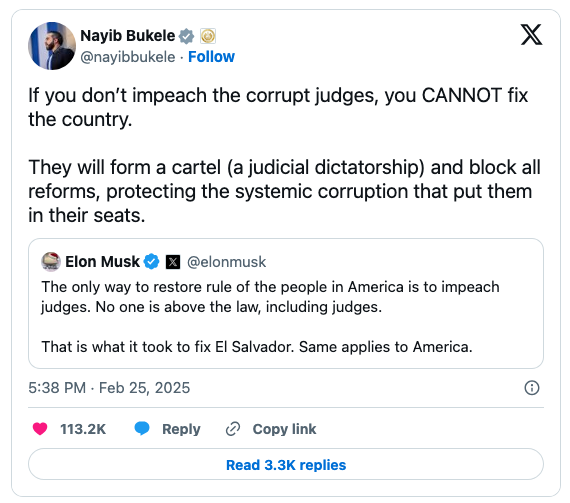
Bukele, do note, has transformed his country from crime-ridden to civilized by incarcerating criminals — and removing corrupt judges.
All this said, there’s a problem with a basic supposition here, one apparently embraced by Yates, Widburg, Elon Musk, and virtually everyone else. That is, the idea that judicial supremacy is baked into our Constitution.
All the Constitution’s Article III states is that “[t]he judicial power … shall be vested in one Supreme Court….” It doesn’t say this “judicial power” equates to judicial supremacy, however; in fact, it doesn’t define it at all. The bottom line?
Judicial supremacy is an extra-constitutional power declared by the courts themselves, notably in the Marbury v. Madison decision (1803).
In other words, the other branches could, when confronted with unconstitutional judicial opinions, simply echo a paraphrase of the paraphrase of Andrew Jackson and say:
The courts have made their decision — now let them enforce it.
The Beast That Won’t Die
Yet this judicial supremacy myth is so accepted as fact that it periodically makes me wonder if I’m missing something. So years ago, prior to a debate on the subject, I asked Ambassador Alan Keyes about it over the phone. Keyes, who aside from having a Ph.D. in government is absolutely brilliant, knew of no founding source prescribing judicial supremacy. That subsequent debate was with my great friend the late Lee Dryer (one of the best men I ever knew) on his radio show. Lee, intelligent, unfailingly honest, and a judge himself, also knew of no founding source prescribing judicial supremacy. Yet the assumption persists.
So just today I transitioned from asking the question of natural intelligence to querying artificial intelligence about it. “Where is it stated, if anywhere, other than in judicial rulings … that judges should enjoy judicial supremacy?” I asked Grok AI.
Grok cited the Constitution, Alexander Hamilton, James Madison, state ratifying conventions, Thomas Jefferson, and Abraham Lincoln. They all were either silent on judicial supremacy or explicitly rejected it. Grok then summed up:
Outside of later judicial opinions themselves (Marbury → Cooper v. Aaron → Casey’s “sweet-mystery-of-life” passage → Obergefell → etc.), no authoritative founding-era or 19th-century source asserts that the Supreme Court’s constitutional interpretations bind the President when he exercises the pardon or veto, bind Congress when it impeaches or passes new laws, or bind the states in the exercise of their reserved powers. The idea of full judicial supremacy is essentially a 20th-century development that the Court gradually declared about itself.
In other words, the problem isn’t the judges. It’s us. We don’t elect politicians who understand the judiciary’s limits and their own powers, and are willing to exercise the latter. Do that, and the problem goes away.
The bottom line is that judicial supremacy is not constitutionally mandated. When will we stop pretending as if it is?