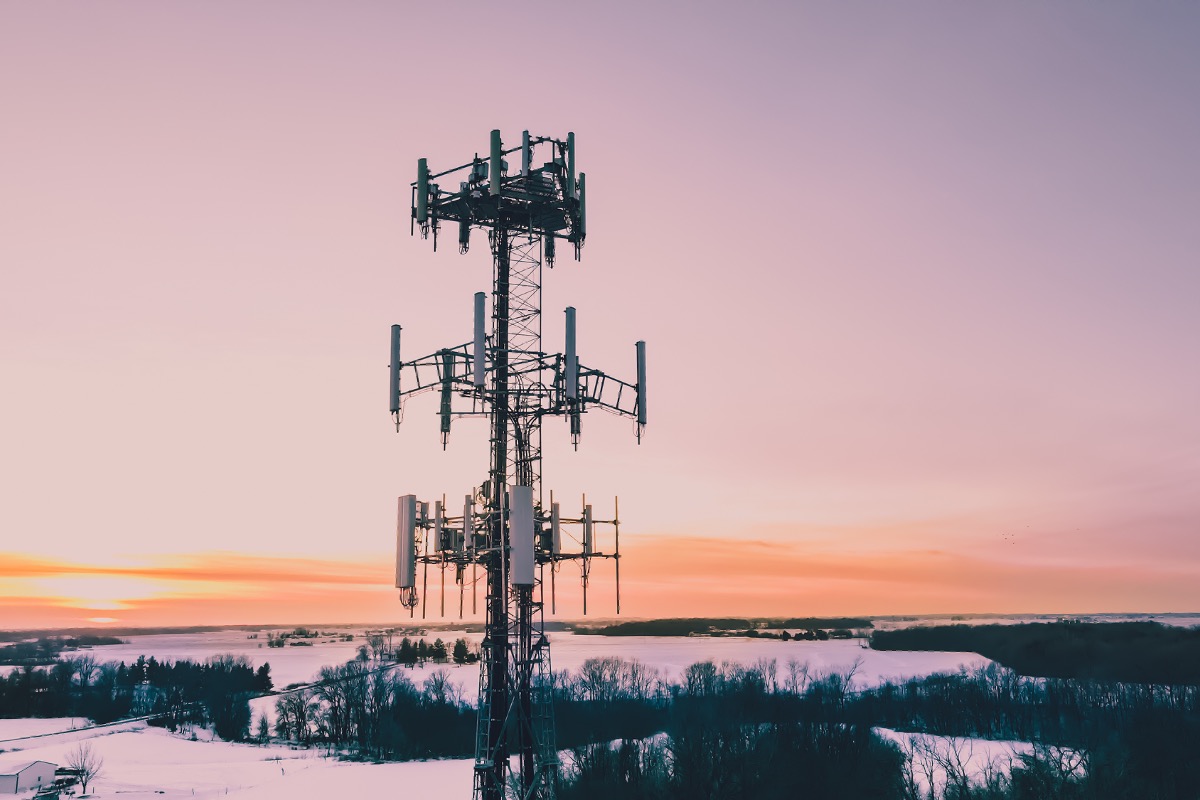
The federal government is moving to accelerate wireless infrastructure deployment nationwide. Two parallel initiatives are now advancing that would significantly weaken state and local oversight.
The first comes from Congress in the form of H.R. 2289, the Proportional Reviews for Broadband Deployment Act. The bill exempts many wireless facility upgrades from environmental and historic preservation reviews. The second is proposed rulemaking by the Federal Communications Commission (FCC), which would broadly preempt state and local authority over cell-tower siting, design, and operation.
Together, these moves reflect the Trump administration’s aggressive posture on advanced communications. The White House treats wireless coverage as essential national infrastructure. Fifth-generation networks (5G) are central to that strategy. The White House frames future technologies such as 6G as inevitable (see here and here).
On Wednesday, President Donald Trump reinforced this agenda during a White House roundtable with technology executives from companies including Qualcomm, Dell, and IBM. During the meeting, Trump drew attention for bizarre remarks about 6G, confusing the technology’s purpose.
The president’s technical fluency aside, the policy trajectory raises concern. Wireless systems associated with health risks and global digital integration are being pushed forward with steadily diminishing public review.
H.R. 2289
H.R. 2289 was introduced on March 24 by Rep. Buddy Carter, a Republican from Georgia. It was referred to the House Committee on Energy and Commerce, with additional jurisdiction assigned to the Committee on Natural Resources.
The bill looks to amend Section 6409(a) of the Middle Class Tax Relief and Job Creation Act of 2012. That section already requires state and local governments to approve certain wireless facility modifications. H.R. 2289 narrows oversight further by eliminating key federal review triggers.
Under the bill, a federal authorization for an eligible facilities request may not be considered a “major Federal action” under the National Environmental Policy Act. This language removes NEPA review entirely.
The bill also specifies that such requests may not be considered an “undertaking” under the National Historic Preservation Act, eliminating historic preservation review.
The definition of “federal authorization” is broad. It includes permits, certifications, special use authorizations, opinions, and other approvals required under federal law.
Children’s Health Defense (CHD), a nonprofit founded by Robert F. Kennedy Jr., who serves as Trump’s secretary of Health and Human Services, blasted the bill as a part of an “unprecedented” power grab. It explained:
The bill, a consolidation of 21 bills, “removes virtually all local and state control over the siting of cell towers, and it strips local authority from being able to protect their communities,” [Odette Wilkens, an attorney with the nonprofit Wired Broadband, Inc.] said.
The organization urged Americans to oppose both the legislation and the FCC’s proposed rule.
The FCC Proposal
While Congress considers H.R. 2289, the FCC is advancing a broader effort through Notice 25-276. The proceeding was launched on September 30 with the stated goal of accelerating wireless infrastructure buildout nationwide.
In its press release, the FCC defines its intent:
The Commission will update its rules to supercharge the deployment, densification, and upgrading of wireless networks and, where necessary, clarify that state and local restrictions cannot unlawfully block 5G or soon, 6G deployment.
The FCC argues that state and local regulations too often slow or block deployment. According to the commission, these rules result in what it calls an “effective prohibition of 5G wireless services.” Zoning restrictions, permitting delays, local fees, and aesthetic conditions are cited as common barriers.
The Notice of Proposed Rulemaking asks whether further federal preemption is necessary. It seeks comment regarding limits on macro cell towers and other wireless facilities, what it describes as unreasonable delays or fees, and conditions tied to aesthetics or visual impact.
The FCC also says it will explore ways to speed permitting disputes, including a possible expedited “rocket docket” process.
The rulemaking builds on earlier FCC actions, including the 2018 Small Cell Order and prior interpretations of the Spectrum Act of 2012, which the agency says increased investment and network buildout.
Under Chairman Brendan Carr, the FCC frames the proposal as part of its Build America Agenda, aimed at accelerating high-speed infrastructure builds, freeing spectrum, and cutting regulatory barriers. The agency links the agenda to restoring U.S. leadership in wireless and space technologies, advancing national security, and supporting the domestic telecom workforce.
What It Means for Local Governments
The nonprofit Environmental Health Sciences (EHS) summarized the core elements of the proposal. The common thread is federal preemption.
Under the proposal, automatic approvals would become possible. If a local government fails to act within a 150-day review window, a tower application could be deemed granted, causing local authority to lapse by default.
The FCC also proposes narrowing aesthetic standards. Communities could lose the ability to require towers to be concealed or designed to blend into their surroundings.
Zoning authority would be further constrained. Local governments could no longer rely on visual or aesthetic considerations to regulate tower height, design, or placement.
Fee authority is also targeted. Local cost-recovery fees that fund inspections and compliance could be capped, shifting costs away from carriers and onto taxpayers.
Setback and siting requirements are labeled potential “regulatory impediments,” opening the door to federal override, including limits on conditions placed on permit renewals.
The proposal extends to radiofrequency radiation oversight, too Community requirements for independent or periodic testing could be preempted entirely.
One of the most significant changes involves the FCC’s reinterpretation of “effective prohibition.” Any local action that slows network upgrades could qualify, even without a coverage gap, reversing long-standing precedent.
The FCC also raises the issue of artificial intelligence. It considers overriding state and local AI regulations if they affect wireless providers’ use of AI tools.
Documented Risks
While wireless expansion is often framed as purely technical, its real-world impacts are well documented. CHD, EHS and other advocacy groups have cataloged risks associated with cell towers and network densification.
One central concern is radiofrequency radiation exposure. Emissions from cell towers may adversely affect health, with children considered particularly vulnerable due to developing bodies and longer lifetime exposure. Some wireless companies, including Crown Castle, acknowledge potential radiation-related liabilities in filings to shareholders.
Beyond radiation, organizations point to physical safety and environmental risks. Towers have fall zones. Equipment failures occur. Ice shedding and falling debris pose hazards to nearby properties and pedestrians. As towers grow taller, these risks increase, even as many projects receive reduced scrutiny by being classified as minor modifications.
Fire risk is another factor. Towers rely on electrical systems and backup power equipment that can fail, requiring a response from local emergency services.
Hazardous materials, including batteries and electronic components, add environmental risk if damaged or improperly handled.
Visual and community impacts are also cited. Towers permanently alter neighborhood landscapes and community character, often with limited public input.
Related to this, property values are another concern. Proximity to cell towers is sometimes associated with significant declines in home values, an effect acknowledged within real estate markets.
Mobile Tech and Globalism
Beyond the threat to state and local authority and other grave risks, the administration’s push for advanced mobile coverage, alongside artificial intelligence and rapid digitization across the American economy and society, has raised concerns about alignment with global technology agendas.
At the international level, 5G is widely framed as a major accelerator of the United Nations’ Agenda 2030. Numerous observers argue the technology enables nearly all 17 Sustainable Development Goals (SDGs).
Within that framework, the UN itself notes,
5G technologies support applications such as smart homes and buildings, smart cities, 3D video, work and play in the cloud, remote medical services, virtual and augmented reality, and massive machine-to-machine communications for industry automation.
The World Economic Forum (WEF), a key UN partner, takes a similar view, casting mobile networks as a backbone of the Fourth Industrial Revolution, intended to merge the physical, digital, and biological worlds.
Together, these frameworks present dense wireless infrastructure not simply as a communications upgrade, but as a prerequisite for broader systemic transformation, one that many Americans have long recognized as the construction of a one-world governing model with unprecedented reach into economies, governance, and daily life.


![Hegseth Demands Fitness Requirements, Says 'Fat Troops' 'Not Who We Are' [WATCH]](https://teamredvictory.com/wp-content/uploads/2025/09/Hegseth-Demands-Fitness-Requirements-Says-Fat-Troops-Not-Who-We-350x250.jpg)