The Mahoney and Maier clans have been best friends for half a century. Our kids – their eight, our four – grew up together and remain close. Kim, the oldest Mahoney sibling, is godfather to our youngest son. A former Marine Corps fighter pilot, he’s now an admirable Catholic husband and dad. As a child though, and one with precocious genes; well, that’s a different story. Somewhere around the age of reason – seven or so – he asked his mother if there really were a Santa Claus. His mother, a committed truth-teller, said no, but Santa’s a beautiful part of the Christmas spirit. To which Kim replied, “If there’s no Santa, I don’t believe in God either.”
This is impressive, if flawed, kid logic. It raises some useful questions about Santa and the entire North Pole propaganda machine.
Consider Elf on a Shelf (hereafter ES). He’s a Christmas favorite. The typical marketing copy for ES goes like this: “Ever wonder how Santa crafts his Nice list? Well, Santa has a trusted Scout Elf assigned to every family around the world. He’ll find a spot in the family’s home to sit and watch all day long. Each night, he’ll fly back to report to Santa at the North Pole to tell him all your stories and adventures.”
Isn’t that sweet? Maybe, but think about it. A skeptic might note that he also reports all your mistakes and failures and bad behavior. The whole ES operation might be subsidized by the coal industry. Worse, Santa’s little helper might actually be working for, or at least sharing your personal data with, Krampus, who’s quite a different kind of Yuletide creature – it’s just a rumor, but where there’s smoke, there’s usually fire. And isn’t it just a bit odd that ES pops up all over the house, uninvited, in the weeks before Christmas with his cute puckish smile, androgynous build, and Aryan blue eyes?
One might reasonably ask: Does jolly old St. Nick really need a branch of Elfdom that functions like the Stasi?
Let’s face it: Elf on a Shelf is an ambiguous figure; enigma incarnate. Is he a friend and champion of children everywhere? Or just another minion of consumer capitalism; a servant of grasping Xmas commerce, and arguably a paid informant for unknown interested parties? These are serious questions.
I’ll come back to them in a moment. Meanwhile, I have a confession. My wife and I are not just complicit in the Père Noël/Father Christmas/Santa Claus racket. We’re veteran agents of the tale; basically a Santa’s Workshop agitprop team for decades.
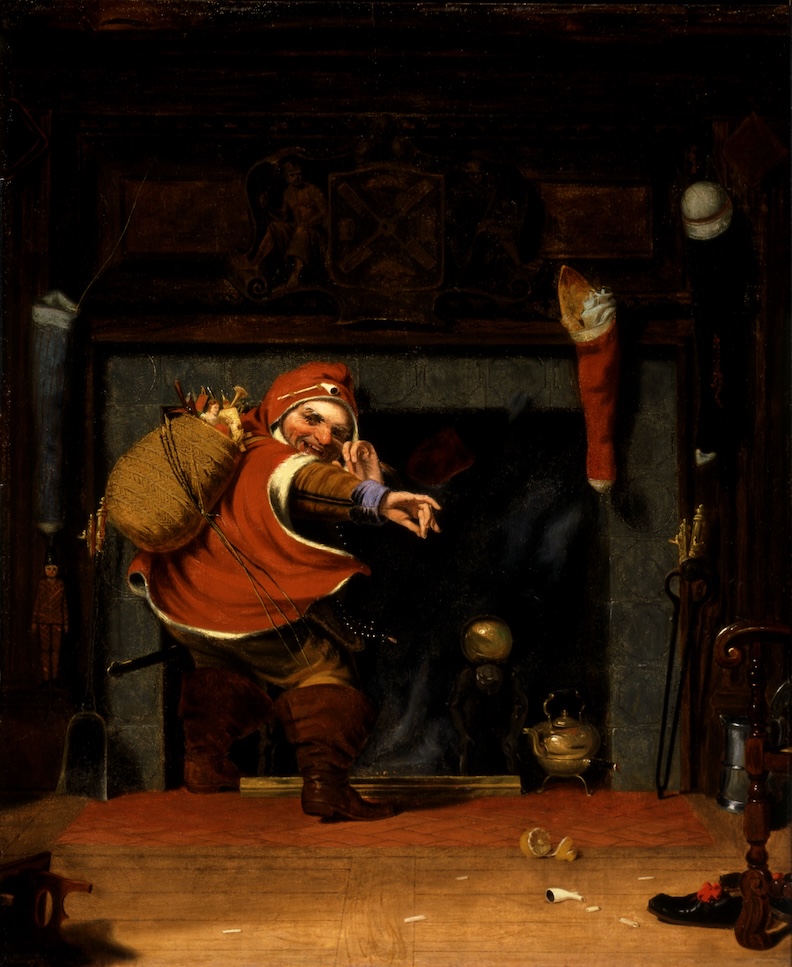
Cleaning out a basement closet earlier this month, we found some 20 years’ worth of annual 3’x2’ homemade Santa’s elf charts – the complete set of North Pole personnel files on our now-adult children. The purpose behind the charts, all those years ago, was simple. Each night starting December 1 through Christmas Eve, Santa’s real elves (us) would visit the Maier household and leave a kind of “performance review” – there’s no kinder way to put it – on each of our kids.
The kids really got into it. They believed in the elves, or at least pretended to, right up to the brink of junior high. Sure, the December chart sometimes bred sibling grievance and finger-pointing. That’s life in a healthy family. But it could also lead, especially in the last week before the Big Day, to modest efforts at conduct reform.
The elves would offer each child some helpful overnight life-coaching in a few scrawled words – Don’t bite your brother,” etc. – but what really mattered were their five graded categories of daily kid behavior: gold star (wonderful work!), silver star (good job!), green star (ok, but you can do better), red star (you’re taking the road less traveled, in the wrong direction), and the dreaded black mark (hope you like coal, kid). Happily, these particular elves were guilty of grade inflation. Black marks were few.
So what’s the point of all the above?
Walking with J.R.R. Tolkien in 1931, C.S. Lewis dismissed myths as “lies breathed through silver.” Only after his conversion could Lewis see the deeper truths about the world captured in myths and fairytales. Only then could he write The Chronicles of Narnia with such beauty and skill.
Much has changed since. We now live in a world where Santa Claus (John Travolta) hawks credit cards for Capital One. The modern consumer economy neither disputes nor tries to disprove supernatural and transcendent things. Instead, it renders them uninteresting, unintelligible, and ultimately absent. It colonizes the heart and hijacks the imagination. It’s anesthetic to the soul and stupefying to the intellect. It’s profoundly materialist, and thus, in practice, quite thoroughly atheist. Assimilating fully to such a culture carries with it an inhumanly high price tag – “inhumanly,” because the meaning of our humanity is precisely what’s at risk.
Which brings us back to Elf on a Shelf, homemade elf charts, and that pesky God issue highlighted at the start by the child Kim. G.K. Chesterton once observed that “[children] are innocent and love justice, while most of us are wicked and naturally prefer mercy.” The young long to know the rules of the game – the nature of justice, right and wrong, good and bad. And before he was drafted for crass commercial service, St. Nicholas offered some of that clarity: gifts for the good, other options for the not-so-good. Think of his elves, seen and unseen, as agents of the moral order.
“Seen and unseen:” We can end there. Reality, as Kim learned as he grew, is more than our meager senses can measure. Behind all the traditions of Christmas lies something greater still. Some myths, as Tolkien wrote, have entered history. Some myths are true. But only one redeems a fallen world: “The birth of Jesus Christ is the eucatastrophe” of the human story – the birthday of joy; the decisive, unearned intervention of God’s love.
That’s what we celebrate next week. That’s the “Merry” in Christmas.


![Hegseth Demands Fitness Requirements, Says 'Fat Troops' 'Not Who We Are' [WATCH]](https://teamredvictory.com/wp-content/uploads/2025/09/Hegseth-Demands-Fitness-Requirements-Says-Fat-Troops-Not-Who-We-350x250.jpg)