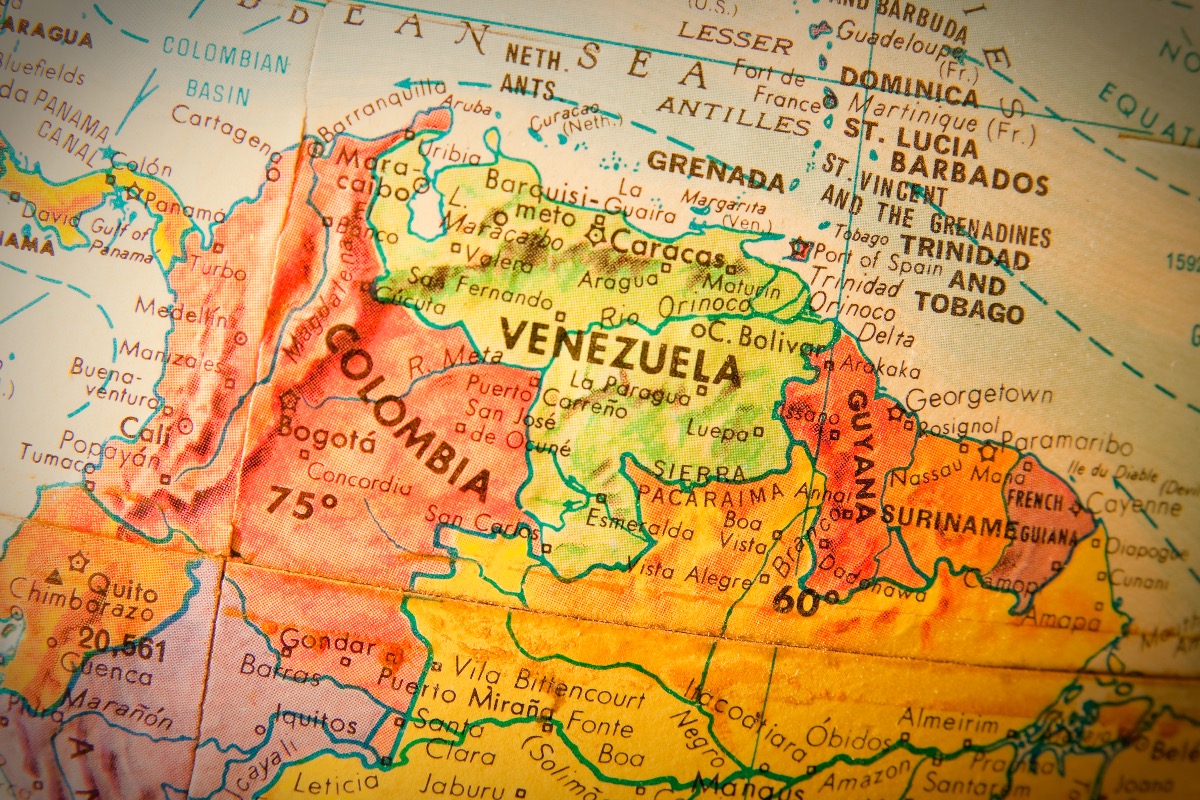
The White House is determined to make Venezuelan dictator Nicolás Maduro cry uncle. On Tuesday, President Donald Trump ratcheted up pressure to effect regime change in one of Latin America’s most corrupt nations by ordering a blockade against sanctioned oil tankers to and from Venezuela.
The move is a clear attempt to starve and dislodge the Maduro regime, which depends on the nation’s main commodity, crude oil. On Tuesday, Trump announced in a Truth Social post:
Venezuela is completely surrounded by the largest Armada ever assembled in the History of South America. The illegitimate Maduro Regime is using Oil from these stolen Oil Fields to finance themselves, Drug Terrorism, Human Trafficking, Murder, and Kidnapping. For the theft of our Assets, and many other reasons, including Terrorism, Drug Smuggling, and Human Trafficking, the Venezuelan Regime has been designated a FOREIGN TERRORIST ORGANIZATION. Therefore, today, I am ordering A TOTAL AND COMPLETE BLOCKADE OF ALL SANCTIONED OIL TANKERS going into, and out of, Venezuela.
Venezuela’s government called the decision a “reckless and serious threat,” and accused the administration of trying to steal Venezuela’s wealth. Indeed, one of the theories as to why Trump is behaving much more aggressively toward this corrupt regime over so many others is because it holds the world’s largest oil reserves.
The announcement of the blockade came just a week after the U.S. military seized a sanctioned oil tanker off the Venezuelan coast. All of this is part of a blatant regime-change campaign the White House began to manifest in September when the U.S. military blew up the first of many boats in the Caribbean. Since then, the White House has struck over a dozen more boats and moved enough military assets into the area to carpet bomb every suspected drug operation on the South American continent.
Maduro the Target
But drugs aren’t the primary target. Maduro is.
A recent Vanity Fair report with comments from White House Chief of Staff Susie Wiles revealed that Trump “wants to keep on blowing boats up until Maduro cries uncle.” Wiles added that “people way smarter” than she is say he’ll get what he wants.
She also said that Trump knows he needs congressional approval for a land invasion into Venezuela. So, for now, it appears he’ll continue doing everything short of going that route to dislodge Maduro. Maduro is indeed an illegitimate head of state, but hardly the only one on the continent.
Earlier reports said that Trump told Maduro to flee, but he refused. Trump did not deny this.
National Security Strategy
Any doubts that the Trump administration would be radically different in its foreign policy were put to rest when the White House released its National Security Strategy. In it, the administration explained that it will not adhere to the Founding Fathers’ noninterventionist foreign policy for the simple reason that it believes such an approach to be impractical in 2025. “For a country whose interests are as numerous and diverse as ours, rigid adherence to non-interventionism is not possible,” the document explains. The administration believes that what happens around the world affects the homeland, thus justifying intervention. (This is also the quintessential neoconservative argument for foreign intervention.)
Regarding the Western Hemisphere, the administration aims to manage and police it rigorously. The strategy is to enlist and expand:
We will enlist established friends in the Hemisphere to control migration, stop drug flows, and strengthen stability and security on land and sea. We will expand by cultivating and strengthening new partners while bolstering our own nation’s appeal as the Hemisphere’s economic and security partner of choice.
Moreover, the White House plans to use a carrot-and-stick approach.
The carrot:
We will reward and encourage the region’s governments, political parties, and movements broadly aligned with our principles and strategy. But we must not overlook governments with different outlooks with whom we nonetheless share interests and who want to work with us.
The stick:
Non-Hemispheric competitors have made major inroads into our Hemisphere, both to disadvantage us economically in the present, and in ways that may harm us strategically in the future. Allowing these incursions without serious pushback is another great American strategic mistake of recent decades.
Venezuela is currently on the receiving end of an intense stick lashing.
China and Russia Support Venezuela
The adversarial inroads mentioned in the strategy document have certainly been paved in Venezuela. The South American dictatorship is very chummy with America’s number one challenger, China, as well as with Russia.
China and Venezuela’s partnership goes back to the early 2000s. It includes energy — oil especially — infrastructure, and trade. China has given Venezuela tens of billions in credit in exchange for oil, part of the commodity-backed loans arrangement the two communist nations have. Moreover, Beijing unveiled a “zero-tariff” trade agreement with Caracas recently at the Shanghai Expo 2025. Venezuelan officials said the accord covers about 400 tariff categories, removing duties on Chinese and Venezuelan goods. Gordon Chang, an expert on China’s global trade strategy, told Fox News, “This really looks like China is going to completely take over the Venezuelan economy.”
The Chinese have publicly denounced Trump’s pressure campaign on Maduro, calling it “unilateral bullying,” according to reports. “China believes the international community understands and supports Venezuela’s position in defending its legitimate rights and interests,” Chinese Foreign Minister Wang Yi said.
As for Russia, its parliament ratified in October a Strategic Partnership Treaty with Venezuela. According to reports:
This move builds on a relationship rooted in 1945 with the Soviet Union, revitalized under Hugo Chávez’s vision of countering U.S. dominance in Latin America.
Since 2019, over 350 agreements have been sealed, including 18 high-level commissions, with Russia providing billions in loans and investments through Rosneft in Venezuela’s staggering 300 billion barrels of proven oil reserves.
Bilateral trade has climbed 64% to $200 million yearly, though ambitions run higher. The treaty spotlights joint oil and gas exploration and production boosts with eco-friendly technology.
Russia has also been sending weapons, military advisors, and mercenaries to Maduro. As we pointed out in the December 5 edition of our Insider Report:
Venezuela is morphing into the new Cuba. Last week, for example, at least one Ilyushin transport plane landed in Caracas, laden with various advanced weapons, including anti-aircraft batteries, and as many as 100 Wagner mercenaries. In addition, Putin has named a top commander in Ukraine, Colonel General Oleg Makarevich (the man who oversaw the destruction of the Kakhovka Dam and the resultant catastrophic flooding of southern Ukraine), as head of Russia’s new military mission in Venezuela.
Opposing Trump’s Intervention
There’s no telling what turns this saga will take. Unfortunately, the partisan nature of the American electorate prevents significant resistance to foreign meddling no matter who the president is. But this scenario is especially interesting because one of Trump’s most frequent reelection pitches was “no new wars.” And it was one of his largest appeals. Sen. Rand Paul (R-Ky.) has said that should Trump invade Venezuela, that would completely break apart an already fractured MAGA coalition.
There’s at least one Republican brave enough to publicly oppose intervention in Venezuela. “The Constitution does not permit the executive branch to unilaterally commit an act of war against a sovereign nation that hasn’t attacked the United States,” Kentucky Rep. Thomas Massie said in a press release for a War Powers Resolution he co-sponsored with some Democrats. “Congress has the sole power to declare war against Venezuela. Congress must decide such matters according to our Constitution,” Massie pointed out. The resolution was drafted to “direct the removal of the United States Armed Forces from hostilities within or against Venezuela that have not been authorized by Congress.”
Rep. Jim McGovern (D-Mass.), another co-sponsor — and someone whose voting record shows his opposition here is political and not principled — accurately pointed out the irony in the administration’s claim that its campaign is about drugs. He said:
Donald Trump claimed he would put America first — instead he’s trying to drag us into an illegal war in Venezuela. Whatever this is about, it has nothing to do with stopping drugs. Trump just pardoned the former President of Honduras who was convicted of sending cocaine to the U.S. And last year he pardoned a guy who brought fentanyl in from China via the dark web. To me, this appears to be all about creating a pretext for regime change. And I believe Congress has a duty to step in and assert our constitutional authority. No more illegal boat strikes, and no unauthorized war in Venezuela.
Massie believes the resolution has a chance of passing the House. “The anti-war Democrats become anti-war again when there’s a Republican in the White House,” he told the Lexington Herald-Leader. “It would take three or four (Republicans) to get it over the finish line. There may be more than that, or there may not be, I don’t know.”