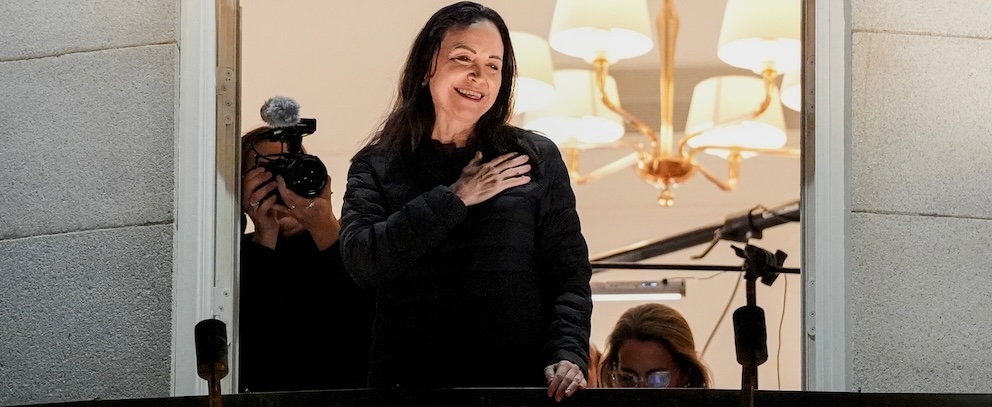
I will never forget my encounter with María Corina Machado, in Lima, Peru, in 2014. Upon landing in that city she learned that the Venezuelan government, which had been persecuting her, had stripped her of her parliamentary immunity and that if she returned to her native land she would not be able to leave again. María Corina did return to Venezuela, and I had to wait more than 11 years to hug and congratulate her in person. It was upon her arrival in Oslo to receive the 2025 Nobel Peace Prize. María Corina arrived one day late due to the challenges of leaving her country. Many aspects of her harrowing extraction from Venezuela are now public. In addition to the psychological challenge of going through such a dangerous trip, she also suffered physically and has stayed in Europe for medical treatment.
María Corina and her team are well known to Acton. In 2018 she was the keynote speaker at our Acton University. Due to government persecution, the speech was delivered online, followed by a conversation with Fr. Robert Sirico, Acton’s co-founder. Fr. Sirico had been following the efforts of Venezuelan freedom fighters, including yearly exchanges with the Venezuelan Catholic hierarchy. During all these years of dictatorship and election stealing, the Venezuelan church maintained its status as the most respected institution in the country.
María Corina’s path to the Nobel Peace Prize started at the beginning of the 21st century, when she was leading Súmate, a civil education organization. I first met her through Rocío Guijarro, the long-time executive director of CEDICE Libertad, the pro-freedom think tank in Venezuela. Long before María Corina captured international attention, she was quietly walking the streets of Caracas, where her mother, Corina, was caring for abandoned children through the Atenea Foundation.
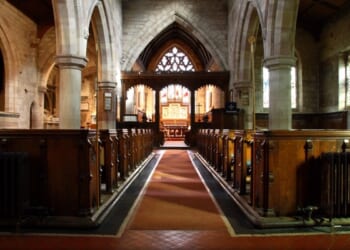
She then moved into politics; hers was constant, principled, ongoing work. Although she does not speak often about religion, during rallies María Corina usually wears a rosary and a simple cross. Her fans frequently give her rosaries, which she collects and keeps in her office. Her rosary necklaces are not a fashion statement but an expression of her true identity. As a young girl she attended Sunday Mass at the Iglesia de la Coromoto, a church dedicated to the Virgin of Coromoto, Patroness of Venezuela. Coromoto was a male Indian tribal leader. It might be inconsequential, but I do not know any virgin named after a man. Her office also has multiple statues and carvings of the Virgin Mary.
Given the many shared principles, the Acton Institute continued to help María Corina’s allies build intellectual and moral support for Venezuela’s liberation and recovery. In 2019, although Acton was determined to host a training program in Venezuela, security concerns led it to move the program to Panama. Several members of María Corina’s team attended that event. One of them, Pedro Urruchurtu, was and is her key aide in policy topics and alliances. Pedro continued to serve as a go-between for Acton and María Corina. He attended Acton University on a couple of occasions with other Venezuelan allies; some are still in that country, so I will not mention them.
When the dictatorship issued an arrest order for Pedro and several others on María Corina’s team, it was another Acton ally who jumped to their aid: Pablo Viana, at the time a young congressman from Uruguay who is also an Argentine citizen and the founder of FREE, a think tank that counted on good allies in the Argentine government. The quick action of his group allowed Pedro and the rest of María Corina’s team to receive protection at the Argentine embassy in Caracas. It is not the place here to describe the difficulties they faced during the 412 days they spent there. Their extraction, thanks to Operation Guacamaya, was as movie-like as that of María Corina’s. (Still, hers was a much longer journey and required more behind-the-scenes help from the U.S. and other governments.)
Several of María Corina’s allies attended the 2025 Nobel Peace Prize ceremonies. They represent different groups and ideological currents. At the start of her political career, María Corina seemed like a talented but typical conservative, a member of Venezuela’s elite. Yet her constant dedication and real closeness to the popular classes—walking through almost all the neighborhoods of Caracas and the country—and her effort to broaden her dialogue with other forces finally allowed her to win the support of most Venezuelans.
There were times when María Corina and her team felt very alone. On January 5, 2019, Juan Guaidó was elected president of the Venezuelan National Assembly. The opposition considered the May 2018 presidential elections illegitimate, declared that power had been usurped, and affirmed the existence of a presidential vacancy. Under the Venezuelan constitution, Guaidó took the oath as interim president at an open town hall assembly in Caracas on January 23, 2019. More than 50 countries (including the U.S., most of Latin America, and Europe) recognized him as president. The United States took the lead, providing full support to Guaidó and his closest allies. Little, if any, of that support went to other pro-freedom forces like the one led by María Corina, despite Guaidó’s failure to gain support among the majority of Venezuela’s conservative and liberal forces. It is common in many bureaucracies, such as the State Department’s, to put all their efforts into their preferred strategy. Visa issues prevented Guaidó from being at the Oslo events, but other members of the opposition in exile—such as Leopoldo López and Antonio Ledezma—were able to attend. Some, like Henrique Capriles, were not invited, as they are seen as instrumental to the current regime.
Lacking the support of the United States and without access to the funds seized from the Venezuelan regime, María Corina and her team accepted modest help and collaboration from think tanks and organizations of diverse ideologies, especially on social issues. María Corina moderated her stance on these topics, which earned her criticism from more conservative sectors.
Several conservatives were present at the events organized around the main Noble Peace Prize ceremony. The most well known, at least to me, were members of the Disenso Foundation, associated with Vox, the conservative political party in Spain. On the night before the prize presentation, they screened the film María Corina Machado: La Conquista de La Libertad, which will soon be subtitled in English. In just one week it became the second-most-viewed video produced by their foundation. Almost everyone who attended that premiere ended up in tears, including me.
The last Nobel event I attended, organized by the Oslo Freedom Forum with support from the Reynolds Foundation, was called “The Nobel Is Ours.” Thor Halvorssen, the program’s leader, told me with his typical energy: “This is the first Nobel Peace Prize won by someone aligned with classical liberalism.” Since María Corina is now, at least for a while, competing with Javier Milei on the podium of fame in Latin America, I am sure that more-liberal conservatives from the Americas will be competing with Europe’s and the rest of the world’s “progressive” liberals to bring her closer to their camps and ideas.
In the field of economics, which I know best, María Corina has presented solid economic programs that are aligned with classical liberalism. In geopolitics, I do not doubt that she will associate more with the conservative side of the U.S. political spectrum. Machado did not mention Trump during her speeches in Norway, but she did not rule out support for an eventual military or quasi-military operation to overthrow the usurping tyrant in Venezuela along with his accomplices.
The cinematic odyssey of María Corina’s journey to Oslo, and the uncertainty about how and when the U.S. government will help reinstate a legitimate government in Venezuela, captures more attention, at least for now, than the impact the Nobel Peace Prize will have in promoting María Corina’s ideas in the Americas. But those of us who love and admire María Corina have the duty to present our thoughts to her and to give her and her eventual team the space and tools needed to choose the best ideas and policies to rescue Venezuela from the horrors of a criminal regime.
Her Nobel Peace Prize marks not the end of a struggle but the dawn of a rebirth—a Venezuela where families can be reunited, where elections are honest, where faith guides public life toward human dignity and human integral development.
María Corina Machado’s legacy is bigger than politics. She stands with other leaders of conscience who prove that moral courage can defeat fear. But her fight is not yet finished.
And that is precisely why this moment matters so much. Venezuela—and the world—needs witnesses like her.