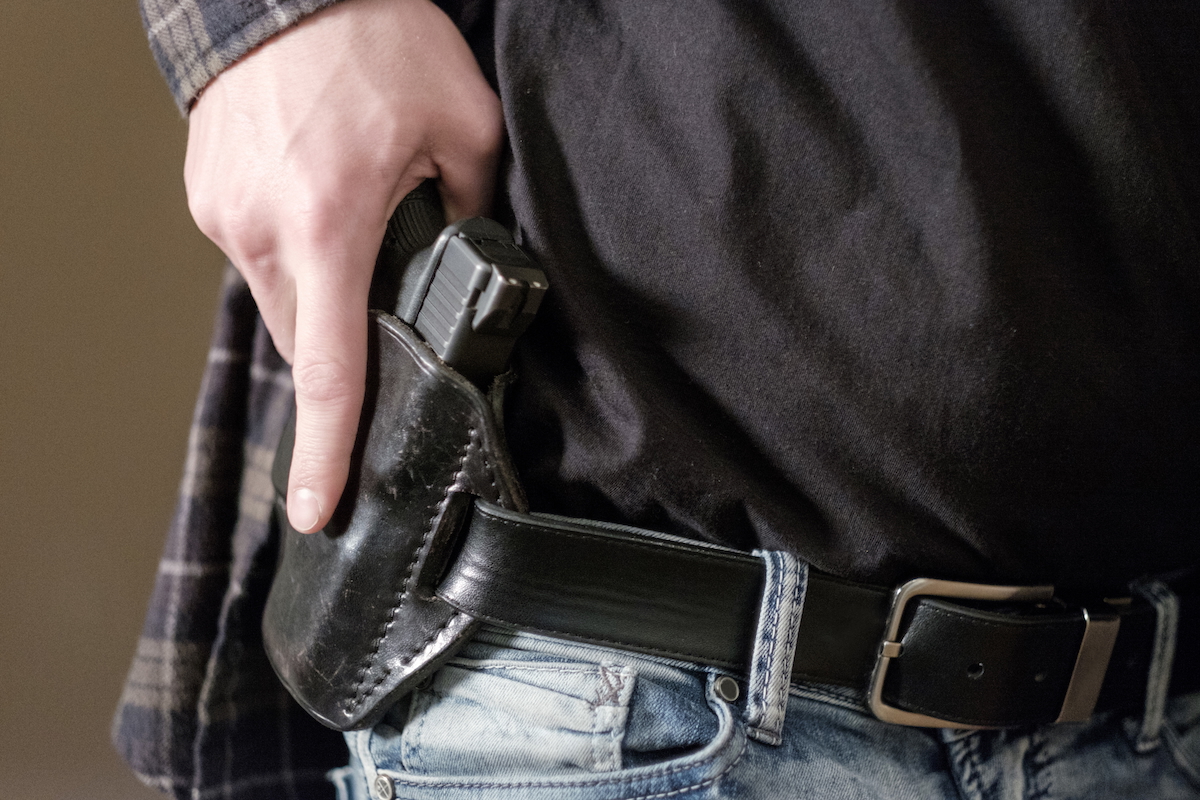
At a time when the constitutionally protected right to keep and bear arms faces relentless attacks at every level of government, The John Birch Society (JBS) stands as one of the nation’s most consistent and effective defenders of the Second Amendment. Unlike organizations that focus almost exclusively on court battles or election-cycle politics — as important as those activities are — the JBS engages where the fight most often determines real outcomes: educating the public on policy and activating citizens to vigilantly defend their God-given rights.
Fighting Where It Matters Most
Over the past several years, The John Birch Society has analyzed and scored well over 150 Second Amendment-related bills across dozens of states through its state Legislative Scorecards. These bills span multiple legislative sessions and cover nearly every major front in the gun-control debate, from constitutional carry and nullification efforts to red-flag laws, gun bans, merchant-category-code safeguards, manufacturer-liability schemes, and “gun buyback” programs.
The JBS has strongly supported legislation that restores or protects the right of self-defense, such as constitutional-carry bills in states including Alabama, Indiana, Iowa, Tennessee, and Utah. Other states have done the same. The JBS has also backed nullification measures — including bills in Arizona, Georgia, Idaho, Kentucky, and Oklahoma — designed to block state and local enforcement of unconstitutional federal gun-control laws and edicts.
At the same time, the JBS has consistently opposed bills that undermine due process and individual liberty. These include red-flag laws in states such as Michigan and Vermont, sweeping “assault weapon” and “ghost gun” bans in California and Washington, and warrantless arrest or surveillance provisions tied to firearms purchases in states such as Maryland. The JBS has also opposed attempts to punish gun manufacturers through liability expansions and coercive “buyback” programs intended to reduce civilian firearm ownership, also seen in Maryland. The bills included in its advocacy are far more numerous than what this article lists.
Defending a God-given Right
Unlike many self-described “pro-gun” organizations that accept incremental restrictions as political compromises, The John Birch Society rejects the false premise that government may regulate a God-given right out of existence or water down protections of it. The Second Amendment was not written for hunting or sporting purposes; it was written to secure the people’s unalienable right to self-defense and serve as a final check against government tyranny.
Just as important as tracking votes, the JBS educates its members and the public on the constitutional foundation of the Second Amendment. The JBS emphasizes that gun control is not a public-safety issue, but a tool of centralized power historically used to disarm populations before imposing authoritarian rule. If the Second Amendment is eroded, the rest of the Bill of Rights will soon follow.
Amplifying Pro-Second Amendment Voices
In addition to legislative analysis and grassroots education, The John Birch Society amplifies principled voices defending the right to keep and bear arms through 2A for Today, a radio program and podcast hosted by constitutional attorney and author Joe Wolverton II, J.D. The show provides serious, constitutionally grounded analysis of Second Amendment issues, countering the emotional narratives and distortions pushed by the corporate media. The program brings together leaders from across the pro-gun movement — including Gun Owners of America, the Second Amendment Foundation, the National Association for Gun Rights, and Attorneys for Freedom — along with members of Congress, constitutional scholars, and legal advocates examining court cases, congressional action, executive overreach, and threats posed by agencies such as the Bureau of Alcohol, Tobacco, Firearms and Explosives.
More than a news program, 2A for Today educates listeners on the foundational truth that the Second Amendment protects a God-given right rooted in natural law, not a privilege granted by government. By addressing issues ranging from red-flag laws and federal gun registries to United Nations disarmament efforts and the moral case for armed self-defense, the show equips Americans to resist disarmament and defend liberty. Through Wolverton and 2A for Today, the JBS continues its mission of educating the public, building unity among constitutional defenders, and carrying the fight for the Second Amendment into the battle for hearts and minds.
Educating the Nation
Beyond legislative analysis and podcast outreach, The John Birch Society advances Second Amendment education through an extensive body of written and visual content published by The New American (a subsidiary of the JBS) and JBS media platforms. For decades, TNA has consistently defended the right to keep and bear arms, publishing hundreds of articles that examine the Second Amendment from constitutional, historical, legal, and moral perspectives, exposing the false premises behind gun control and reaffirming that the right of self-defense is inseparable from liberty itself.
Complementing this written analysis, JBS has produced a vast library of educational videos, events, and constitutional-training materials dedicated to explaining and defending the Second Amendment as part of the broader Bill of Rights and the U.S. Constitution. The late JBS CEO Arthur Thompson repeatedly warned that the Second Amendment has been deliberately misrepresented in modern education. He explained that the phrase “well-regulated militia” was never intended to justify government control, but to affirm the necessity of an armed citizenry for the security of a free state. Thompson emphasized that “the right of the people” means all citizens, that “shall not be infringed” admits no regulatory exception, and that distortions such as registration schemes and militia-only interpretations are designed to condition Americans to accept disarmament.
Those warnings are emphasized in Thompson’s book The Second Amendment: Under Attack From All Angles, which traces how assaults on property, speech, education, and sovereignty are deliberately intertwined with attacks on the right to keep and bear arms. Drawing on history and firsthand accounts, Thompson shows that confiscation begins rarely with force, but often with pressure — utilities withheld, property seized, children leveraged, and crises exploited — and warns that when one liberty is surrendered, the rest soon follow.
Through this long-term educational effort, the JBS continues to expose the systematic erosion of the Second Amendment while equipping citizens to defend their God-given rights, educate their communities, and restore constitutional limits on government.
A Long Record
Long before today’s pro-Second Amendment movement became influential, JBS publications were documenting and vocally opposing gun-control efforts. The New American’s pro-Second Amendment position traces directly back to American Opinion, its predecessor magazine and a longtime JBS vehicle for promoting America’s founding principles and warning about centralized power.
In 1968, amid political assassinations and escalating calls for federal intervention, American Opinion published multiple articles warning that “public safety” was being used as a pretext for expanding federal authority. For example, in an article titled “The Gun Grab,” Analysis Editor Susan L. M. Huck documented how commissions and task forces were already treating nationwide registration and licensing as the ultimate goal, with “research” structured to sell infringements as “reasonable” reforms. That same year, correspondents Reed Benson and Robert W. Lee argued that registration and licensing would primarily burden law-abiding citizens, not criminals, citing examples from Great Britain, New York, and even maximum-security prisons to show that illegal firearms persist where legal ownership is restricted.
In a 1975 American Opinion article, Rep. Larry McDonald (D-Ga.), who later became chairman of the JBS, rejected the claim that the Second Amendment is a government-granted privilege, emphasizing that the Bill of Rights protects pre-existing rights and that “shall not be infringed” was meant to prevent erosion through regulation, registration, and bureaucratic “compromise.” In September 1979, writer and radio commentator Alan Stang described the right to keep and bear arms as the “bottom line” of American liberty — not merely a hunting provision — and warned that disarmament historically precedes broader tyranny, often facilitated by administrative abuse that turns peaceful citizens into “criminals.”
Stang returned to the theme the following month, pointing to a growing split even among some self-described “liberals” as evidence mounted that handgun bans and discretionary permit regimes function less as crime-control tools than as political instruments. He highlighted the work of civil-liberties attorney Don B. Kates Jr., who argued that many gun restrictions originated as efforts to disarm politically disfavored groups — from freedmen in the post-Civil War South to immigrant communities targeted by New York’s Sullivan Law. Stang also warned that permit systems protect the well-connected while ensnaring ordinary citizens who attempt to defend themselves.
In 1982, American Opinion documented not only new federal gun-control proposals, but also a growing pro–Second Amendment counteroffensive. Contributing Editor Robert W. Lee reported that Sen. Edward Kennedy (D-Mass.) and Rep. Peter Rodino (D-N.J.) were pressing major new restrictions even as reform legislation sponsored by Sen. James McClure (R-Idaho) and Rep. Harold Volkmer (D-Mo.) gained momentum as a corrective to abuses embedded in the Gun Control Act of 1968. Lee warned that when national efforts stalled, gun-control activists increasingly shifted to local ordinances because, once enacted, restrictions are difficult to reverse. The proposed reforms aimed to punish violent criminals more severely while reducing harassment of lawful gun owners and dealers through clearer statutory definitions, due-process protections, and limits on warrantless “inspections.”
Over the decades, the message remained consistent: punish criminals, not peaceful citizens — and resist incremental policies that transform constitutionally protected rights into privileges dispensed and revoked by government.
Results, Not Rhetoric
By evaluating hundreds of votes, exposing lawmakers’ records, and mobilizing grassroots opposition to unconstitutional legislation, The John Birch Society has proven itself to be one of the strongest, if not the strongest, pro-Second Amendment organizations in the country — not in rhetoric, but in results.