
The history of salvation is long. It begins, as we read in Genesis, even before Creation itself. Before space and time were, God already was preparing all that would unfold. The ultimate culmination of that story is as yet unknown, though it has been revealed to us in part. Our own part in the story of salvation is unfolding every moment. And while God comprehends all from outside of time, our own actions and choices cooperate (or not) with the plan which He laid down before the foundation of the world.
We human creatures are not eternal beings; we have a beginning. While our bodies are mortal, our souls are not; there is no end to us. Unlike God, we are changeable – mutable, in the language of theologians and philosophers – in both our mortal bodies and our immortal souls.
From the study of physics we learn about the conservation of mass and energy, by which all the mass and energy that ever was or will be already exists. Carl Sagan famously observed that we are “star dust,” which is true in one sense. But the celestial origins of our material existence do not tell the whole story. We are more than recycled bits of the Big Bang’s leftovers. Much more.
With the creation of every new soul, an entirely new thing comes into existence. The composition of the cosmos changes in kind, not just degree. When a new person comes into existence, reality itself is altered forever. Souls are not star dust, neither do they pass away.
And so there are new things – genuinely new things – which come into existence every day. Changes – irrevocable, eternal changes – happen all around us. New souls come into being. Souls are marked indelibly with baptism or by holy orders. Souls are parted, for the time being, from their mortal bodies. Souls are judged. And they are saved or they are damned.
The history of salvation, told in something like its fullness, is a story not only of Creation, but of God’s continual intervention. God visits His people. He makes covenants with them. He calls them to Himself. He chastises them and shows them mercy. He delivers them from bondage. He keeps His promises.
The central event in this long tale of salvation history is, of course, the greatest New Thing in all Creation. An angel appears to Mary, and she conceives by the Holy Spirit: the Word made flesh. A child is born in Bethlehem. He grows in wisdom and favor before God and man. He is tempted. He is without sin. He preaches the coming of the Kingdom and good news to the poor. He performs great miracles. He is betrayed, suffers, dies, descends into hell, rises, and ascends to the right hand of the Father. He sends the Holy Spirit. He feeds His people with His own body and blood. He keeps His promises.
The scope of this glorious mystery is so vast that it can be difficult, if not impossible, to behold all at once. The Church, in her wisdom, recalls it through the rhythms of the liturgical year. We savor one moment at a time through our successive feasts. The whole is always there, but we encounter it most often in some particular facet: the life of some great saint, the commemoration of great moments in the life of our Lord or of the Blessed Virgin, whole seasons of penance and rejoicing.
It is at Easter, and particularly the Easter Vigil, that the Church draws our eyes to the broadest horizon. We hear the whole story of salvation history, and the full glory and import of the Resurrection is made as plain to mortal minds as our liturgy and praise can make it. Easter joy is cosmic, triumphant, exhilarating. Easter joy is all trumpet blasts and blinding light. Easter joy is apocalyptic in the oldest sense: a revelation of what was previously hidden in the divine mind.
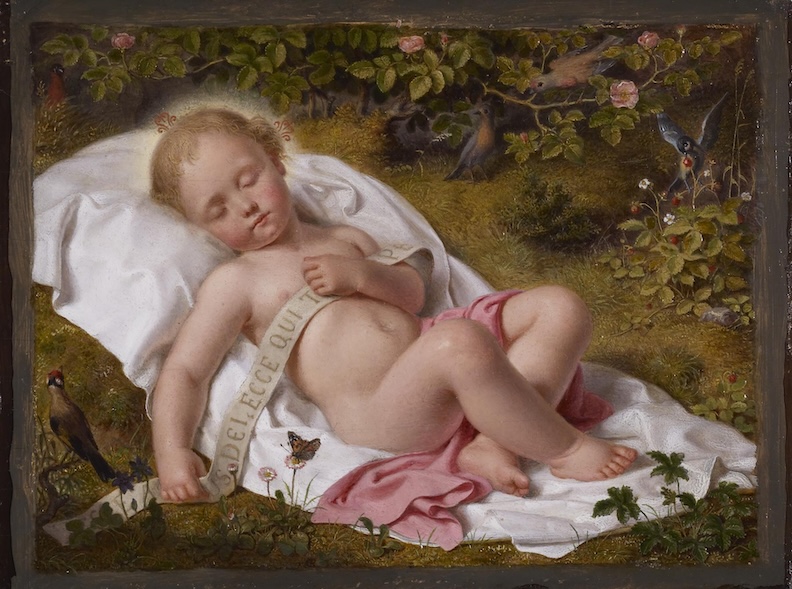
The joy of this season, Christmas joy, is of a different timbre altogether. Christmas joy is humble, quiet, less exalted, somehow more profoundly. . .human. The joy of Christmas is as different from that of Easter as the smile of a sleeping baby is from a triumphal march of the King of Kings.
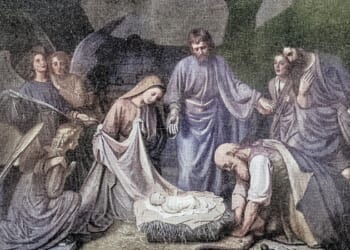
Different and yet somehow the same. The Babe in the manger is the same Christ who conquers death. But that we should behold Him first as a meek and vulnerable child, His arrival unknown to all both Mary and Joseph and a few shepherds, is an astonishing grace.
Christmas allows us to savor just how fully human this Christ-child is. His humanity is no mere cloak or skin. It is His nature. Just as grace builds upon and perfects nature, the divine triumph of Easter builds upon and perfects the human joy of Christmas.
We can grasp more fully the divinity of the Risen Christ when we come to know first the humanity – our own humanity – in the slumbering child in the manger. In this sense, Christmas is not just a temporal or chronological milestone in the mystery of the Incarnation – He must be born before He can suffer and die – but it is a preparation for those of us who cannot comprehend all at once.
In the dim light of the manger, with the star overhead, our spiritual eyesight is permitted, as it were, to adjust. We are allowed to begin to see slowly. We are spared, at first, the full, unbearable brilliance of that Sunday morning in spring. Gathered round the manger, the reality of what God is doing begins, quite literally, to dawn upon us.
In this, we see the generosity of our God, who not only comes to save us, but does so with the quiet tenderness of a sleeping child.
What joy!






![WHAT POLICY? Crockett Trips Through MS NOW Softball Question on Her Agenda if Elected to Senate [WATCH]](https://teamredvictory.com/wp-content/uploads/2025/12/WHAT-POLICY-Crockett-Trips-Through-MS-NOW-Softball-Question-on-350x250.png)