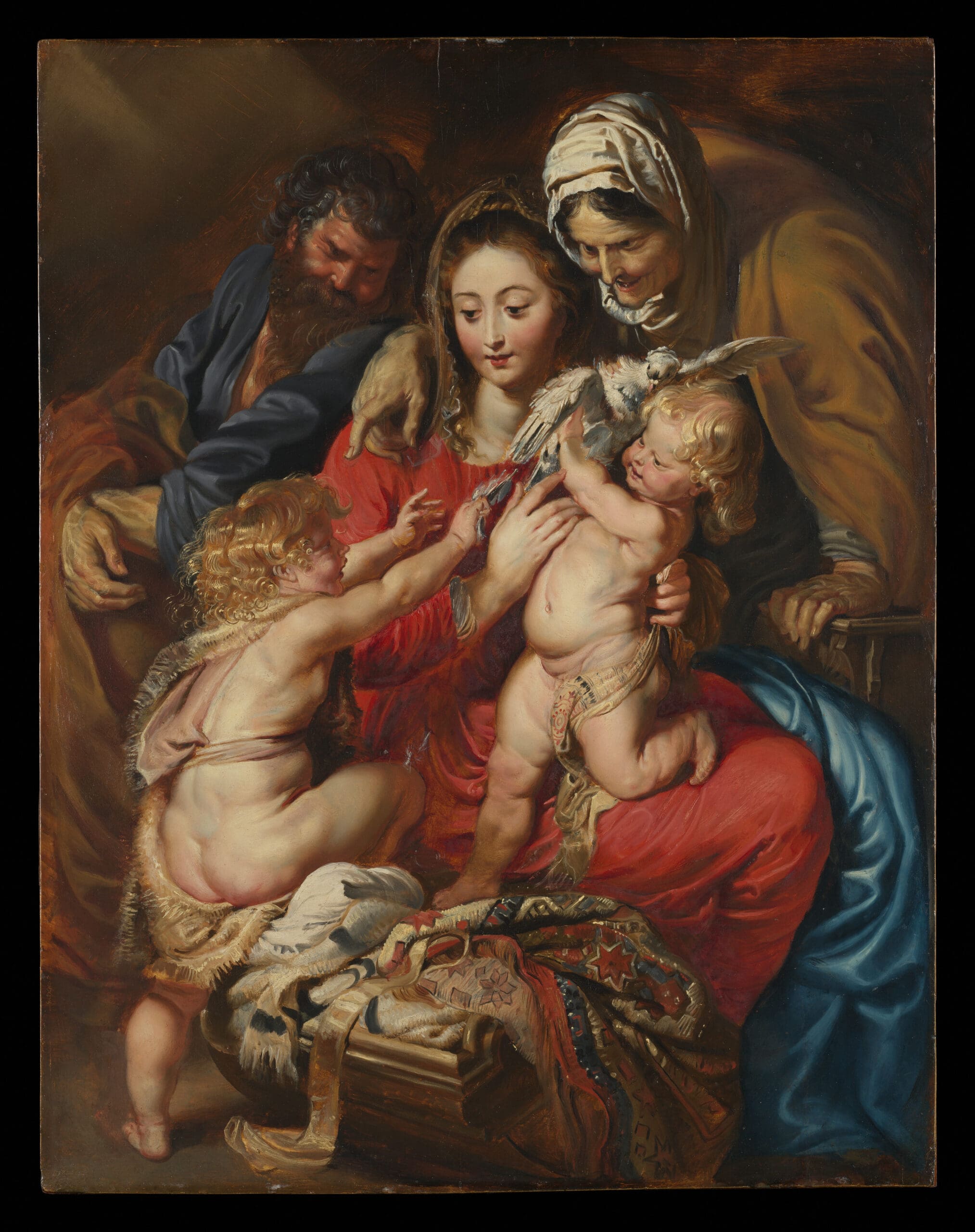
The collect for today’s feast prays, “O God, who were pleased to give us the example of the Holy Family, graciously grant that we may imitate them.” Now, that’s a tall order. After all, the Holy Family was exceptional. Inimitable, one might say. Joseph and Mary were indeed married. But their marriage was unlike any other. Jesus was indeed their Son. . .but not in the usual sense.
Still, this collect and the intuition of the faithful throughout history indicate that there is, in fact, something to be imitated here. And capable of imitation. Now, that doesn’t mean tugging the Holy Family down to our level. Rather, what we encounter in a unique and unrepeatable way in the Holy Family reveals what is true for every family.
First, the Holy Family begins with the love of Joseph and Mary. Many Christians might see their marriage as something of a fiction. Mary was going to have a baby and there needed to be a husband/father in the picture. Hence the depictions of the doddering old Joseph trying to keep up with Jesus and Mary.
But God doesn’t traffic in make-believe. Joseph and Mary loved one another with an authentic spousal love, even if it was lived out in a unique manner. She entrusted herself and her vowed virginity to his protection. He gave himself in love as her spouse and guardian. What each desired for the other was the holiness to which God called them. Her sanctity inspired his generous response to God and his protection enabled hers.
Just so, the holiness of a family begins with the love of the spouses. This isn’t the romanticized “soulmate” theory that ironically leads to infidelity and broken families. No, it’s the simple spousal love discerned by a bride and groom that prompts them to vow permanence, fidelity, and openness to children. It is the daily choosing to love one another that not only keeps those vows intact but also deepens them.
Second, although Joseph and Mary never had conjugal relations, they were nevertheless open to life – obviously, in an exceptional way. The Child born of Mary is the fruit of their union. Their marriage already existed at the time of Christ’s conception. It was within their marriage that He was conceived. It was due not only to her faith in God but also to her trust in Joseph that Mary could say Yes to the angel. This singular openness to life brought the Lord of Life into the world.

“Be fruitful and multiply.” That is God’s first and thus most fundamental command. As with all His commands, it’s for our good, and flouting it only brings us sadness. A couple’s openness to children – and, even better, their generosity in receiving them – indicates trust in God’s providence and a willingness to be stretched in self-giving. That openness and generosity in turn become a means of sanctification, of growing in trust and self-giving. The ordinary sacrifices of mothers and fathers have been woven into the fabric of Christian holiness.
Third, the Holy Family had a clear purpose. Indeed, a mission. Christ had been entrusted to the marriage of Joseph and Mary. Their mutual love established the home where He was received and where He “advanced in wisdom and age and favor before God and man.” (Luke 2:52) In short, their purpose was Jesus. Everything about their love and their home was ordered towards Him and His mission.
Every family has a mission and purpose. On a natural level, the family brings many benefits to society (and as the family unravels, we’re sadly discovering how many of those benefits will be lost). But the ultimate purpose of the family is beyond this world. Indeed, as with the Holy Family, the purpose of every family is Jesus Christ. To give Him a dwelling place in the home, among the members. To increase in knowledge and love of Him, to grow in the capacity to imitate Him.
Finally, the Holy Family prayed. Given the presence of the Incarnate Word and the Immaculate Conception in their home, their prayer would have been unique. But in another sense, it was ordinary. They prayed as their people prayed. They knew themselves as members of God’s People and prayed in the times, seasons, texts, and rituals handed down to them. Their prayer was ordinary also in the sense that it was simply woven into their daily life. To speak with God was as natural as breathing.
Every family is called to prayer. Father Peyton’s famous adage still holds true: “The family that prays together stays together.” But prayer brings more than just staying together. Prayer in the home – beginning with the spouses – brings sanctification. It makes the family more attentive to God’s presence and gives Him more room to work in their lives.
Like the Holy Family, every family’s prayer should be ordinary. In that first sense that it’s done according to the Church’s times, seasons, texts, and rituals. The domestic church should be the place where the doctrines and liturgy of the Church take root. Family prayer should be ordinary also in that second sense – that there’s nothing unusual or strange about it. It should be in the ordinary family to be aware of God’s presence – to bow one’s head in prayer, to give thanks and praise to the One from Whom every family in Heaven and on earth is named. (Ephesians 3:15)







![Hegseth Demands Fitness Requirements, Says 'Fat Troops' 'Not Who We Are' [WATCH]](https://teamredvictory.com/wp-content/uploads/2025/09/Hegseth-Demands-Fitness-Requirements-Says-Fat-Troops-Not-Who-We-350x250.jpg)