With the Somali welfare and child-care fraud scandals growing daily, a little-noticed report from the Center for Immigration Studies appears to be more important than ever. The CIS’ Somali Immigrants in Minnesota: Profile of a struggling group shows that importing Somalis means importing people who quickly land on welfare — and stay there.
Upshot: Forgetting all the fraud, including $18 billion in Medicaid fraud since 2018 and what one reporter called $110 million in child-care fraud, the vast majority of Somali households in Minnesota — almost 90 percent — receive some form of welfare.
Somali Invasion
A frightening aspect of the report, ignored by the far-left Mainstream Media, is the growth of the Somali population from practically zero in 1990 to almost 100,000 now.
From 1990 to 2000, more than 10,000 showed up, hat in hand, thanks to Somali’s never-ending clan wars. But that was only the beginning, CIS reported. The Somali population tripled by 2010, and by 2024 had surged to more than 75,000.
“The population has become especially visible because of its concentration in Minneapolis, where tension between rival Somali clans is rumored to have influenced the city’s recent mayoral election,” CIS reported, proving yet again that Third World immigrants bring their ethnic hatreds with them. Those hatreds then become part of American politics.

The Somali population was 76,320 as of last year; the Somali immigrant population was 41,748.
Drain on the Taxpayers
Some “37.5 percent of adult Somali immigrants in Minnesota live below the Census Bureau’s official poverty line, compared to just 6.9 percent of adult natives,” CIS explained about the free-loading population.
And 52.3 percent of kids in Somali immigrant homes live in poverty.
“Among the strongest predictors of poverty are low education and lack of English-language ability,” CIS explained, problems that Somalis exhibit “at dramatically higher rates” than real Minnesotans.
“Virtually all native Minnesotans speak English very well, for example, but 58.2 percent of working-age Somalis do not,” the report continued:
Meanwhile, 39 percent of working-age Somalis have no high school diploma, compared to just 5 percent of natives.
As well, 21.6 percent of working-age Somali men are unemployed, CIS reported, and Somalis “who are long-term U.S. residents continue to struggle. In fact, the institutionalization [likely in prison] rate for young Somali men who have lived in the U.S. for more than 10 years is higher, at 19 in 1,000, than in the population of all young Somali men.”
Forty-nine percent of working-age Somalis with 10 years here “speak English less than ‘very well’.” And 46.6 percent of kids in “long-term Somali households” live in poverty.
Welfare Users
Somalis are a woeful drain on the public treasury due to their use of welfare, the report continued.
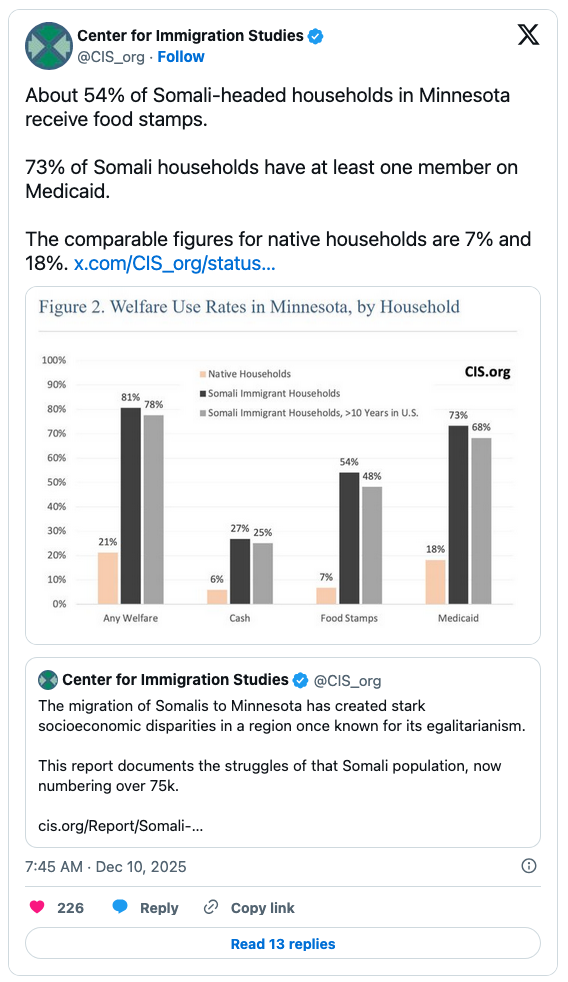
“While just 6 percent of native households in Minnesota receive cash welfare — including Temporary Assistance for Needy Families, Supplement Security Income, and general assistance — 27 percent of Somali households do,” CIS reported:
The disparities are even greater for food and medical care, with over half of Somali households receiving food stamps and nearly three-quarters using Medicaid. Altogether, 81 percent of Somali households consume some form of welfare, compared to 21 percent of native households. Somalis with 10 years of residency have welfare consumption rates that are only marginally lower than the Somali population as a whole.
Those shocking data typically involve households with kids: 86 percent of the African households with kids use Medicaid.
As for the welfare fraud scandal — some $1 billion so far — it “goes beyond money,” CIS continued:
Minnesota’s social services have roots in the Scandinavian model, which assumes that civic-minded residents will treat aid as a safety net, not as money free for the taking. With fraud cases like these, it cannot be surprising when researchers find that culture clashes tend to degrade social trust.
That said, Somali welfare use would still be high even without fraud. [Emphasis in original.] Any population with poverty rates as high as theirs will legally qualify for extensive means-tested aid, either directly for themselves or indirectly through their U.S.-born dependents. The way to reduce immigrant consumption of welfare is not simply to crack down on fraud, but to reduce the number of new arrivals who have the low earnings power characteristic of Somalis.
Fraud Scandals
The Somali fraud scandals in Minnesota have reached epic proportions.
Investigative reporter Nick Shirley recently uncovered a major child-care fraud scheme, which FBI chief Kash Patel said is under investigation. On X, Shirley said his team “uncovered over $110,000,000 in ONE day.” He even found a daycare center that didn’t have any kids on the premises.

And as CBS News reported before Christmas, federal prosecutors believe Somali fraudsters have skinned the taxpayers for some $18 billion since 2018.
“The magnitude cannot be overstated,” Assistant U.S. Attorney Joe Thompson told the network:
What we see in Minnesota is not a handful of bad actors committing crimes. It’s staggering, industrial-scale fraud.
Noting that the FBI had smashed a $250 million fraud scheme, Patel warned that the Somali fraudsters might find themselves back in Africa:
Many are also being referred to immigration officials for possible further denaturalization and deportation proceedings where eligible.



![Hegseth Demands Fitness Requirements, Says 'Fat Troops' 'Not Who We Are' [WATCH]](https://teamredvictory.com/wp-content/uploads/2025/09/Hegseth-Demands-Fitness-Requirements-Says-Fat-Troops-Not-Who-We-350x250.jpg)