
The fog of war is thick in Eastern Europe, where Russia has accused Ukraine of sending a swarm of kamikaze drones to strike one of President Vladimir Putin’s houses. The Russians say they thwarted the attack.
So far, it’s been difficult to verify whether the Russians are telling the truth. But whatever it is, any slight chance there may have been at a peace agreement seems to have further diminished.
The “Attack”
Russian Foreign Minister Sergey Lavrov decried the alleged attack. On Monday, he said, “The Kiev regime has fully switched to state terrorism policies, and Moscow will review its negotiating position accordingly.” He emphasized that although the Kremlin won’t completely abandon negotiations, “Russia’s negotiating position will be revised.”
Ukrainian President Volodymyr Zelensky says the attack never happened. He says Russia is making it up to serve as an excuse for torpedoing the working peace negotiations and to keep charging ahead into Ukraine. “Russia must stop inventing ways to wage war and start thinking about how to restore security,” he said in a social media post.
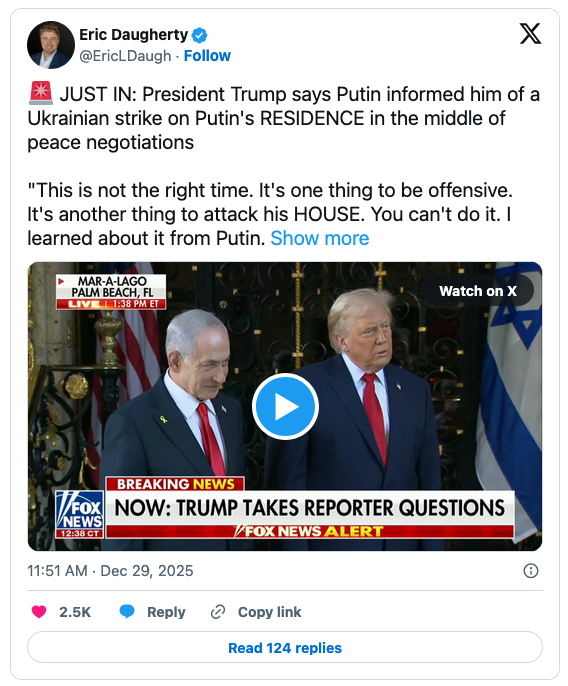
President Donald Trump answered questions on Monday about the supposed attack. “I don’t like it. It’s not good,” he said, adding that he heard about it from Putin himself and conceding that it might not be true. He then said that he made the right decision in refusing to give the Ukrainians long-range Tomahawk missiles. “It’s a delicate period of time,” he noted, adding:
It’s one thing to be offensive, because they’re offensive. It’s another thing to attack his house. It’s not the right time to do any of that. … I was very angry about it.
Neither of the warring sides is above outright lying, and neither head of state is an angel. As we suggested shortly after Russia invaded Ukraine in 2022, this is a war between two villains. Since 2022, the media have done a good job of reminding the world of the historic corruption and tyranny of Russia’s leaders, chief among them the former KGB officer and committed communist. However, the media have also consistently painted Russia’s attack as entirely unprovoked, a verifiably false representation.
Ukraine’s Position
But when it comes to Ukraine, the media have worked overtime to memory-hole not only Zelensky’s statist and depraved ideologies, but the government’s long-standing track record of corruption and tyranny. Since the invasion, Ukraine has suspended all government elections, including the one for the presidency. It has also banned opposition media, allegedly killed at least one dissenting journalist who was getting a lot of attention in the West, arrested a slew of Orthodox priests, and kidnapped an unknown number of men off the streets to throw them on the battle lines. Also, many in Ukrainian military command positions are bona fide neo-Nazis. Moreover, the Ukrainian government is knee-deep in scandals, with another one just recently emerging (more on this later).
Ukraine is also light on negotiating power. Its military is losing ground daily as its long-standing manpower shortage grows exponentially worse by the day. Between a constant deluge of desertions and war deaths, some analysts say, Ukraine’s military is operating at no more than half capacity. And the only help it’s gotten from its saber-rattling European “allies” has come in the form of hugs, constant talks, and — so far — meaningless declarations of solidarity, albeit Europe has recently begun to buy American weapons for Kyiv.
Nevertheless, Ukraine has consistently refused peace terms Russia deems nonnegotiable. The main reason has been that the proposals have favored Russia, which makes sense given that the Kremlin is clearly the emerging victor. History is replete with losing nations conceding to unfavorable terms. Nevertheless, in Ukraine’s case, it appears they’d rather fight to the last man than preserve their remaining male population and territory.
Trump’s Efforts Toward a Deal
Before the alleged attack on Putin’s house, the White House had been working on building consensus toward the latest version of a peace deal that became publicly known back in November. Trump and Zelensky met at Mar-a-Lago on Sunday, and Trump talked to Putin that same day. He told reporters, “I do think we’re getting a lot closer.”
The original agreement started with 28 points, but has since been reduced to 20. But less doesn’t mean less complicated. For more than a week, officials involved in negotiations have been telling media outlets that the parties have agreed to 90 percent of the working deal. But that remaining 10 percent may as well be the entire agreement. Two main obstacles are territory and security guarantees.
Security Guarantees for Ukraine
Reports say that Trump is open to providing Ukraine with 15 years’ of security guarantees. One official called them “the most robust set of security protocols they have ever seen,” according to Ukrainian media. But Kyiv wanted at least double the 15 years proposed by the United States, possibly more. The Wall Street Journal reported that “Kyiv had asked for security guarantees to last up to 50 years after the end of the conflict.” Zelensky told reporters:
We have been at war for almost 15 years, and therefore we would very much like the guarantees to be longer. And I told him that we would very much like to consider the possibility of 30, 40, 50 years, and that this would then be a historic decision by President Trump.
While public details are light, the working security measures reportedly do not include American boots on the ground. Officials called the guarantees “Article 5-like.” They include “military oversight, verification, deterrence and deconfliction mechanisms.” Moreover, Trump said he expected the Europeans to “contribute significantly” to those guarantees. “There will be a security agreement, it’ll be a strong agreement and the European nations are very much involved,” he said Sunday. The working security measures will apparently require congressional approval.
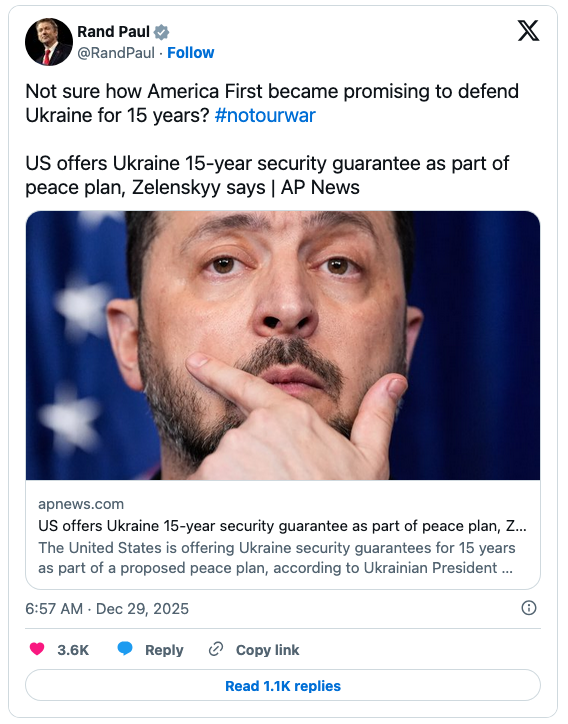
Sen. Rand Paul (R-Ky.) — among the staunchest of noninterventionists — commented on the proposal, saying, “Not sure how America First became promising to defend Ukraine for 15 years?”
The Kremlin has made it clear numerous times that the presence of foreign troops, especially those of NATO member states, in Ukraine is unacceptable.
The financial aspect of a postwar Ukraine reportedly includes “a reconstruction plan involving BlackRock and the World Bank.”
No Budging on Territory
As for another main sticking point, territorial concessions, both sides are still as far away as they’ve ever been. Russia wants the eastern portion of the country, most but not all of which it now controls, and Ukraine refuses to concede any territory.
Russia has never budged from its territorial demands. Kremlin spokesman Dmitry Peskov said that if the war has any chance of ending, Ukraine needs to pull back from the Donbas region.
Multiple Scandals
All this is playing out as yet another scandal in Ukraine has emerged. “Ukraine’s anti-corruption agencies exposed a criminal group involving lawmakers who received cash in exchange for parliamentary votes, the National Anti-Corruption Bureau (NABU) said on Dec. 27,” according to reports. Others reported:
Officers from NABU mounted a fresh raid on the elite government quarter in Kyiv on December 27 and reportedly questioned four deputies from Zelenskiy’s Servant of the People party, who are accused of selling their votes to support important legislation. A fifth deputy is included in the investigation, but reportedly fled the country only hours before the NABU raid.
Among those targeted for investigation is a lawmaker named Yuriy Kisel, who is in Zelensky’s political party and the head of the Parliamentary Transport Committee. Kisel was a close friend of Zelensky’s longtime business partner and former aide Serhiy Shefir. All three come from the same eastern Ukraine city of Kryvyi Rih. And just this year, Zelensky sold a house to Kisel’s wife.
This is only the latest. In November, news broke of a $100 million profiteering scheme involving the state-owned nuclear power company Energoatom. The people involved supposedly capitalized on the martial-law ban on lawsuits against state entities by demanding kickbacks before contractors were paid for their work.
Get U.S. Out
All this reinforces the wisdom of America’s noninterventionist Founding Fathers. American taxpayers have funneled more than $100 billion to Ukraine since 2022. And what do they have to show for it? Obviously, it has helped make foreign kleptocrats rich. But for Americans, it has only added to a ballooning debt crisis while helping to perpetuate a war that can escalate and draw America’s men and women into it. Echoing a sentiment that has become common among noninterventionists, if the Trump administration truly wants an end to this war, it should end all American involvement in the region. No more intelligence, no more sanctions, and no more selling weapons that go to Ukraine. Barring intervention by the Europeans, that would leave the Ukrainians with no choice but to wave the white flag.