
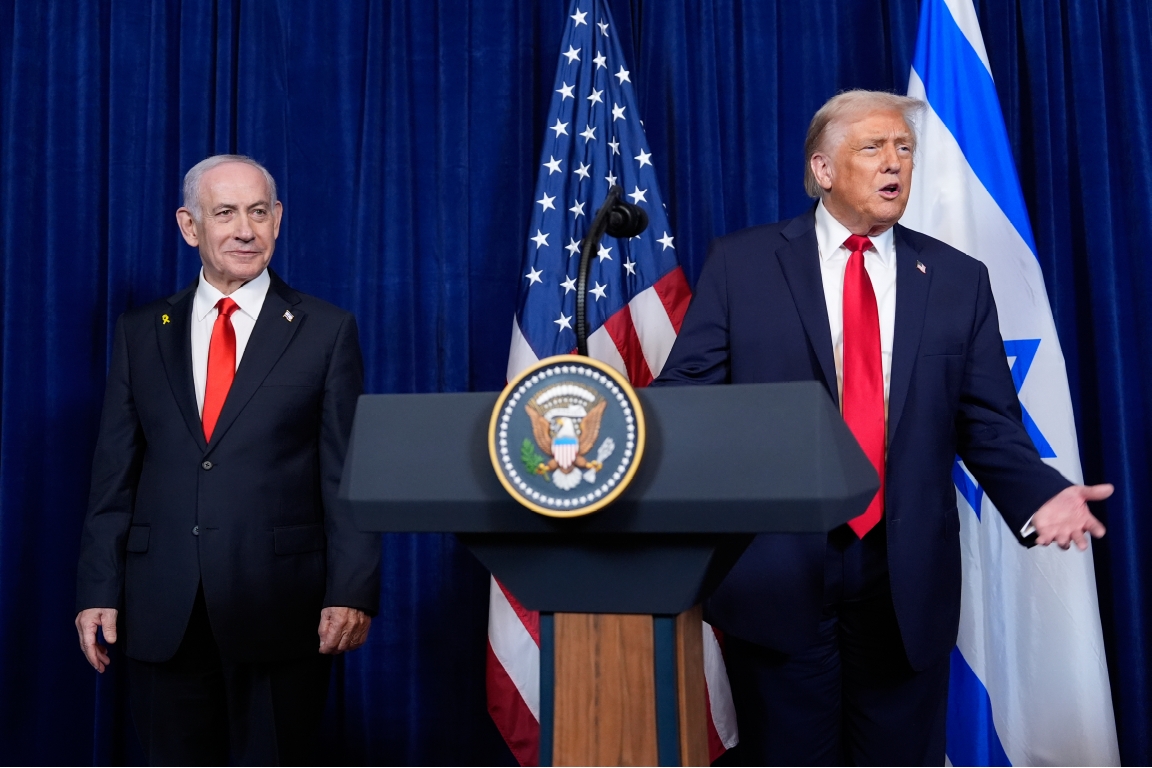
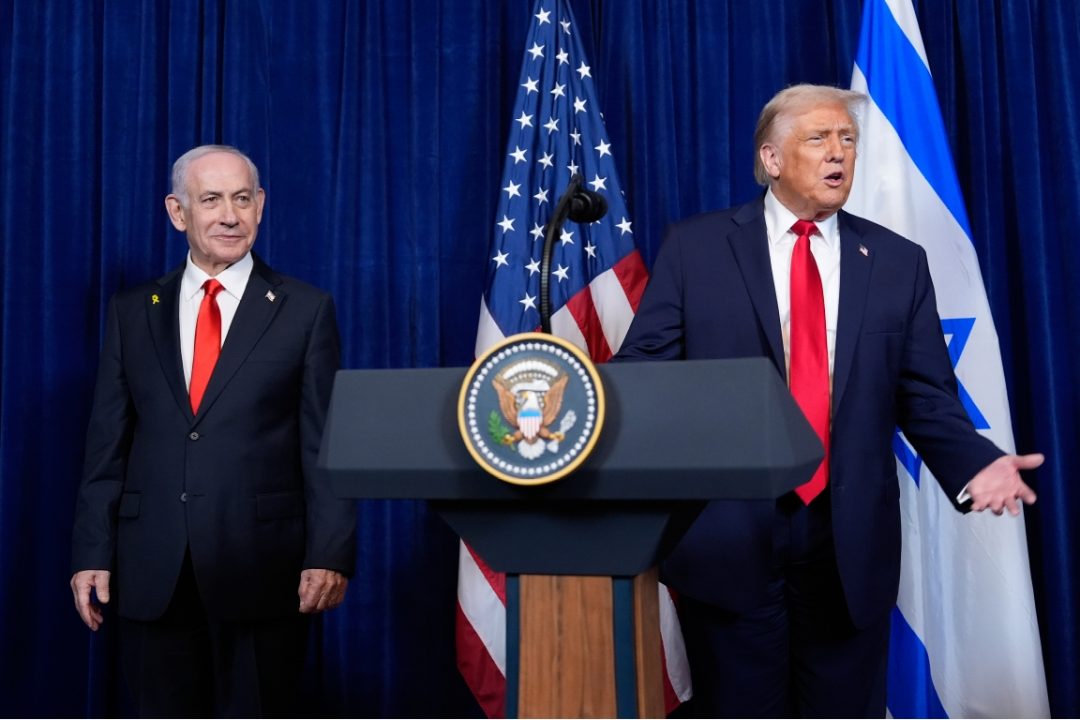
The United States won’t hesitate to bomb Iran again. President Donald Trump made this crystal clear on Monday during a press conference with Israeli Prime Minister Benjamin Netanyahu at his side. Trump’s comments were related to rumors that Iran has been secretly reviving its nuclear enrichment program.
“Now I hear that Iran is trying to build up again. And if they are, we’re going to have to knock them down,” Trump told reporters. “We’ll knock the hell out of them, but hopefully that’s not happening.”
Trump said Iran may be thinking about, or is already, enriching uranium at sites the U.S. military didn’t bomb in June. If that’s happening, “we’re going to have no choice but very quickly eradicate that buildup,” he reiterated.
Trump said he would unleash a similar destructive response if he believed Iran was developing advanced long-range missiles.
Iran Ready
Ali Shamkhani, an advisor to Iran’s supreme leader Ayatollah Ali Khamenei, issued a proud and defiant response to the American president’s threat. He said Iran’s missile capability and defense “are not containable or permission-based.”
And the previous day, before Trump met with Netanyahu, Iranian President Masoud Pezeshkian said his nation was already in a “full scale war” with the United States, Europe, and Israel. Newsweek reported that Pezeshkian also said, “Tehran’s military forces are now ‘far stronger’ than during the brief, deadly war Iran fought with Israel earlier this year.”
Pezeshkian’s comments were followed by a statement from Iran’s military, which pledged to “deliver a ‘far harsher, more crushing and more damaging’ response to any hostile action,” according to reports.
Iranian officials have maintained that they are no longer enriching uranium at any site in the country. Obviously, the United States and Israel are not taking them at their word. When a reporter asked why he suspected Iran was reviving its nuclear enrichment program, Trump didn’t provide any details. He said he hasn’t confirmed the developments yet.
Nuclear Warnings
It’s highly likely that Netanyahu had something to do with Trump’s recent threats. Remember, the bombing in June was the result, at least in large part, of Israeli persuasion overriding that of U.S. intelligence. Director of National Intelligence Tulsi Gabbard acknowledged that Iran was enriching uranium, but said there was no evidence that the Iranians were pursuing nuclear weapons. When reporters pointed this out back in June, Trump said she was wrong.
Netanyahu is on record repeatedly warning of Iran’s nuclear ambitions going back all the way to the 1990s. But even after the United States bombed Iranian nuclear sites in June, the Israelis continued to see their regional rival as a threat. Just two days after the American strikes, The Times of Israel published an article with the headline “Tehran will restore its nuclear program, Iranian atomic chief vows.” The report cited Iranian nuclear chief Mohammad Eslami, who said his government had anticipated America’s attack and planned “to prevent interruptions in the process” of nuclear enrichment.
Iran Rebuilding
On October 23, The Jerusalem Post published an analysis with the headline “How Iran is rebuilding its nuclear program, learning from past Israeli strikes.” The article featured a report from the Institute for Science and International Security, a U.S.-based nonprofit funded, in part, by Carnegie, Rockefeller, and Ford Foundation money. The report, which largely relied on satellite imagery, claimed that the Iranians were rebuilding the Taleghan 2 site, a former nuclear weapons site the Israeli Air Force bombed in October 2024.
The Taleghan 2 site is one the Americans did not bomb in June. The report acknowledges that the true purpose of the construction project was unknown, but given its history, it was concerning. Moreover, it appears the Iranians are working on improving the site with the capability to withstand bombings. From the report:
The purpose of the new construction at this location cannot be discerned from the imagery, a multitude of other non-nuclear purposes are also possible. However, it is deeply concerning that construction is occurring at a former AMAD plan nuclear weapons development site, raising considerable questions as to the true purpose of the facilities there. Although there is no current evidence to support any nuclear weapons related purpose, an effort should be made to discern if this is an attempt by Iran to build a facility to reconstitute either the nuclear weapons related high explosive test chamber facilities that were originally part of the AMAD program, or the more recently reported PETN plastic explosive manufacturing capability that would have been a key part of Iran’s nuclear weapons efforts.… More information is needed to make an accurate assessment. Given the arch roof design of the structures, there is the likelihood that they may yet all be earth covered, to bunker them, thereby enhancing survivability in the event of a future bombing attack.
And on November 10, another widely read Israeli news outlet, Haaretz, republished a Reuters article about inspectors from the International Atomic Energy Agency (IAEA) being blocked from the nuclear facilities that were bombed in June.
And, as we reported in August, there was little chance the 12 Day War would put a bow on this saga. A July analysis by Yoni Ben Menachem for the think tank Jerusalem Center for Security and Foreign Affairs made clear that tensions between Israel and Iran would not ease.
Regime Change Agenda
The message from Israel is clear: Iran remains a threat. It appears that short of regime change, no amount of bombing and wars will calm Israel’s nerves. Netanyahu made it clear during one of his messages to the Iranian people when the 12-Day War began that he wanted them to rise up and overthrow the supreme leader and his government. That didn’t happen, and Trump has said he’s not interested in effecting regime change, which is interesting because that’s exactly what he’s trying to accomplish in Venezuela.
Maybe the United States and Israel will catch a break and the Iranian people’s anger over their nation’s imploding economy and the record low value of their currency will trigger the regime change Israel wants. In a surprisingly candid speech earlier this month, Pezeshkian said that Iran’s problems are not exclusively caused by the pressure coming from Israel and America. He attributed them, in part, to corruption, factional infighting, and decades of government spending practices that he described as “what crazy people do,” according to reports.
On Monday, protests erupted across Iran. Western media has hailed the protests as the largest in three years. They were the culmination of smaller protests that happened in prior days.
Nevertheless, Trump said on Monday that he would rather make a deal with the Iranians than bomb them. But given that Israel attacked them while the United States was engaged in talks, Iranians may be justified is passing on any more talks.
Netanyahu’s Troubles
Monday’s conference started with a volley of chummy compliments between Trump and Netanyahu. The prime minister can use a friend right now. Back home, he’s facing criminal charges of bribery and fraud. Three cases against him were filed in 2019. One case alleges that Netanyahu and his wife took gifts worth about $192,000 from two businessmen in exchange for political favors. Another case accuses him of making a deal with the owner of a newspaper for favorable coverage in exchange for legislation that would limit the growth of a rival news outlet. And the third case alleges that Netanyahu gave Israeli telecommunications company Bezeq regulatory favors in return for positive coverage on a news site controlled by the its former chairman. “The benefits reportedly included mergers and financial gains,” reports say.
Netanyahu has denied the charges and claims they are part of a political “witch-hunt.”
Some analysts have floated the idea that Israel’s enduring campaign in Gaza is part of a plot by the PM to stave off trials and conviction. Trump has asked Israeli President Isaac Herzog to pardon his friend. On Monday, the U.S. president said Herzog was about to do just that. But Herzog quickly swatted down Trump’s claim. His office issued a statement, saying, “There has not been a conversation between President Herzog and President Trump since the pardon request was submitted.”









![WHAT POLICY? Crockett Trips Through MS NOW Softball Question on Her Agenda if Elected to Senate [WATCH]](https://teamredvictory.com/wp-content/uploads/2025/12/WHAT-POLICY-Crockett-Trips-Through-MS-NOW-Softball-Question-on-350x250.png)