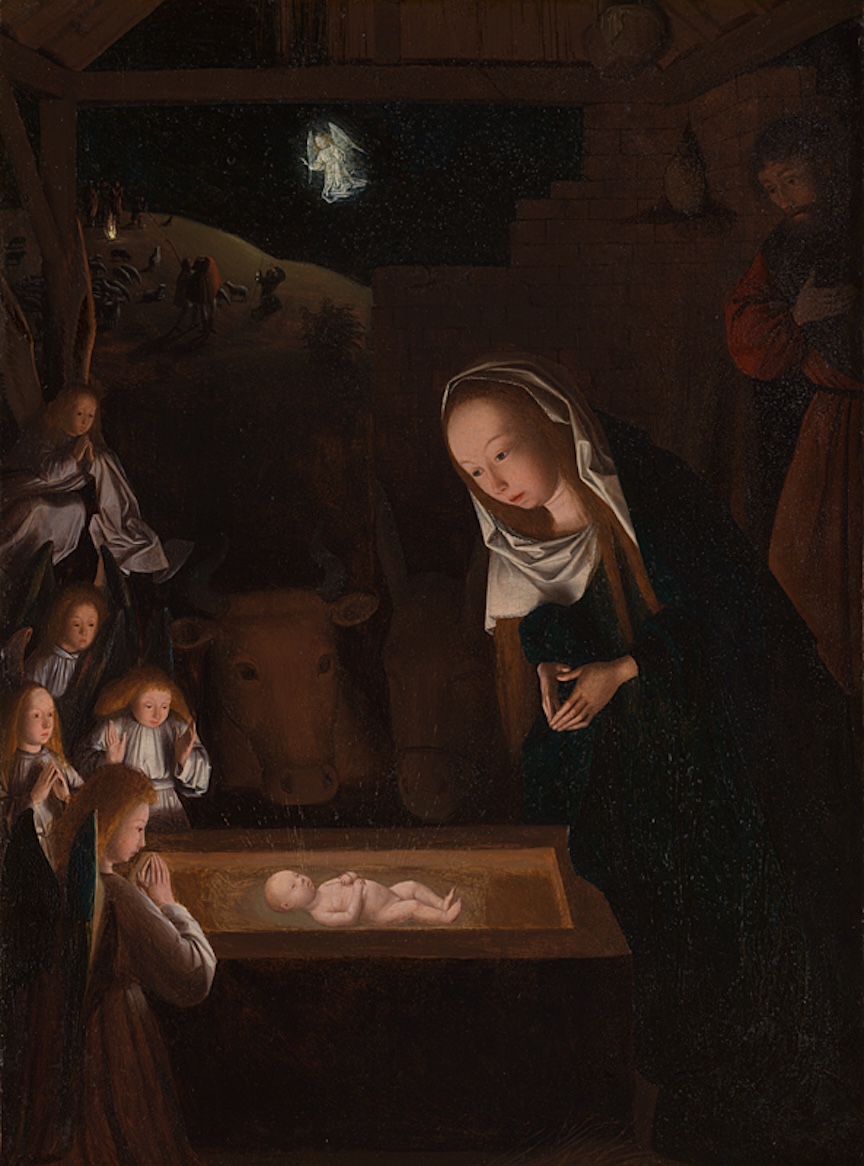
It’s been thirty years since I entered the Church, but I am still learning more about what the birth of Christ (Christmas) really means, including that the Christmas Season only ended yesterday officially. Reading the Gospel of John, I find that before Christ became man, He was the Word (λόγος – “logos”). So, I wonder, can I translate that Greek word to physics-speak, relate it to logical concepts that I’m familiar with as a scientist? Here’s what I’ve found.
First, about light, since Scripture gives many references to Christ as light: “This then is the message which we have heard of him, and declare unto you, that God is light, and in him is no darkness at all.” (1 John 1:5) Can we relate the physics of light to its theological significance?
In the early 20th century, Einstein’s explanation of the photoelectric effect gave light a new character, that of a particle (photon), rather than its classical formulation, an electromagnetic wave. Since a photon travels at the speed of light, special relativity requires that time does not exist for it. Why? A fundamental assumption of special relativity is that a light signal (the measurement agency) can’t measure itself.
What are the theological implications that time does not exist for photons? Here’s a thought: If we say that God is light implies that time also does not exist for God. As St. Augustine pointed out, God does not exist IN time; God’s Word is always there, without time, no beginning, no end. And as we see below, God’s Word, our Lord, is light: “Then spake Jesus again unto them, saying, I am the light of the world: he that followeth me shall not walk in darkness, but shall have the light of life.” (John 8:12)
There’s more in the Gospel of John in the very first words: In the beginning was the Word, and the Word was with God, and the Word was God. What is the connection between the Word and light?
The Greek word in the New Testament that translates as “Word” is “λόγος” (“logos”). In addition to the meaning “word,” other general meanings are “principle,” “reason,” “logic,” etc. What do we mean when we say, “I see the light!”? We see the reason, truth, rationale, and principle of what is said. Thus, “Word” implies both light and reason.
For St. Augustine, this means: “The eternal light which is the unchangeable Wisdom of God, by which all things were made, and whom we call the only-begotten Son of God.” (City of God, XI, 9) But light is only one aspect of how things work. What about “λόγος” in the sense of the overall scheme of the universe? Do proposals from contemporary physics admit a governing entity for how things work, an agency that we could identify as God, the Creator and Sustainer?

There are two main scientific visions: 1) the Participatory Universe proposed by the physicist John Wheeler (“It from Bit”); 2) the Holographic Universe. Wheeler poses three questions:
- How come existence?
- How come the quantum?
- How come “one world” out of many observer-participants?
Wheeler’s answer to the first question and implicitly the others was: “‘it from bit’ symbolizes the idea…that what we call reality arises in the last analysis from the posing of yes-no questions and the registering of equipment-evoked responses.”
The notion that an observer has to measure, something has to be perceived to be real, is not new. Three centuries ago, Bishop Berkeley made essentially the same proposal, that for something to be real it has to be perceived. And thus, for a universe to have existed before man, the agency of God the Logos is required.
Or as Msgr. Ronald Knox’s Berkeleyan limerick “God in the Quad” puts it:
There was a young man who said, “God
Must think it exceedingly odd
If he finds that this tree
Continues to be
When there’s no one about in the Quad.”
REPLY
Dear Sir:
Your astonishment’s odd:
I am always about in the Quad.
And that’s why the tree
Will continue to be,
Since observed by
Yours faithfully,
GOD.
And as to that second scientific view, you might well ask “What is a hologram?” It’s a kind of 3-D projection. It results from information from both a laser light beam reflected from three dimensional objects and a reference beam. When illuminated by a technical process an apparently solid image appears. (If you want to go deeper into this, click here.)
How does the “holographic universe” relate to this? Some scientists speculate that our universe could be represented as a holograph. Information stored on the boundary of the universe yields the universe. However, there is a catch. If the theory is applied to a finite universe, it requires an agency to interact with the universe in order that more than one thing exists in such a universe, i.e. for the universe to be non-trivial.
In short, an observer is required. And who might that observer be? The question answers itself: the Logos, the Word by whom all things were made, the One who holds all things in being.
Again, we can turn to revelation to understand how the universe works. The conjectures of physics are consistent with the notion that an agent enables the universe to exist. We are not guilty of cognitive dissonance if we believe both the New Testament and appreciate cosmological speculations.
One last word. All that has been said above deals with mathematical constructs. But reality is more than mathematics, we cannot reduce all reality to mathematics. It may provide a cloudy mirror of part of reality, but it cannot comprehend the totality. As St. Augustine said, Si comprendis, non est Deus (“If you understand it, it is not God”). We should glory in the ultimate mystery: Jesus Christ, the Son of God, Who created and now sustains the universe.
He became man, as we celebrated during these weeks of Christmas, for our salvation.