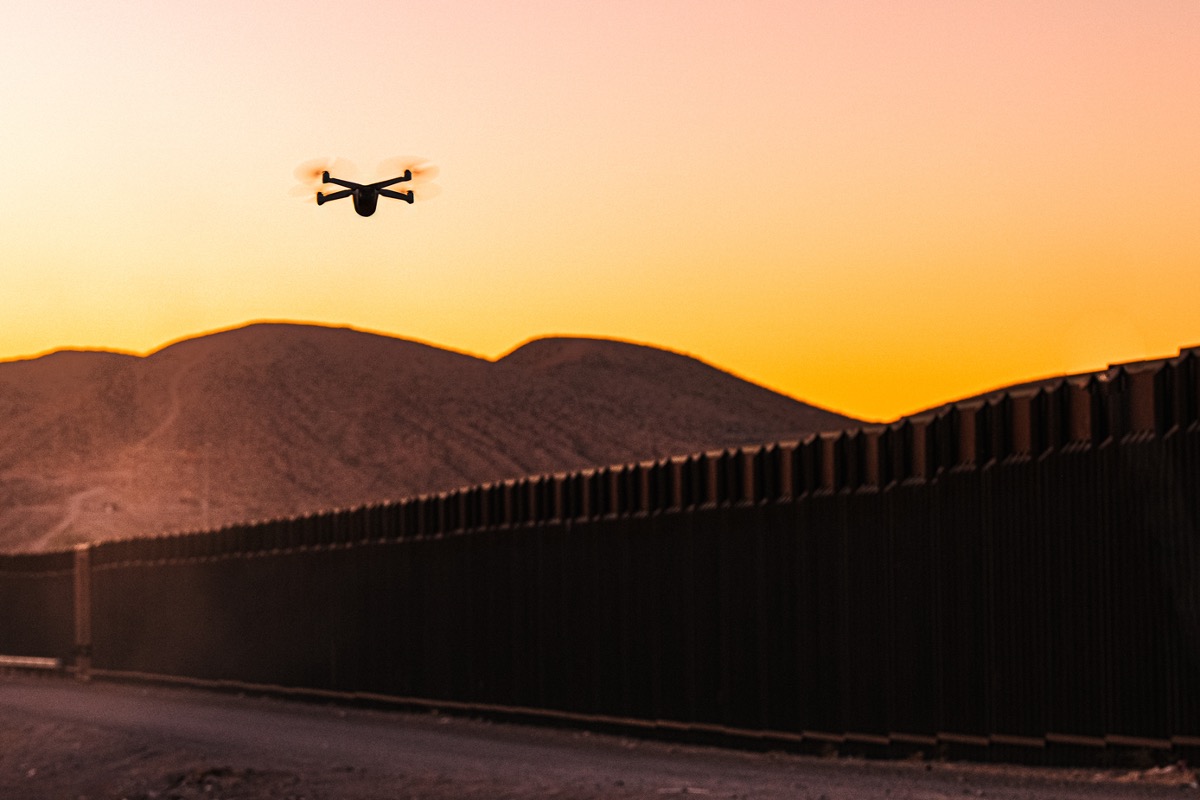
The Department of Homeland Security (DHS), long seen as emblematic of unconstitutionally expanding state power and surveillance, is increasing its capabilities again with a new office focused on drone and counter-drone technologies. The move adds another layer to a surveillance apparatus that already includes biometric tracking, AI systems, wide-area cameras, and data-fusion tools used across federal agencies. The announcement comes as the nation prepares for multiple high-profile events later this year.
The New Office
DHS explained in its press release:
Drones are transforming industries nationwide, but they are also increasingly exploited by malicious actors. The new DHS Program Executive Office for Unmanned Aircraft Systems and Counter-Unmanned Aircraft Systems will oversee strategic investments in drone and counter-drone technologies that can outpace evolving threats and tactics.
The language emphasizes speed, adaptability, and scale. DHS confirmed that the office is already operational and focused on rapid procurement and deployment across its components.
The department said it is finalizing a $115-million investment in counter-drone technologies.
DHS Secretary Kristi Noem cast the initiative in geopolitical terms. “Drones represent the new frontier of American air superiority,” she said, adding that the new DHS entity will address both long- and short-term security needs of America:
[The new office] will help us continue to secure the border and cripple the cartels, protect our infrastructure, and keep Americans safe as they attend festivities and events during a historic year of America’s 250th birthday and FIFA [soccer’s World Cup venues in] 2026.
As reported by NextGov/FCW, the authority stems from the FY26 National Defense Authorization Act, which “extended DHS and the Justice Department’s counter-drone authorities until 2031.”
“Securing American Airspace”
The DHS signals the next level of the aerial security:
With support from President Trump, the Department is now making unprecedented investments to secure American airspace.
The phrase sounds as familiar as baffling. Domestic airspace is already tightly regulated and monitored. The Federal Aviation Administration (FAA) governs civil aviation and unmanned aircraft under Part 107 rules, airspace classifications, and flight restrictions. State and local police departments already operate helicopters and drones, often for search and rescue, traffic monitoring, and tactical operations. What DHS is now rolling out is a deeper layer of federal oversight focused on low-altitude airspace.
Procurement reinforces this shift. The department noted in its announcement:
DHS recently requested proposals from the counter-drone industry for a new $1.5 billion contract vehicle, enabling Components such as Customs and Border Protection (CBP) and Immigration and Customs Enforcement (ICE) to quickly and strategically acquire advanced technologies needed to protect their officers and U.S. citizens.
Federal authorities have expanded as well:
In December, DHS authorities were broadened, authorizing all Department Components, state, local, tribal, and territorial law enforcement partners, and correctional agencies to fully combat drone threats.
The move standardizes both technology and authority across layers of government.
And funding is moving just as fast:
Last month, [the Federal Emergency Management Agency] completed the fastest non-disaster grant award in the history of the Department, awarding $250 million in grants for counter-drone capabilities to the 11 states hosting FIFA World Cup 2026 matches and the National Capital Region.
While references to the high-profile events are frequent, in practice, “securing American airspace” translates into permanent surveillance infrastructure. Low-altitude skies become another monitored layer of public life, embedded into everyday federal policing.
Local Adaptation
The One Big Beautiful Bill (OBBB) Act signed into law in July contains a sweeping expansion of homeland-security funding that reaches deep into local airspace surveillance. Most notably, the act appropriates $500 million for state and local capabilities “to detect, identify, track, or monitor threats from unmanned aircraft systems” under the State Homeland Security Grant Program.
The language emphasizes federally compliant systems that integrate seamlessly with DHS operations. In effect, the program accelerates the spread of drone and counter-drone infrastructure while tying local law enforcement capabilities to national security frameworks.
At the same time, local purchases of drones for policing have already drawn scrutiny. As reported by The Grayzone last November, numerous jurisdictions have acquired drones made by Skydio. This is a U.S. company whose AI-powered drones the report describes as “battle-tested” during Israel’s military onslaught in Gaza. Those same systems are now “flying over American cities, surveilling protestors and automatically uploading millions of images to an evidence database.”
According to the investigation, at that time Skydio held contracts with more than 800 law enforcement and security agencies, up from 320 earlier in 2025, with drones launched “hundreds of times a day.” The outlet reported that “almost every large American city has signed a contract with Skydio in the last 18 months.” These include Boston, Chicago, Philadelphia, Detroit, San Diego, Cleveland, Miami, and Jacksonville.
These contracts have intensified concerns about the off-the-shelf adoption of military-adjacent surveillance tools and the transfer of tactics from foreign conflict zones into domestic policing. Supporters argue the grants improve safety at major events like the World Cup. Critics counter that there is little transparency around the collection, storage, and sharing of the surveillance data.
DHS’s Broader Dragnet
The new drone office fits into a comprehensive surveillance buildout that is rapidly reshaping the DHS. Under the OBBB Act, DHS is doing more than funding enforcement. It is building a durable, technology-driven infrastructure whose reach extends well beyond immigration control.
At the center of that expansion sits ICE. A June report by the BiometricUpdate website contended that the legislation “[codified] a vision of the national security state where biometric surveillance, AI, and immigration enforcement converge at unprecedented scale.” ICE’s budget is nearly $30 billion through 2029. A significant portion goes to digital infrastructure:
More than $5.2 billion within ICE’s share is dedicated to infrastructure modernization, including $2.5 billion specifically for artificial intelligence systems, biometric data collection platforms, and digital case tracking.
It is noteworthy that ICE’s technological growth is matched by force. The agency is authorized to hire 8,500 new agents. At the same time, its weapons spending has surged sharply. There are concerns that, under the banner of immigration enforcement, the state is transforming this legitimate authority into an apparatus with unprecedented militarized and digital capabilities.
Digital expansion is mirrored on the physical border, where CBP will expand the deployment of Autonomous Surveillance Towers. BiometricUpdate reports that since 2020, about 300 towers have been set. They cover roughly 30 percent of the southern border, using radar, infrared cameras, electro-optical sensors, and AI to detect and track movement. Notably, Democrats have often promoted such systems as a “smart” and “humane” alternative to physical barriers.
This architecture now intersects with identity governance. After years of delay, DHS has begun enforcing REAL ID requirements for domestic air travel. In November, the department proposed sweeping biometric rules, including expanded DNA collection. In September, WIRED reported that DHS had already routed the DNA of nearly 2,000 U.S. citizens into an FBI database.
ICE Reactivates Contract With Israeli-linked Spyware Firm Paragon








![Hegseth Demands Fitness Requirements, Says 'Fat Troops' 'Not Who We Are' [WATCH]](https://teamredvictory.com/wp-content/uploads/2025/09/Hegseth-Demands-Fitness-Requirements-Says-Fat-Troops-Not-Who-We-350x250.jpg)