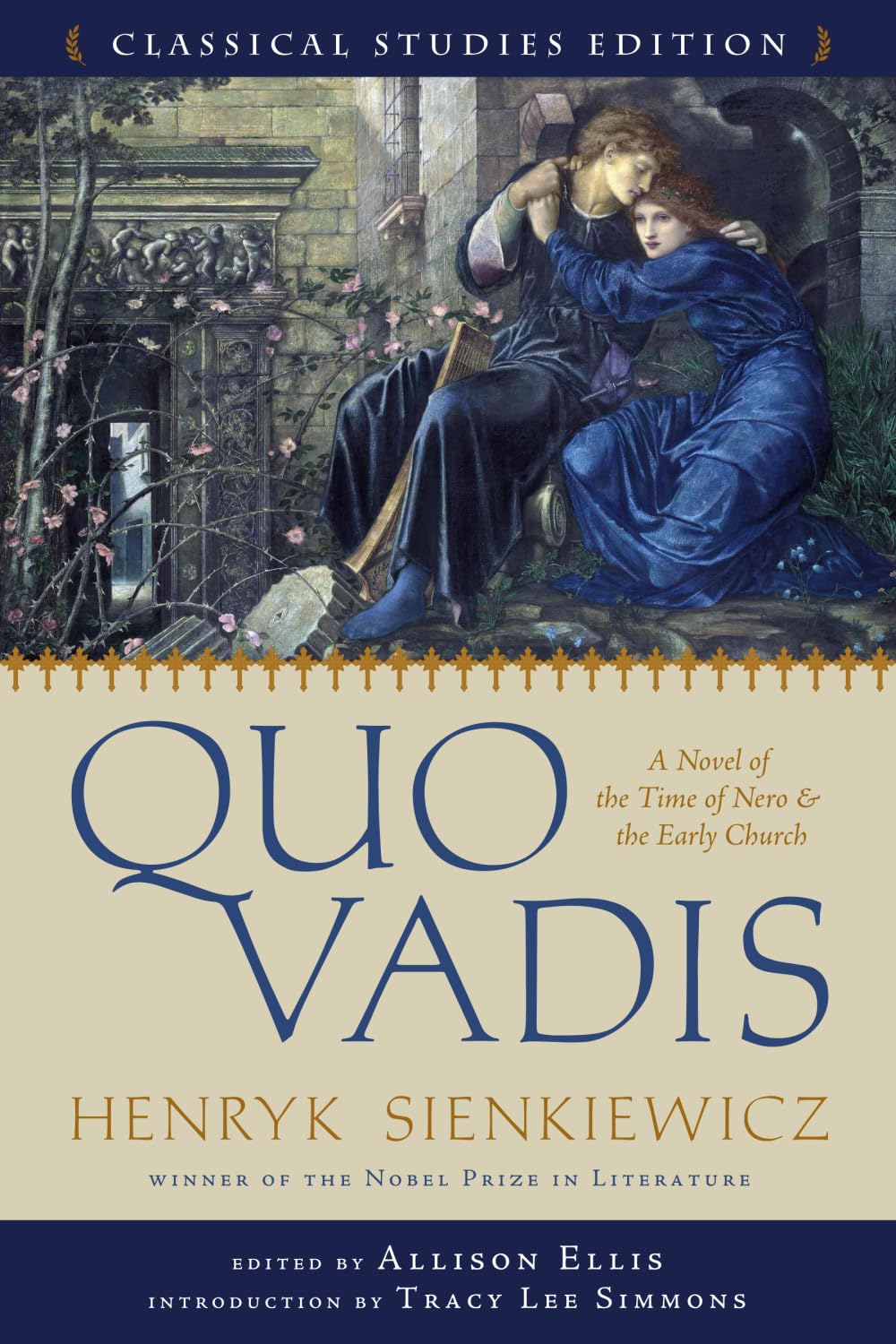
This column is slightly adapted from the introduction to the new Mount Titano Media republication of the classic novel.
Zealously celebrated and thoroughly thumbed by the literarily inclined up until, say, 1960, Quo Vadis held pride of place on living room bookshelves, back when living rooms still had bookshelves. Now the book is more likely to be found in second-hand bookshops than in corporate-owned chain bookstores. In other words, nowadays the book sits snugly out of sight, out of mind, and certainly out of fashion, but perhaps in part for that very reason, Quo Vadis makes a fair and fresh claim in our day on the consideration of educated people – and of people who would wish to be so. It is due for reclamation in an age of thinning literacy and little faith.
The source of the book’s popularity over nearly 70 years, though, requires no explanation, particularly when we reflect upon the leisurely, readerly, tobacco-tinctured, and elocuted Victorian period out of which it arose, a time when attention spans were longer and more reliably mature. It’s a well-paced – if not fast-paced – character-driven story, set in the thickets of a distant time and mixing, in equal parts, faith, history, and romance.
And during those earlier decades of the 20th century, when people knew more about both faith and history than we do now, enmeshing oneself in this novel must have been akin to binge-watching a mini-series online today. It’s a page-turner. But for many Christians, and for many Catholics especially, familiarity with this book was also de rigueur. Not bad for a novel originally published in Polish.
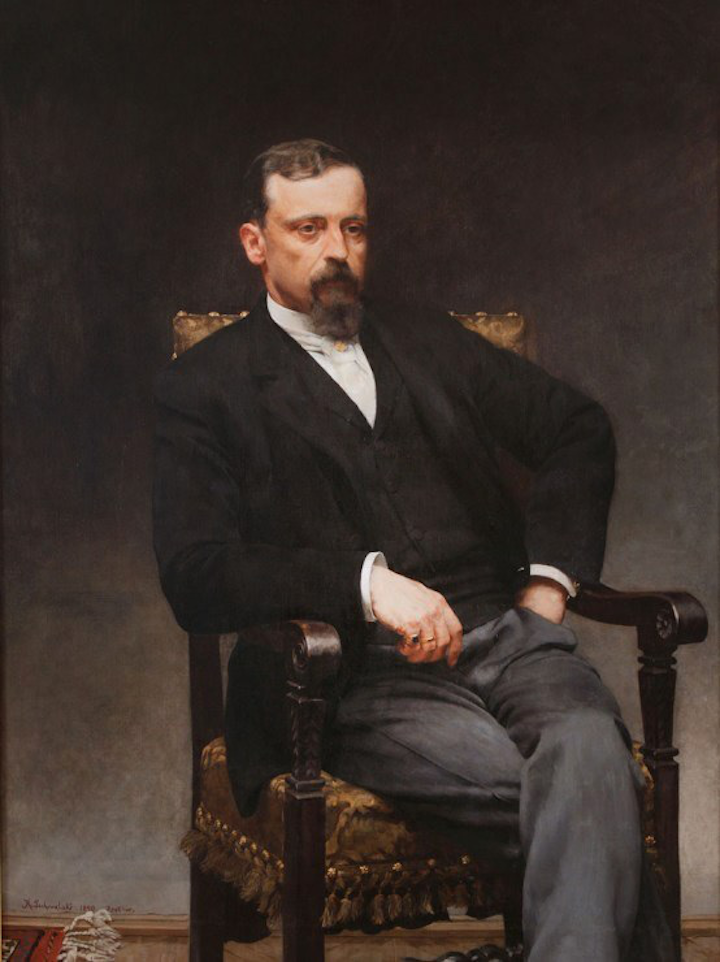
Henryk Sienkiewicz (1846-1916) was born into a noble but penurious Polish family, schooled in the severe manner of the time and, on reaching his majority and feeling the itch to write, he set out as a journalist and travel writer with an eye for the picturesque and politically dramatic, trekking over Europe and as far as America to pen dispatches on all he saw.
And although later he would try his hand as a newspaper editor, in the end it was the art of fiction that drew out and harnessed his greater talents. It was also fiction that eventually brought him the financial security to practice his skills and fulfill his vocation full time. For this was the century of Dickens and the serialized novel, when readers the world over would wait with finger-biting anxiety for the next installment of epics to appear in popular journals and magazines, making the better novelists of that time something like celebrity filmmakers today.
They told the tales that people talked about. This was a vibrant literary culture. As entertainers, novelists tapped into the public taste, but as artists, they also sought to form that taste, both diverting and enlightening that public by the deft and expansive handling of words. In just this way did the intelligent amusement of one generation become the respected literature of the next.
Quo Vadis stands as one of Sienkiewicz’s mature (originally) serialized works. Written in Polish and published in full book form in 1896, it achieved immediate success and was translated liberally into scores of languages as its fame grew. And grow it did. The novel spawned stage productions and, later, several film and television adaptations, making the story familiar even to generations who had never read the book. It is the author’s crowning feat. In recognition of his long line of distinguished literary work for a larger public, Sienkiewicz was awarded the Nobel Prize for Literature in 1905.
While this book may be a work of fiction, not all contained herein is purely fictive. Sienkiewicz takes us back to the ancient Rome of the 60s A.D., days, weeks, and months when the Emperor Nero reigned. Rome was choked in debased corruption, the Great Fire destroyed large swaths of the city, and a small sect that had arisen in provincial Judea from Jewish roots called ‘Christians’ was slowly infiltrating the debauched capital of the world’s most powerful empire to bring salvation from sin that most sophisticated Romans did not acknowledge or could even imagine. This was the century when the secular met the sacred most spectacularly; this was Rome as a spiritual battleground. No mean assignment for a novelist.
The historical setting posed an artistic problem for him, though. When this novel was written well, the West was more securely Christian, informed and fortified by Christian assumptions and guideposts; even the skeptical atheist grasped Biblical references readily. But Sienkiewicz bore the burden of trying to make the overwhelmingly familiar and triumphant Christian Church of his time seem impossibly miniscule and feeble in its birthing days, and to do this, he joined certifiably historical personages – Nero, Petronius, Seneca, Paul of Tarsus, the Apostle Peter et alia – with fictional characters, like Marcus Vinitius and his beloved Lygia, who then strut the stage of the story together. And the fictional characters, if a bit idealized as types, nonetheless quicken the pace and engage the sympathies of good readers.
Historical fiction is always a gamble, as the contrivances of art can threaten to falsify facts of the past and dull their sharpness. But Sienkiewicz did his reading and managed to revivify that remote time and place with a piercing verisimilitude without gumming the gears of the plotted narrative with extraneous detail.
The characters strike us as real people who take on a solidity that only the best-written books of history can bestow. The story reads majestically even for the reader knowing neither ancient Roman nor early Christian history. But if the reader does happen to know anything about that time, the story rises off the page and rings echoes in the imagination.
We see the pagan world in all its ripeness and rotten over-ripeness, and some of the scenes can still shock in their brashness and cruelty (though we know now that the reality was often far worse). Still, we see another light rising from the east beginning to penetrate that darkness, a new faith fermenting, a faith that propels every character, real and fictional, in one direction or the other, inexorably to the end.
Quo vadis, Domine? Peter asks Christ on the road to Rome in the legend. “Where are you going, Lord?” Where indeed? But the question is instantly reflexive. For every character in the novel, choice is of the essence, and the inquiry of the title is the ultimate one upon which all else depends. This is a work of historical fiction, but it’s also a work of devotional fiction.
The author’s treatment of historical figures is certainly assailable but easily defensible. Sienkiewicz clearly read deeply into the major Roman sources – Suetonius and Tacitus, mainly – to create his fictional world. And the scenes and events he constructed, whether they all happened as told or not, remain plausible to the historical record.
He takes the side of those, for example, who believe that Nero, that prime model of villainy, started the Great Fire of 64 A.D. intentionally and then went on to blame Christians, an act justifying mass persecution. Maybe. And maybe not. What is not in doubt is that the fire occurred, many died, much was destroyed, and that the persecution and slaughter of Christians went on for many years afterwards, right up to the early 4th century.
One drawback to this novel for a reader today may be the archaic language – a decision of Sienkiewicz’s translators, not necessarily of Sienkiewicz himself – peppered with “Thees” and “Thous” in which “Where are you going?” is rendered as “Whither thou goest?” Admittedly, this practice can be off-putting for some readers, yet it’s a Biblical, time-honored device for conveying reverence.
For we must not forget that, despite all its crimes and corruptions – and we do see glimpses of pagan charm here and there – this was a world that strove toward the ceremonial in language, thought, and action. Distancing language can help modern readers to transport themselves imaginatively into another time.
We see and experience here an age of sin and sacrifice, a world of debauched banquets, furtive assignations, political intrigue, and acts of ultimate devotion and commitment, all set against a backdrop of Roman sunsets, witty conversation, wine goblets, and the tall silhouettes of pines and cypresses, all long lost to time but made almost sacramentally present again by literary art.
This is a story that reminds us that the classical world was a peopled world, one beset with all the temptations of triumphs of human and superhuman nature, and it still has much to say to us over 700,000 sunsets later.
The post The Return of ‘Quo Vadis’ appeared first on The Catholic Thing.