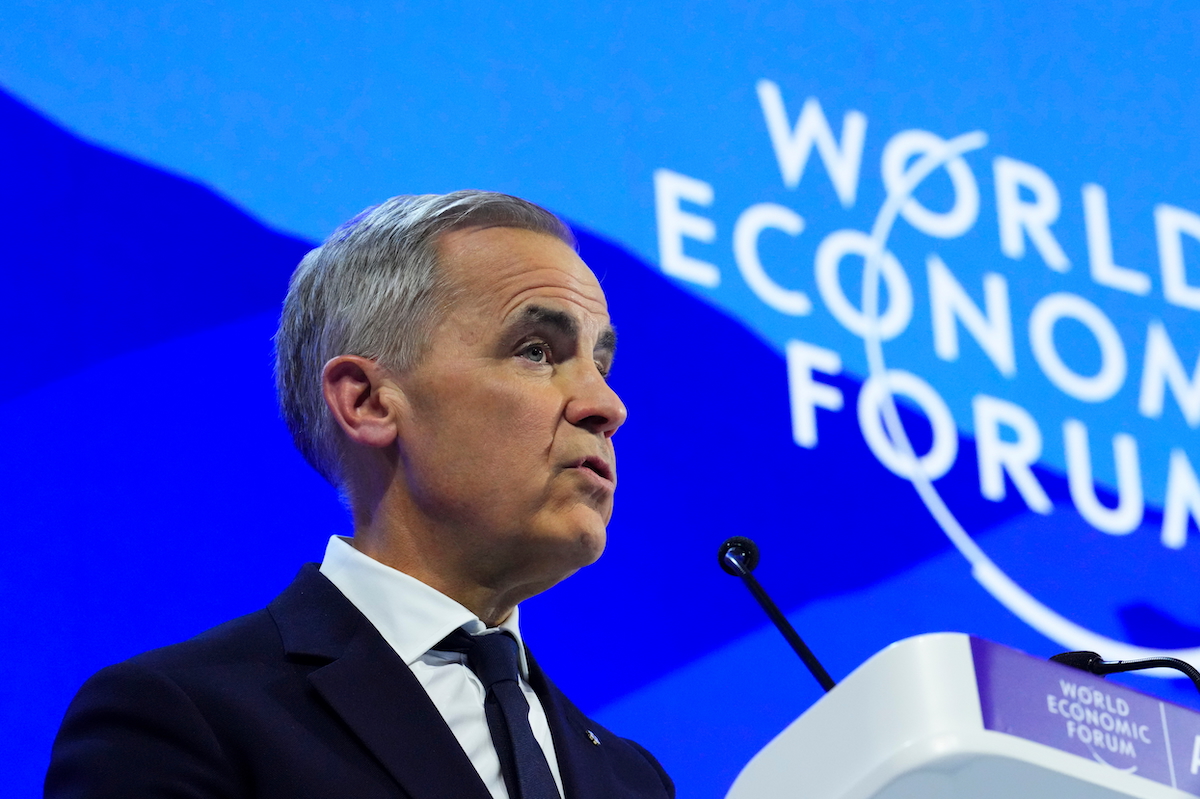
The World Economic Forum’s “New World Order,” the scheme under which humanity will “own nothing and be happy,” is being torn asunder by President Donald Trump, but the so-called global community must charge forward regardless with new tactics, argued Canadian Prime Minister Mark Carney at the WEF’s annual meeting in Davos, Switzerland.
There is a “rupture in the world order,” Carney, a former board member of the WEF, said. Adding that America is “submitted to no limits, no constraints.”
To combat Trump’s rupturing of the global order and rising U.S. independence, medium-sized nations must pick up the slack and push forward to ensure a world order without the United States as a major player.
These nations have the power to “build a new order that encompasses our values, such as respect for human rights, sustainable development, [and] solidarity.”
Globalization must win out, Carney continued, explaining that “a world of fortresses” where nations make their own decisions will result in chaos and a failure to achieve the United Nations’ charge for global government through the Sustainable Development Goals.
No More U.S.-led Order
Carney also explained that the so-called U.S.-led order is no longer a reality.
“For decades, countries like Canada benefited from what was called the rules-based international order,” Carney said. “We joined its institutions. We praised its principles. We benefited from its predictability.”
But all the while, “we knew the story … was partially false,” Carney admitted. “The strongest would exempt themselves when convenient,” he continued, arguing that “trade rules were enforced asymmetrically” and “international law applied with varying rigor depending on the identity of the accused or its victim.”
That “pleasant fiction,” he states, no longer works. “We participated in the rituals. And we largely avoided calling out the gaps between rhetoric and reality.”
“If you are not at the table,” Carney said, “you are on the menu.” His remarks were met with a rare standing ovation in the room.
Indeed, the rise of nationalist leaders and policies — including those championed by Donald Trump in the United States, Javier Milei in Argentina, and Viktor Orbán in Hungary — poses a significant threat to the World Economic Forum’s agenda, and the gloves are coming off.
The U.S. Blowing Up the Ship
Just weeks before the WEF summit, President Trump sent a clear message to the internationalists that the United States is serious about reclaiming national sovereignty by withdrawing from 66 global organizations, conventions, and treaties.
The sweeping act included a historic withdrawal from the United Nations Framework Convention on Climate Change (UNFCCC); the UN’s pseudo-science outfit, the Intergovernmental Panel on Climate Change; and others.
Speaking on a panel about international trade, U.S. Secretary of Commerce Howard Lutnick torched the WEF and backed Trump’s moves to reclaim American sovereignty.
“We are in Davos, at the World Economic Forum, and the Trump administration — and myself — are here to make a very clear point. Globalization has failed the West and the United States of America. It’s a failed policy,” Lutnick said to an awkwardly silent crowd of bureaucrats and so-called journalists.
“The fact is, it has left America behind,” he continued. “It has left the American worker behind. And what we are here to say is that America First is a different model — one that we encourage other countries to consider — which is that our workers come first.”
Lutnick went on to lambast the foreign leaders for outsourcing everything from medicine to semiconductors while opening their borders to the foreign world. That foolish policy has opened the door for the Communist Chinese to step in and make the West dependent on their production abilities, he argued.
This blunt articulation of the score represents a different way of thinking, according to Lutnick: “It is completely different than the WEF.” America First is the only task of the Trump administration, he concluded.
The Ship Is Sinking, but Still Savable
Carney and Larry Fink, the CEO of financial behemoth BlackRock and interim co-chair of the WEF, recognized that the establishment is losing steam and American support in an “age of populism.”
In fact, Fink acknowledged that global “elites” have totally lost public trust after the disastrous handling of the Covid-19 “pandemic” and now must overcome deep institutional mistrust. “If the World Economic Forum is going to be useful going forward, it has to regain that trust,” Fink stated.
The path forward for the WEF lies in pushing the same old scheme but under new slogans, rebranded graphics, and verbiage that is in step with the current political trends. This, Carney said, can be labeled as “value-based realism,” or principled pragmatism.
Carney, whom Maxime Bernier — former Canadian member of Parliament, Cabinet minister, and leader of the People’s Party of Canada — described to The New American as the “globalist-in-chief,” reminded the technocrats in Davos that they must be patient.
“Progress is often incremental,” he said, and interests often diverge. But the mission must be carried forward by upholding the UN Charter, Sustainable Development Goals, and international cooperation.
The Fight Is Not Over
Indeed, the actions and anti-globalist rhetoric of President Trump have been severely damaging to the conspiracy to consolidate power in a global government, but the fight is not even close to being over.
The oligarchs united in the conspiracy to destroy America at the United Nations, the World Economic Forum, the Bilderberg Group, and the Council on Foreign Relations have a simple remedy for Trump’s crusade to reclaim U.S. sovereignty: wait out, outspend, and out-organize the opposition.
But thankfully there is a Trump card. The United States can fully withdraw itself from international quagmires that are designed to weaken the nation at taxpayer expense. The first order of business for freedom-loving Americans should be a swift and complete withdrawal from the United Nations, which is the headquarters for global control. Only then can Americans celebrate.