The Trump administration’s disorienting deluge of anti-globalist moves and ambitions of conquest are toppling a hitherto U.S.-led “Rules-based” Western order, one that’s also facing attacks from budding nationalism spreading across the European continent. In response, Western elites are scurrying about and trying to glue the international project back together without the America piece.
Meanwhile, what’s next for America? While the Trump administration claims to operate according to an America First agenda, its foreign policy suggests an inclination toward imperialism.
Globalists Fret
There’s been a steady stream of tears emanating from globalist figures and outlets over the massive shock Donald Trump has delivered to the system. “We are in the midst of a rupture, not a transition,” Canadian Prime Minister Mark Carney said on Tuesday at the World Economic Forum (WEF). Carney said institutions including the World Trade Organization and the United Nations are “greatly diminished.” He said those who aren’t at the table are on the menu. More on Carney later.
European Commission President Ursula von der Leyen also believes the U.S.-led international order may be dead. “Nostalgia will not bring back the old order,” she said Tuesday. “If this change is permanent, then Europe must change permanently too. It’s time to seize this opportunity and build a new independent Europe.”
The Wall Street Journal took it a step further, announcing that Europe’s “major ally for the last 70 years has turned into one of its most urgent threats.” The primary context is the growing friction over Trump’s push for American ownership of Greenland, which was a major topic at the WEF. But there’s more to it than that. “Trump has destroyed Western cohesion,” according to an Italian senator. This collapse in trust between longtime allies “is forcing the Continent to re-examine its reliance — from security to trade — on America under an unpredictable Trump administration that has expressed an antipathy toward Europe.” Tom Switzer summarized in The Spectator: “Trump appears intent on ending the Pax Americana.”
Shaking Things Up
After only a year back in the White House, Trump has rendered Europe’s managing elites dizzy, disoriented, and dejected. Just days into his tenure, his vice president went to the Munich Security Conference and told Europe’s elite managers that they were becoming the tyrants their grandfathers fought. Then Trump began leveling tariffs against Europe and Canada. He’s also forced the Europeans to raise their own armies, pay for their own security, and hinted that he is willing dial back America’s military presence on the Continent and leave them to fend for themselves against the big scary Russians.
He has ridiculed and exited several international organizations, including the United Nations, World Health Organization, Paris Agreement, UNESCO, and many others. He stopped writing blank checks for their anti-Russia project in Ukraine. And he tore up their script of silence toward Russia and has held regular conversations with our Cold War enemies, who undoubtedly enjoy watching the arrogant and detached European elites squirm.
In addition to the UN and a slew of its subagencies, the European Union is also in big trouble. “No one seems to seriously care about the EU,” the left-wing German newspaper Süddeutsche Zeitung recently lamented. Not only is the American president setting the tone for debate in Europe, but the Continent’s globalist projects are losing support from within. Franziska Brantner, co-president of the German Greens, observed:
When I defend it, people say to me: “Who do you want to build your Europe with? Giorgia Meloni is Eurosceptic; Hungary, Czechia, and Slovakia are as well. Emmanuel Macron has lost power, and France could shift to the far right in 2027.” People are giving up on moving forward, especially in defense and security, because of the possibility that Marine Le Pen could be at the Elysée in 2027. If we keep letting Trump divide us like this, the end of the EU is possible.
Collapse of Europe?
Trump is also supplementing inspiration for the populist sentiment spreading across the Continent. Assuming the people in charge don’t figure out more creative and illegal ways to quash this movement, they are on track to dominate European politics in the coming years. Süddeutsche Zeitung predicted “’the collapse of Europe as early as next year [2027]’ due to the electoral success of populist and Eurosceptic parties in France and Poland.” Nationalism is also rising in Spain, the United Kingdom, some Scandinavian nations, and Germany, where the AfD is becoming the most popular single party. It took them awhile to figure it out, but the regular people of Europe have finally concluded that unless they resist, they’re heading toward “civilizational erasure.”
Also fighting for air is the North Atlantic Treaty Organization (NATO), the U.S.-led military alliance that has been deceptively portrayed as a security pact instead of an aggressive military alliance created to consume the world. The rift over Greenland is providing most of the ammo against this “Cold War relic,” as some American legislators have called it.
But since he got back into office, Trump has made a series of moves and statements indicating that America will not be as involved in European security as it has been in the past. He’s asked Europe to beef up defense infrastructure, which many of them have already begun doing. He’s pulled some troops out of Romania’s NATO base, albeit a relatively small number. And just Tuesday, The Washington Post reported that “the Pentagon plans to cut its participation in elements of NATO’s force structure and a range of the alliance’s advisory groups.” Assuming WaPo’s sources are accurate, Washington plans to incrementally withdraw NATO participation:
The impending move will affect about 200 military personnel and diminish U.S. involvement in nearly 30 NATO organizations, including its Centers of Excellence, which seek to train NATO forces on various areas of warfare, [Pentagon officials] said. … The Pentagon will also reduce its involvement in official NATO organizations dedicated to special operations and intelligence, two officials said, though one noted that some of those U.S. functions will be shifted elsewhere within the alliance, limiting the move’s impact.
How Will Europe Respond?
So what’s next for Europe? The acrimony with America has left it in a tough spot, given how frail it has become since World War II. “The conditions for a fresh start are not ideal,” admitted a German lawmaker. It turns out that decades of subsidizing their security to the U.S. so they spend themselves into debt on dreamy welfare programs — while taking in a deluge of Third World migrants — hasn’t helped them any. Neither has the illogical and destructive embrace of green energy implementation. European citizens now find themselves strangers in their ancestral lands and governed by a nefarious continental oligarchy that cares nothing for them.
Word is that European leaders are considering imposing their own tariffs of more “than $100 billion of American goods, and making it harder for American multinationals to bid on European contracts,” reports say. The only problem is that “a trade war would be devastating for Europe, which already suffers from stagnant growth.” That’s not to say the American economy wouldn’t suffer, say the experts; a trade war would slow economic growth. American companies would sell less to Europe, which would reduce their profits and open the door to competitors such as China.
Some countries are already starting to pivot. Canada recently made a trade deal with China that includes electric vehicles and canola oil. Carney wants to double Canada’s non-U.S. exports over the next 10 years. To do this, the country will have to rely more on China, which is its No. 2 trade partner. Our northern neighbors send about 70 percent of their exports to America.
Canada’s Carney
It appears that Carney is also interested in a top leadership position in the emerging, America-less international order, according to reports.
Carney as a globalist leader makes sense. He was groomed for this. His background is in central banking (he’s the former head of both the Bank of England and the Bank of Canada), he’s a former WEF Young Global Leader, and he has ties to the Bilderberg group, Chatham House, and the United Nations, to which he was appointed as special envoy for climate action and finance.
America at Davos
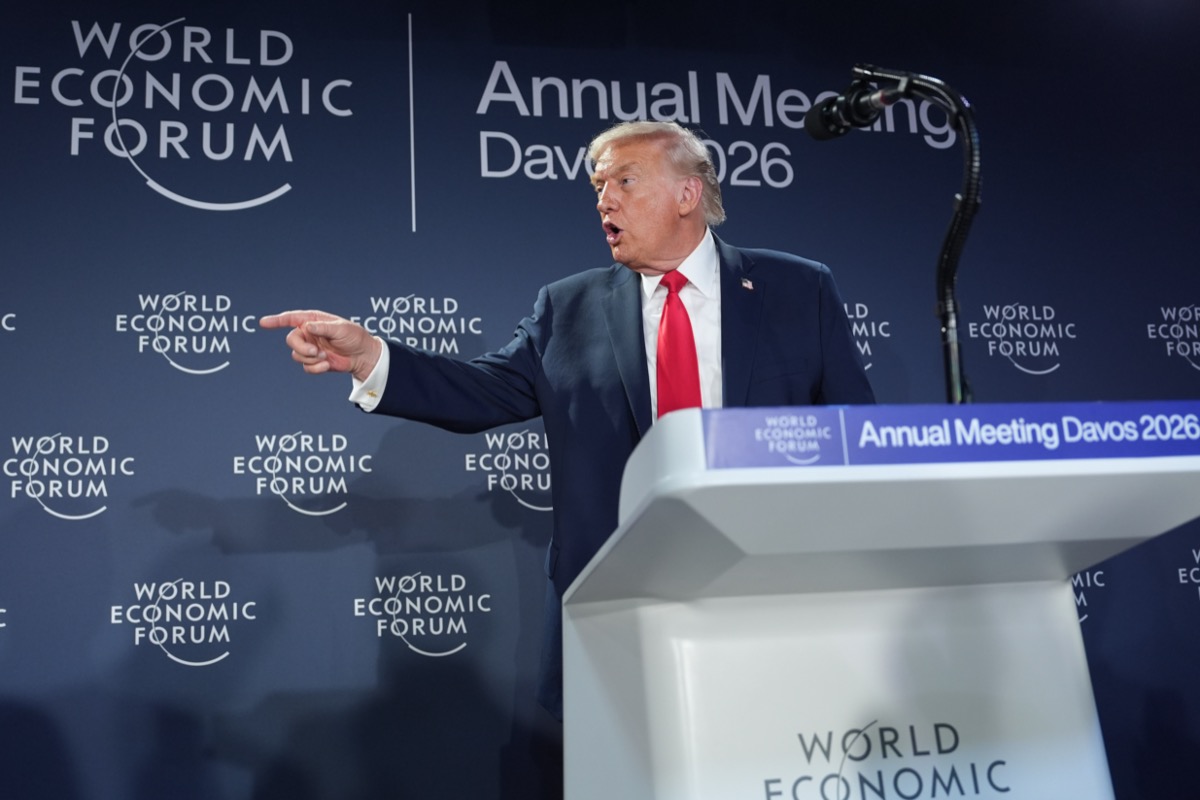
This week, the elites are meeting in Davos, Switzerland, “against the most complex geopolitical backdrop since 1945,” as WEF chief executive Børge Brende put it. Trump has brought “the largest U.S. delegation ever.” U.S. Secretary of Commerce Howard Lutnick has already hinted that Trump’s people were not bringing niceties. “Globalization has failed the West and the United States of America,” Lutnick said during a panel discussion. “It’s a failed policy. It is what the WEF has stood for.” He also went on a tear against the WEF:
I viewed the WEF as not a flagpole in the middle, but in fact they are the flag. Whichever way the wind blew, so it blew. You should have solar, you should have wind. Why are you going to do solar and wind? Why would Europe agree to be net zero in 2030 when they don’t make a battery. … So if they go 2030, they are deciding to be subservient to China, who makes the batteries.
Lutnick also challenged the sentiment that America and Europe are not on friendly terms anymore. He said the U.S. is great allies with both Europe and Canada.
From Globalism to Imperialism
Which brings us to the less-desired component of Trump’s policies. While you won’t find us shedding any tears over the crumbling globalist order and America’s leading role in it, there are some concerning signs about what is emerging out of this.
Trump ran on an America First platform. Lutnick emphasized this in Davos. People have taken the America First platform to mean that Americans would be prioritized. But, to some extent, they were mistaken. The nation is approaching a $40 trillion national debt. People are struggling to pay for food, healthcare, and heat for their homes. Yet the White House is spending enormous resources on foreign projects. Trump is bombing countries in the Middle East; he’s swooping in, abducting heads of state, and taking over other country’s governments; he’s mulling over invading Cuba in a similar fashion; and he’s threatening a military takeover of Greenland. Perhaps Ishaan Tharoor was right when he said a year ago in the The Washington Post that “Trump hates globalism, but he seems to like imperialism.”
As the United States retreats from the international order, the chances that the dollar will lose its reserve currency status only increase, making a financial disaster more likely and the urgency to get our debt under control more pressing. Americans voted against globalism, but they didn’t vote for might-makes-right imperialism or continued intervention all over the world. In fact, one of Trump’s most appealing campaign promises was “no more foreign wars.”
It will be of little benefit if America trades internationalism for blatant imperialism (as opposed to the covert empire-building it has been engaging in for decades). Both are destructive.
We Must Remain Vigilant
It’s also important that Americans and populists worldwide don’t let their guard down. The old order is falling apart mainly because of the Trump administration. But the apparatus, people, and ideas that fueled it for decades will still be there when Trump is no longer in the White House. Some of those people are eyeing the Oval Office here in America. As we reported from COP30, the internationalists have said outright that their plan is to wait Trump out and come back with a vengeance. And with the pervasiveness of AI technology, their schemes for global totalitarianism are never out of reach.



![Hegseth Demands Fitness Requirements, Says 'Fat Troops' 'Not Who We Are' [WATCH]](https://teamredvictory.com/wp-content/uploads/2025/09/Hegseth-Demands-Fitness-Requirements-Says-Fat-Troops-Not-Who-We-350x250.jpg)