In one of the last frames of Wake Up Dead Man (the latest in the Knives Out series), we get a glimpse of the newly edited parish sign announcing, “All Are Welcome.” It’s a signal to our therapeutic culture that (spoiler alert) the good priest has triumphed over the bad. In a culture that shuns distinctions, boundaries, and limits, there’s no surer badge of goodness than welcoming everyone, without exception.
Now, our Lord’s first words in public ministry were not “All are welcome.” They were the seemingly less inviting “Repent, for the kingdom of heaven is at hand.” But these two phrases are not as opposed as some might think – or want – them to be. This Sunday’s Gospel (Matthew 4:12-23) gives us occasion to consider our Lord’s curious invitation to all.
The Christian message has two fundamental parts: sin and redemption. Jesus’ words capture them. Repent – because there is such a thing as sin, and we commit it. For the kingdom of heaven is at hand – because God has sought us out to bring us back to Himself. Let’s take each of these in turn.
First, Repent. Our culture values religion only to the extent that it makes us feel better about ourselves. So, the command to repent sounds harsh and forbidding – anything but welcoming. In fact, however, repentance is the most universal invitation. What we all have in common – without exception, beyond any distinction of race, class, or sex – is our sinfulness. There is nobody who doesn’t need to repent.
In this regard, consider the Penitential Rite at Mass. The priest invites all, without exception, to acknowledge their sins and then together, as one, to pray I confess to Almighty God. . . .It’s one of the most egalitarian prayers. By making no distinction among people, it therefore distinguishes the Mass (and the Church in general) as radically different from any other human gathering. We are not together because of a shared worldly interest (politics, sports, music, etc.) that might exclude others. We are gathered because of the universal need for mercy.
Second, For the kingdom of heaven is at hand. This is what repentance leads to, the Kingdom. And that Kingdom is at hand – no longer a theory, idea, or pious aspiration but a reality. It is, in effect, there for the taking, extended to anyone who truly desires it. The only thing necessary for attaining it was stated before.
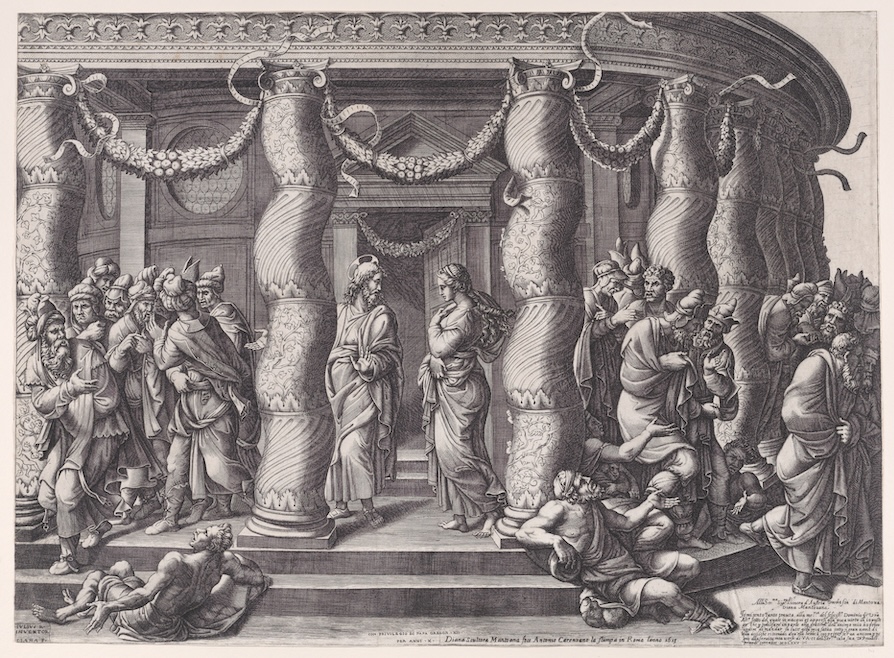
And that gets to the heart of the Gospel message, which must be sin and redemption, repentance and kingdom in equal measure. They are necessary to each other. The call to repentance is an invitation to recognize one’s dignity, one’s capability of reaching the Kingdom. We have behaved below our worth, but we still have the ability to change course. If man were not capax Dei, there would be no point in the call to repentance. The command to repent is not a scolding but a calling back of all to their dignity and worth.
This is a universal call. All are welcome – indeed, invited – to the dignity of repentance that leads to the Kingdom. It is not by accident that our Lord begins this proclamation in the “Galilee of the Gentiles” (Isaiah 8:23; Matthew 4:15) – that is, a region of Israel, of God’s People, that was also a crossroads of cultures. The net that figures prominently in today’s Gospel (mentioned three times in four verses) also hints at this universality. For a net is not selective. It is tossed into the sea (a Biblical figure of the nations) to catch whatever swims into it. All are welcome into that net.
Repent. . .Kingdom. There are always some who would eliminate one part or the other of the Gospel message. Some preach the condemnation of evil very strongly but forget about the Kingdom’s mercy and forgiveness. Others preach mercy and forgiveness but fail to mention sin at all. One without the other does damage. A call to repentance without a kingdom is cruelty. The Kingdom without repentance is presumption.
There is an internal logic at work here. If we do not repent, we cannot enter the kingdom of heaven. If there is no such thing as evil, wrongdoing, and sin, then the offering of forgiveness is meaningless. Conversely, if there is no such thing as mercy and forgiveness, then how awful it would be to call attention to evil and sin.
Repent, for the kingdom of heaven is at hand. Our Lord begins with these words and then He lives them out in His public life. First, in His teaching. At times, we find Him condemning evil strongly – indeed, more severely than the popular idea of Him would convey. At other times, we encounter words of great mercy and gentleness.
More importantly, our Lord is the subject of His own teaching. He embodies the words Repent, for the kingdom of heaven is at hand. By His passion and death, He creates the path of repentance for us; He opens the way of forgiveness. To repent is to walk with Him Whose Heart expresses perfect sorrow for our sins. Without Him, our repentance falls short.
He Himself is the Kingdom. He extends the Kingdom not as a gift apart from Himself but as His very self. The Kingdom is at hand because He is present. By our repentance, we grant Him admittance and receive the Kingdom. And that’s possible for all.