Loyalty is a republican virtue, and more than that. “The American people have been chary of the word loyalty, perhaps because they regard it as the correlative of royalty,” Orestes Brownson says, in his great work on our country, The American Republic, “but loyalty is rather the correlative of law.”
That fact pops up from a cursory glance at the components of the word. It clearly comes from the French for law,loi. Loyalty is loi-alty. In Medieval Latin, it was simply legalitas. Loyalty is most fundamentally lawfulness.
But loyalty is not simply “a” virtue, if Brownson is correct. Recall he was writing in 1865, just after disloyal men, the “rebels,” had been put down, and hundreds of thousands of loyal men gave up their lives for their country. Let us hear him out:
Loyalty is the highest, noblest, and most generous of human virtues, and is the human element of that sublime love or charity which the inspired Apostle tells us is the fulfilment of the law. It has in it the principle of devotion, of self-sacrifice, and is, of all human virtues, that which renders man the most Godlike. There is nothing great, generous, good, or heroic of which a truly loyal people are not capable, and nothing mean, base, cruel, brutal, criminal, detestable, not to be expected of a really disloyal people.
So, the stakes are high for this virtue, loyalty.
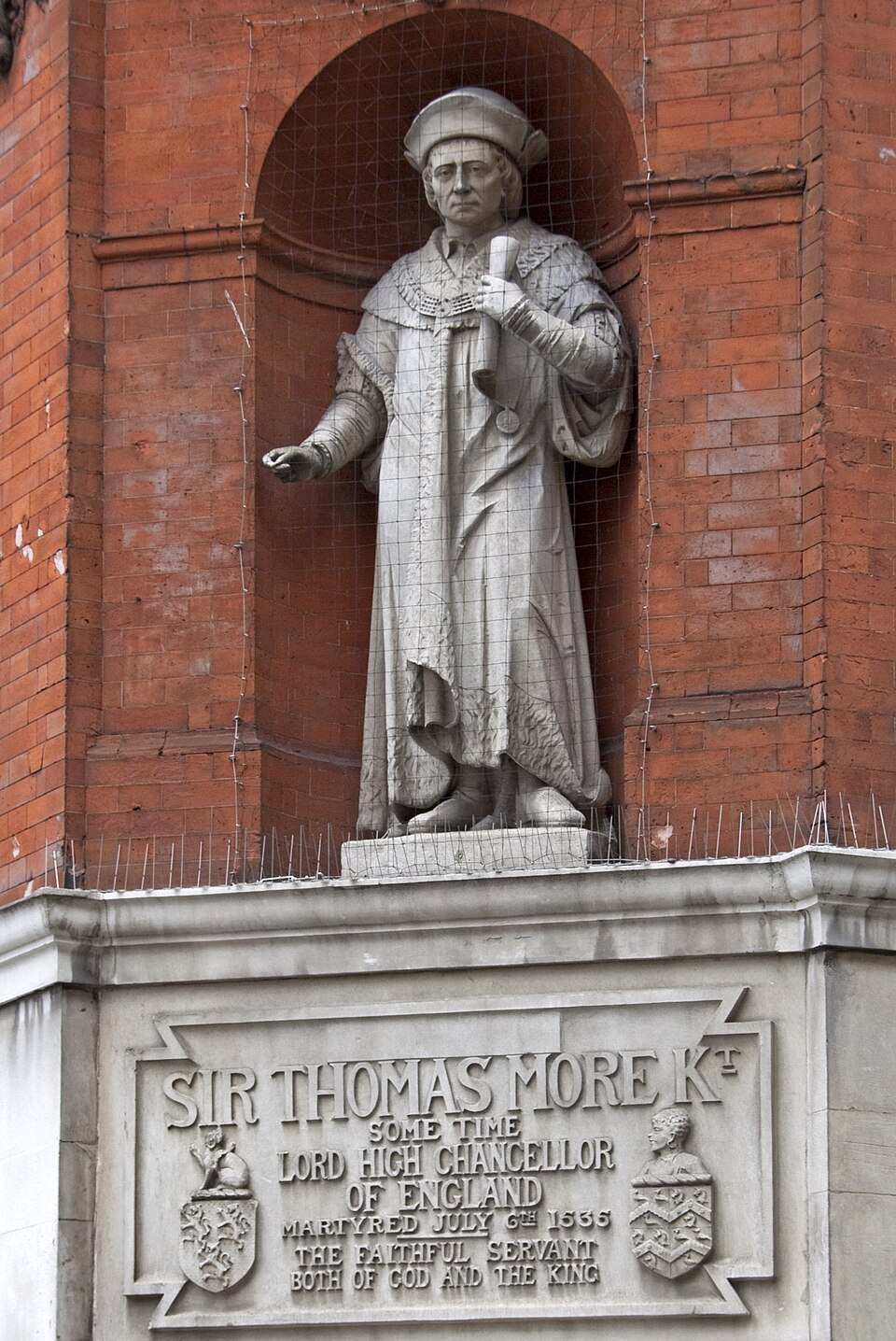
And yet, it seems correct to say, our Catholic tradition in its system of ethics at least does not give direct guidance in it. I say “in its system” because who can be a better instructor in the nature of loyalty than St. Thomas More with his martyrdom and “the King’s good servant and God’s first”?
And yet there is no classical virtue in St. Thomas that quite corresponds to it, and the Catechism is just about silent about it. “Each man rightly owes loyalty to the communities of which he is a part” (§ 1880), the English translation has, but the Latin and French say, more simply, that he needs to be devoted to those communities, which is something else.
Brownson seems to have believed that it was impossible for what we would call “a liberal” to be loyal at all. Define a liberal as someone who believes that we are under no obligation that we have not contracted into. A mother’s obligation to her child, then, comes from the fact that she has agreed to bear him to term. A Christian’s obligation to believe comes from his commitment to the faith as a mature adult. A citizen’s obligation to obey the law comes from the fact that he somehow has participated in a social contract by which he has “alienated” certain claims to a government. He is loyal and lawful only in the sense that he wishes to be true to himself and his word.

But Brownson places loyalty first among human virtues because it is a recognition of the authority of God and his law, flowing down from above, through a government responsible for the common good of some definite people, rooted in some definite place. We are bound by God’s law because He is our Creator, and He is true and just, quite apart from what we have agreed to. That is why the self-sacrifice of a soldier on the field of battle in a just cause can be so admirable and even fruitful, because it is a return back to God of the gift of one’s life.
Loyalty so understood ethically requires personification. It is for the motherland or fatherland, or for the nation in relation to the Father of the Country.
St. Pope John Paul II’s famous homily in Victory Square, Warsaw, before the Tomb of the Unknown Soldier, is a hymn to loyalty, “I wish to kneel before this tomb to venerate every seed that falls into the earth and dies and thus bears fruit.”
And then he generalizes and, without quite saying so explicitly, makes loyalty the animating virtue for the entire life of a citizen and patriot:
It may be the seed of the blood of a soldier shed on the battlefield, or the sacrifice of martyrdom in concentration camps or in prisons. It may be the seed of hard daily toil, with the sweat of one’s brow, in the fields, the workshop, the mine, the foundries and the factories. It may be the seed of the love of parents who do not refuse to give life to a new human being and undertake the whole of the task of bringing him up. It may be the seed of creative work in the universities, the higher institutes, the libraries and the places where the national culture is built. It may be the seed of prayer, of service of the sick, the suffering, the abandoned – “all that of which Poland is made”.
St. Maximilian Kolbe’s virtue from a human point of view was loyalty. So is a mother’s refusing to contemplate abortion. So is the professor’s writing that scholarly article, which may fall into the earth, in the sense that no one will read it.
I said that the Church in its tradition of classical ethics does not directly teach about loyalty. But it does teach that lawfulness requires respecting the order of authority, and the fundamental claim of the natural law, and the principle that “the law must rule not a man.”
So St. Thomas More was not disloyal when, respecting the order of authority, he said he was God’s servant first, and neither were the Apostles when they said they must serve God before man.
And Antigone was not disloyal when she obeyed the natural law to bury her brother, and neither would a German soldier have been disloyal, to his country or to any oath, in disobeying an order to murder.
And likewise, the charge of disloyalty, quite, is never apposite for someone who criticizes or even resists any arbitrary exercise of authority.

![Hegseth Demands Fitness Requirements, Says 'Fat Troops' 'Not Who We Are' [WATCH]](https://teamredvictory.com/wp-content/uploads/2025/09/Hegseth-Demands-Fitness-Requirements-Says-Fat-Troops-Not-Who-We-350x250.jpg)