What is a feminist? This used to be an easy question to answer. When feminism simply meant equal rights and opportunities for women, most people felt comfortable identifying as such. After all, who could be against women having the right to vote and owning property?
Even as feminists have broken glass ceiling after glass ceiling, however, it has become less clear what their goals are anymore. Worse still, the rise of transgenderism has undermined the core claims of feminism by questioning the objective reality of womanhood.
Perhaps the touted benefits of the movement were overblown, and its history and underlying principles deserve more scrutiny. Perhaps those currently embracing this movement should reconsider what exactly they have accepted.
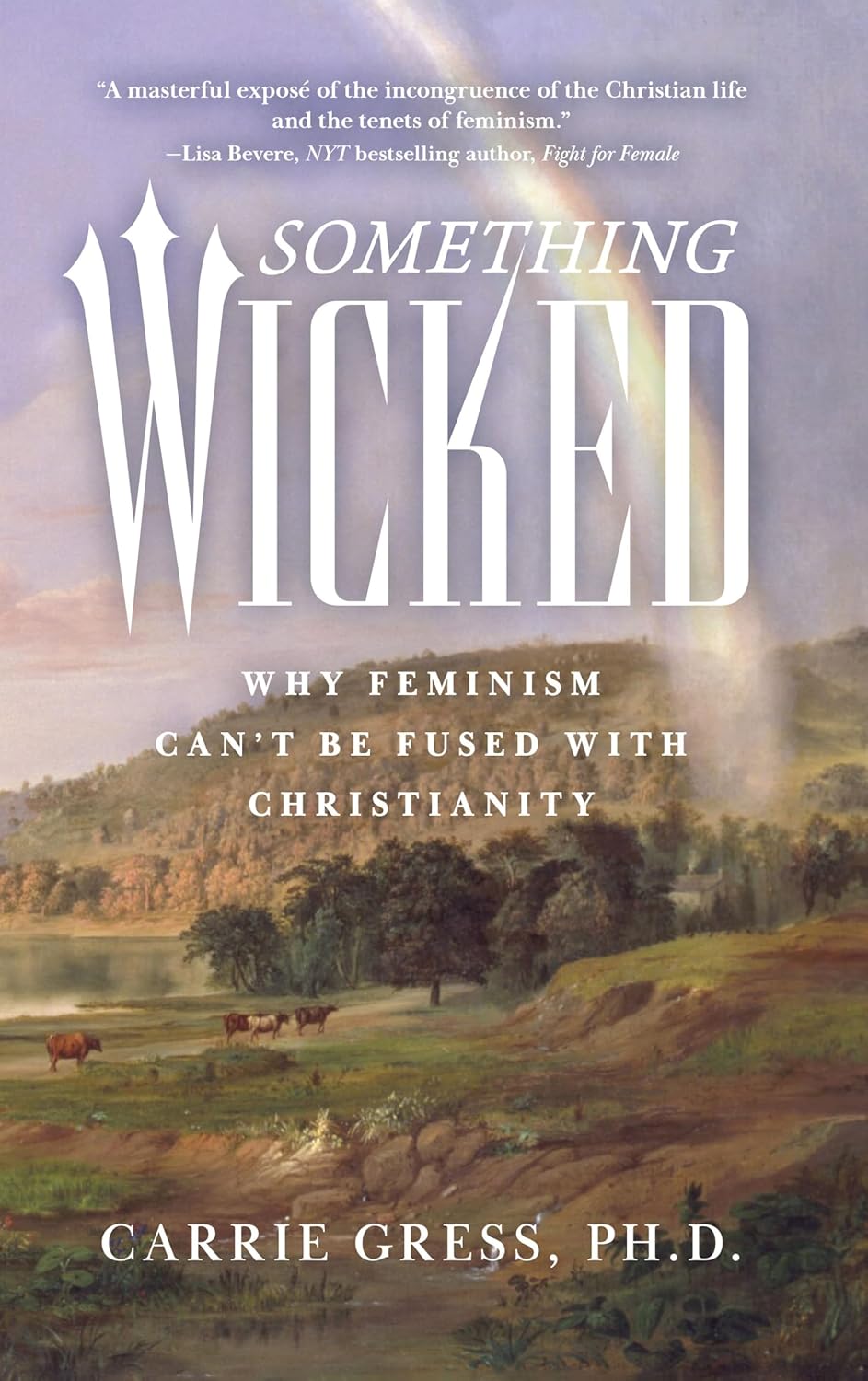
One person to guide this reconsideration is Dr. Carrie Gress, a sometime TCT contributor, in her new book Something Wicked: Why Feminism Can’t Be Fused With Christianity. Far from being an unalloyed good that has empowered and liberated women, without any tradeoffs, Gress exposes the very roots of the feminist movement, which make it incompatible with the Christian Gospel. As she dismantles the many myths of feminism, she opens up much-needed inquiries into what a true Christian feminism would look like for people today.
Gress begins her case with the founder of modern feminism, Mary Wollstonecraft, who applied the Enlightenment ideals of freedom and equality in her celebrated pamphlet A Vindication of the Rights of Woman. In line with her rationalist unitarianism, Wollstonecraft believed “that priests, pastors, or any kind of male authority – even Jesus – were an obstacle to female potential and divine life. Instead, reason. . .was women’s access point to God.” Thus, from the very beginning, the main goals of feminism were liberation and empowerment, and the main obstacle was Christianity.
Even so, Wollstonecraft and other like-minded feminists often made common cause with Christian social reformers like Hannah More, combating the evils of slavery, child exploitation, and mass alcoholism. Secular feminists, however, eventually came to dominate the movement, readopting a generally hostile view of Christianity. Many of them, including American heroines Susan B. Anthony and Elizabeth Cady Stanton, were even involved in spiritualism and the occult.

This in turn laid the groundwork for feminists afterward to equate true feminism with a total rejection of sexual boundaries and roles. Luminaries like Simone de Beauvoir, Virginia Woolf, Margaret Sanger, and Betty Friedan all concluded that sex was a social construct that was fabricated and reinforced by patriarchal institutions. Therefore, it was their job to dismantle these institutions, disempower men, and become their own gods. Autonomy, the “new idol” of the feminist movement, demanded nothing less.
Thus, a movement once associated with temperance, suffrage, and protecting the family degenerated into one dedicated to promiscuity, misandry, and witchcraft. Whenever this inevitably resulted in further misery and exploitation for women at large, feminists would reflexively blame systemic sexism and demand still more privileges for women to remedy the issue.
Beyond leading so many women astray with false promises and incoherent arguments, Gress shows how modern feminism has completely obscured the deeper realities of womanhood. Instead of compromising with this ideology, Gress recommends reframing the issue with non-ideological language:
Words like woman, anthropology, male and female, common good, complementarity, equal in dignity, subsidiarity and solidarity, and even patriarchy could be used with precision. It would also have the advantage of forcing us to find new ways to describe complex realities beyond sound bites.
In other words, women should stop trying to deny their own femininity by closing their eyes and trying to be the same as men.
Gress fits this idea within the Christian context as she confronts the efforts of contemporary Christian feminists to shoehorn modern feminism into Christian theology. While well-meaning Christian feminists attempt to effectively baptize modern feminism by characterizing women like Mary Wollstonecraft as devout Christians while portraying St. John Paul II and St. Edith Stein as progressive feminists, Gress rightly explains how this has everything completely backwards.

Rather than studying women in “a vacuum, isolated from family, husbands, and children,” a deeply Catholic anthropology recognizes that “man and woman are complementary creatures, reflecting two ‘equal’ but different ways of being in the world” and that “the nature and genius of woman actually cannot be understood apart from that of man.”
Gress concludes her argument by exploring the wider implications of modern feminism on Western culture. Citing the work of neuroscientist and philosopher Ian McGilchrist, who divides the mind into the right and left hemispheres, Gress explains how modern feminism, along with most modern ideologies, overemphasizes the left hemisphere at the cost of the right hemisphere. In practice, this means fixating on generalities, policies, and reductive abstractions and neglecting life’s deeper mysteries, emotions, relationships, and complex realities.
Hence, it becomes possible for feminists to tout their many legal victories while simultaneously becoming ever more collectively depressed about their situation.
Gress succeeds in her primary objective of thoroughly discrediting modern feminism as a corrosive ideology threatening Christianity and women alike. Yet her discussion of what true Christian feminism would look like remains incomplete. This is likely because such a discussion would require many more chapters and delving into even deeper concepts that most readers would struggle to follow.
Nevertheless, it is more than enough that Gress even kicks off this discussion in the first place. Women are more than sexless ghosts in female shells, and they are more than an oppressed minority in need of more rights and representation.
They are fully integrated, rational, and relational beings with unique souls and bodies that conform to a transcendent female nature that is complementary yet distinct from that of men. It is well past time to embrace this truth, profound and mysterious as it is, if Christians hope to set women and men on the path that God has created for them.