
Secretary of State Marco Rubio’s speech two weeks ago at the Munich Security Conference has been praised for its conciliatory tone, and even for its putative revival of grand political oratory. Looked at from the point of view of recent papal commentary on Europe, its origin and destiny, Rubio’s remarks were welcome, but incomplete. Yet he cannot be faulted for that; Europe has left him little choice in the matter.
Gabriel Marcel used to say that life in general has an existential character. You must seize the moment, or risk being like some sad ticket holder on the platform who just missed his train.
I think of Marcel’s image when I look back to the debates, twenty years ago, over whether the new European Union should recognize its debt to Christianity in the Preamble to the EU constitution.
A “constitution” is just what the word says – as the great Jewish legal scholar, Joseph Weiler, warned everyone then – it is a people’s “constituting itself.” What they say in that moment fixes who they are, and what they will become.
The European Union had a chance to constitute itself as having a Christian heritage, and it deliberately turned against it, speaking instead in bland terms about its commitments to “humanism,” “progress,” and “transparency.” Does it have any means now of going back to that missed train?
In his speech, Rubio reiterated several items from the “What We Want” section of the Trump administration’s recent National Security Strategy, wrapping these up in warm fuzzies a bout Dante, Beethoven, Christopher Columbus, and American settlers from the old country:
• Europe must assume more responsibility for its own defense;
• practice fair trade;
• and not insist on a supposed “rules-based order,” which cannot guarantee peace, and which is often manipulated to undermine U.S. interests.
• Furthermore, Europe must not continue to undermine itself, out of an overwrought guilt, through mass immigration policies that erode nationhood.
No diplomat there was surprised by the list. What they welcomed was Rubio’s communicating, through all the warm fuzzies, that “we are in this together, because we have a shared heritage and civilization.”
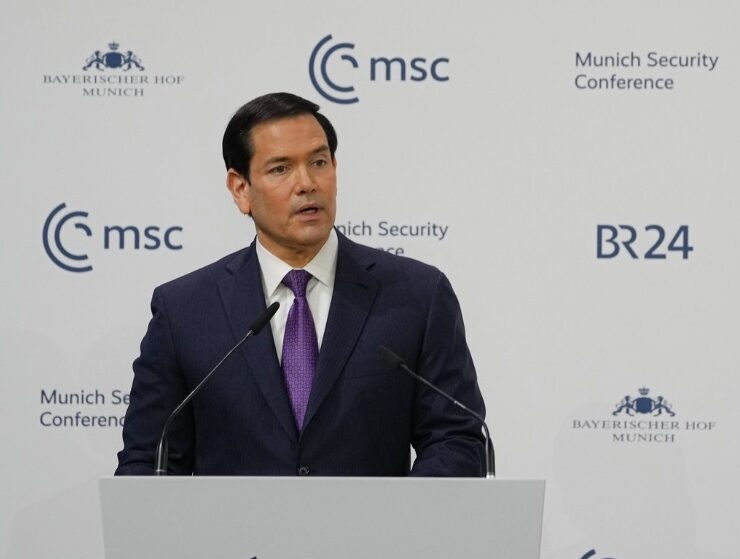
Yet here precisely was where Rubio was incapable of addressing directly the fundamental issue – again, because of Europe, not because of us. “We are part of one civilization – Western civilization,” he said. But Western civilization is Christian civilization. “We are bound to one another by the deepest bonds that nations could share, forged by centuries of shared history, Christian faith, culture, heritage, language, ancestry.”
Ah, yes. But Europe was incapable of acknowledging that history and heritage. It did not constitute itself with such language.
“The alliance that we want,” the Secretary said, “is one that is not paralyzed into inaction by fear – fear of climate change, fear of war, fear of technology. Instead, we want an alliance that boldly races into the future. And the only fear we have is the fear of the shame of not leaving our nations prouder, stronger, and wealthier for our children.”
Not quite. “We” (and especially “they”) are evidently confronted with the fear of simply not having children – the “demographic decline” not mentioned by the Secretary in his speech. Europe, having turned away from Christianity, seems to have lost any boldness for having children at all. It suffers from hopelessness. For a deep treatment of this problem, see Pope Benedict XVI Spe salvi (“Saved in Hope”).
I wondered as I was reading the speech: Exactly how clever is Rubio? Is he speaking with an awareness that he is a representative of a genuine nation, addressing an assemblage of nations which, except on one condition, has no real unity? Was his aim, without his saying it explicitly, actually to telegraph to the Europeans that their best hope for continued unity, as nations and among themselves, is unity with us – who, by contrast, are indeed a Christian nation, de facto?
Pope John Paul II was the great commentator on European identity and unity. His post-synodal Apostolic Exhortation, “The Church in Europe” (Ecclesia in Europa) written just when Europe was missing its train, is poignant today as well as prophetic.
He lamented especially “the loss of Europe’s Christian memory and heritage, accompanied by a kind of practical agnosticism and religious indifference whereby many Europeans give the impression of living without spiritual roots and somewhat like heirs who have squandered a patrimony entrusted to them by history.”
He saw the trend:
This loss of Christian memory is accompanied by a kind of fear of the future. Tomorrow is often presented as something bleak and uncertain. The future is viewed more with dread than with desire. Among the troubling indications of this are the inner emptiness that grips many people and the loss of meaning in life. The signs and fruits of this existential anguish include, in particular, the diminishing number of births, the decline in the number of vocations to the priesthood and religious life, and the difficulty, if not the outright refusal, to make lifelong commitments, including marriage.
And added: “Many of the great paradigms. . .which are at the core of European civilization, have their deepest roots in the Church’s trinitarian faith. And it has no other basis for political unity.”
Over the course of his pontificate, St. Pope John Paul II recognized Saints Cyril and Methodius, and Saints Catherine of Siena, Bridget of Sweden, and Teresa Benedicta of the Cross (Edith Stein), in addition to the traditional St. Benedict, as patrons and patronesses of Europe. One might hope that Pope Leo XIV, recognizing the civilizational emergency, would add one more to their number: his great predecessor, St. John Paul II.









![WHAT POLICY? Crockett Trips Through MS NOW Softball Question on Her Agenda if Elected to Senate [WATCH]](https://teamredvictory.com/wp-content/uploads/2025/12/WHAT-POLICY-Crockett-Trips-Through-MS-NOW-Softball-Question-on-350x250.png)