How we treat our dead has long been a sign of what we believe it means to be human in the first place.
One of the strangest of many strange 21st-century phenomena is the adoption of the ideas of 20th-century left-wing thinkers by the New Right. From Marcuse and Baudrillard to Jameson and Camus, left thinkers have exerted significant influence on the contemporary postliberal and even anti-liberal right. One figure whom the New Right has appropriated is the French post-structuralist Michel Foucault. Foucault’s anarchist radicalism was very attractive to the 20th-century left, who viewed the Western nation-state as an oppressive and reactionary behemoth. In a paradoxically similar manner, Foucault’s anti-statism appeals to some members of the 21st-century right who view the contemporary state as a fundamentally oppressive and radical behemoth. That many left-wing thinkers of the previous century continue to provide nourishing intellectual fodder for their purported rivals demonstrates how rich and complex their thought was and is.
One of Michel Foucault’s most curious and flexible ideas is the notion of heterotopias, or places that exist outside the normal mass political, linguistic, cultural, and temporal structural. Similar to his fellow radical intellectual Giles Deleuze’s notion of the “schizo,” a heterotopia is a place in which alternative and radical ways of being can exist. In the 20th century, gangsta rap, punk, “the gay scene,” and other subcultures served as heterotopias. However, in the 21st century, when these subcultures have become part of mainstream culture, it is Christian homeschooling co-ops, men’s groups, and trad-wife Facebook chats that have become heterotopias, places apart from the dominant culture.
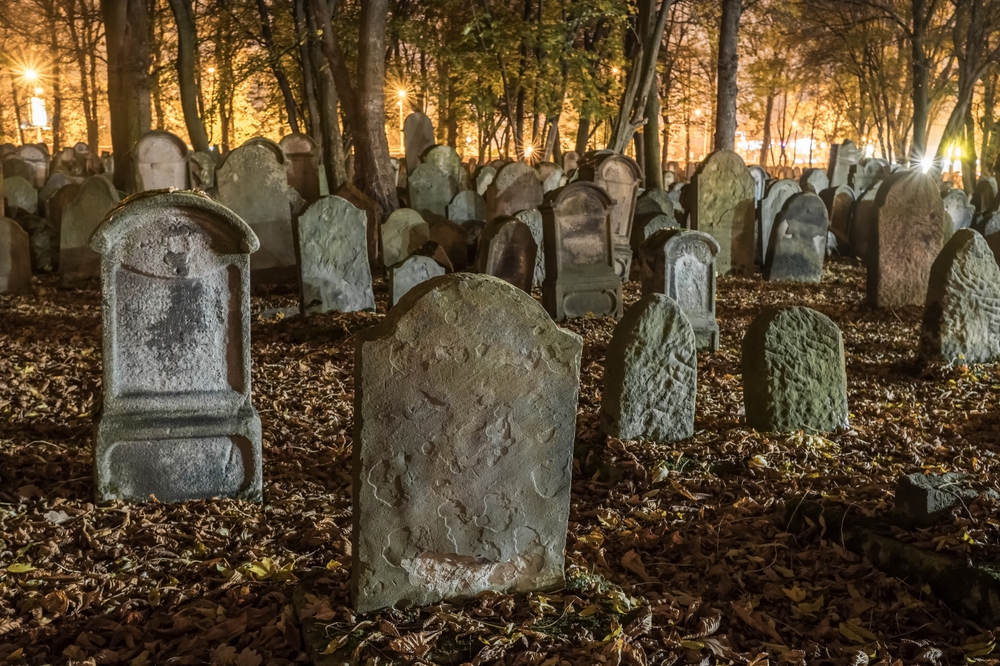
One of the examples of Foucault’s heterotopias is the graveyard, and in his new work, Graveyards: A History of Living with the Dead, Birbeck College’s Roger Luckhurst has crafted a history of the ways in which graveyards have served as places outside the normal structure of human life even as they are integrated—sometimes beautifully, sometimes grossly—into the world of the living. Luckhurst points out that many of the world’s great structures—the pyramids of Giza, St. Peter’s Basilica, and the Taj Mahal—serve, at least on one level, as memorials to the dead. Luckhurst further argues that much of what is called “dark tourism” is focused on visiting sites of death such as the Chernobyl nuclear site and Ground Zero, and is rooted in the human fascination for and veneration of human death. Further, Luckhurst demonstrates that death has a dominion over swathes of popular culture: Works such as Frankenstein, Carrie, and Night of the Living Dead deal with death and contain iconic scenes involving graveyard mishaps. Such films have been called a “pornography of death,” and though such a moral condemnation might be warranted, the fact that humans have always been fascinated with death, internment, and even reanimation remains nevertheless a worthy topic of study. Indeed, for religions like Christianity and Buddhism, as well as philosophies such as Stoicism and Existentialism, the reminder of death can be a spur to right moral action.
Luckhurst begins Graveyards with a portrait of his home city of London as a city of the dead, rooted in the Roman tradition of a people “extramural,” that is, outside the city walls, with a host of graveyards outside the old city of Longdon. He further notes that many of London’s cemeteries have been deconsecrated and repurposed as parks. This is one of the fundamental tensions in Graveyards: the clash between the desire for humans to venerate and cherish the dead and the harsh material reality of human decomposition.
The burial or at least ritual commemoration of the dead has always been a defining human characteristic, though it is often unclear exactly how early humans felt about their dead. Unsettlingly, Luckhurst writes that the earliest human remains in locations such as Hadar, Ethiopia, and Gran Dolina, Spain, show human bones that likely were stripped of their soft flesh. This could point to some sort of religious ritual or to cannibalism. As human history progresses, there are clearer signs of ritual burial in sites such as the Es-Skhul cave in Israel. Moreover, in the Shanidar Cave in northern Iraq, scientists found bodies with several kinds of pollen intermixed with them. This led archeologist Ralph Solecki famously to propose that mourners laid flowers on the bodies, and thus we see a deep empathy and love for the deceased in early humans.
Perhaps the deepest ritualized respect for the dead can be found in the monotheistic religions of Judaism, Christianity, and Islam. The story of Jewish cemeteries (or lack thereof) is a profound marker of the often contentious struggle between Christianity and Judaism. Islam, famously averse to visual imagery and drawing from Near Eastern, Egyptian, and Persian traditions of large-scale buildings, is famous for the aboveground “cities of the dead” cemeteries in countries like Egypt and Iraq, as well as such colossal funeral monuments as the Iranian Tower of Toghrul and the Amir Timur Tomb complex. Christianity, rooted in the death, burial, and resurrection of Christ, traditionally has advocated veneration for the human body and has displayed the remains of saints, which themselves served as loci of spiritual power.
Luckhurst’s afterward, “Graves After Graveyards,” explores the more avant garde ways in which humans have treated the dead. Departing from millennia of Christian inhumation, cremation began to gain traction in Protestant northern European countries in the late 19th century. Patented by Ludovico Brunetti, a cremation device appeared at the 1873 Vienna World Exposition. A Cremation Society of England was formed by Sir Henry Thompson in 1874. While not entirely at odds with Christianity, cremation was often associated with secular modernity and a tendency to present human death in its raw, earthy aspects. This embrace of the “material” aspect of human death is one of the key marks of how death is increasingly approached (at least among intellectuals).
Luckhurst also makes note of the U.K.’s contemporary Natural Burial Movement and the phenomenon of eco-burial, which advocates the burial of corpses in the raw ground as a means of emphasizing death as merely a biological process culminating in ecological renewal. Luckhurst also makes much of the work of photographer Sally Mann, whose 2003 What Remains depicts decomposing bodies in the University of Tennessee’s “Body Farm.” Mann records in graphic detail her experience walking among the bodies and photographing them. While such depiction of the biological element of human death may have seemed “edgy” in the 20th century, it is more a source of eye-rolling than avant-garde interest in the 2020s. People now are longing for a return to normalcy, and that normalcy includes respect for humans—body and soul—even, and especially, in death.



![Hegseth Demands Fitness Requirements, Says 'Fat Troops' 'Not Who We Are' [WATCH]](https://teamredvictory.com/wp-content/uploads/2025/09/Hegseth-Demands-Fitness-Requirements-Says-Fat-Troops-Not-Who-We-350x250.jpg)