
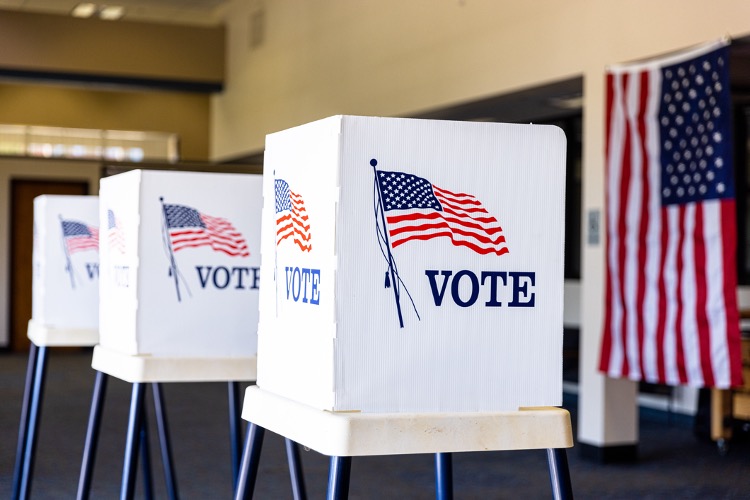
Though the U.S. House passed the SAVE America Act in February, analysts predict it will not pass the Senate. SAVE stands for “Safeguard American Voter Eligibility,” and it would require voters in federal elections to provide valid identification and proof of citizenship, among other provisions.
The New American (TNA) recently met with election integrity expert and retired U.S. Air Force lieutenant colonel Kurt Hyde, who sits on the National Council of The John Birch Society. He has been studying vote fraud since 1986 and warns that the SAVE America Act is an unconstitutional wolf in sheep’s clothing.
The Interview
TNA: What are your reservations about the SAVE America Act?
Hyde: This bill may have been initiated with good intentions, or it may have been written to help sneak in a National ID card in via the back door. It may have been written to do the right thing, but to do it in an unconstitutional manner so it can later be declared unconstitutional. In any case, in its present state, it is far off target for several reasons, including constitutionality.
TNA: Could you explain specific reasons for opposing the bill?
Hyde: It needlessly complicates the voter registration process and specifies unconstitutional involvement by the federal government. The SAVE America Act relies on coordination with federal agencies. The recent federal government shutdown has shown us that there are serious risks in relying on the federal government during a shutdown. What are we going to do if the SAVE America Act becomes law, and then there’s a federal government shutdown during the months leading up to an election? What if it adversely affects the voter-registration process? What if someone who is unhappy with the how the election is doing in the polls deliberately causes failure in the voter registration process in order establish grounds for invalidating an election?
TNA: The bill that passed the U.S. House is H.R. 22, and its companion bill in the Senate is S. 128. Could you give details to explain why these bills are not in Americans’ best interests?
Hyde: First, the SAVE America Act amends the National Voter Registration Act of 1993, also known as the Motor Voter Act. We need to repeal Motor Voter, not amend it. That is what U.S. Representative Andy Biggs (R-Ariz.) is trying to do with his H.R. 55, and I encourage everyone to contact their representatives in support of this legislation.
Second, the SAVE America Act endorses “a form of identification issued consistent with the requirements of the REAL ID Act of 2005.” Constitutional conservatives have been fighting REAL ID for years. It’s a National ID card and could possibly morph into a World ID card.
Third, the Act mandates “proof of United States citizenship with national mail voter registration form.” A federally mandated mail-in voter application form is unconstitutional. This is exactly the problem with Motor Voter. What we really need is to reinstate voter registration by the registrar of voters, except in certain limited cases.
Next, SAVE America strikes out “Federal Election Commission” and inserts “Election Assistance Commission.” FEC and EAC are unconstitutional agencies. They should both be abolished, not used in a bureaucratic swap. Furthermore, the act states that the “Election Assistance Commission shall develop a uniform affidavit for use by State and local officials.” This is blatantly unconstitutional, as is the provision included in SAVE America that “the Election Assistance Commission shall adopt and transmit to the chief State election official of each State guidance with respect to the implementation of the requirements under the National Voter Registration Act of 1993.” Do you see how this is disguised as assistance but is actually giving EAC unconstitutional authority to dictate to the states? The EAC should be abolished, and HAVA [the Help America Vote Act] should be repealed.
Additionally, the SAVE Act makes provision for states that permit individuals to register to vote in an election on the day of the election. Not only should same-day voter registration be abolished, but it is unconstitutional for the federal government to dictate such practices to the states.
TNA: Isn’t it a good idea to check citizenship before allowing someone to vote?
Hyde: Checking for citizenship is a good idea, but it’s unconstitutional for the federal government to mandate that it be done by a federally specified governmental organization. [We don’t need] another federally mandated government agency. Besides, there is no guarantee that future administrations will be as cooperative as the current administration. What will happen if a government shutdown or lack of cooperation by an administration disrupts the process?
TNA: How does the federal government propose to check citizenship status?
Hyde: There is a gaping loophole in the list of verification sources. The text of the bill includes the following verbiage: “Other sources, including databases, which provide confirmation of United States citizenship status.” That sounds good until you notice that it doesn’t require a government database. Also, there’s no guarantee that the specified federal government agencies will remain at least partially open to enable these checks.
TNA: What happens when the federal agency determines that someone needs to be removed from voter registration lists?
Hyde: This is where we see the unnecessary bureaucratic red tape in overdrive. The Act states: “The Secretary of Homeland Security shall conduct an investigation to determine whether to initiate removal proceedings.” Removal of a voter from the voter registration list should be done under state law. Why make a federal case out of the fact-gathering portion? This is too much power in the hands of one federal agency. A corrupt administration could easily apply double standards to the investigation phase to favor one side or the other in an upcoming election.
TNA: Any closing thoughts?
Hyde: It is always prudent to consider what the framers of our Constitution wrote about its limited powers. This particular case recalls The Federalist, No. 59, written by Founding Father Alexander Hamilton. It states the case very simply: “Suppose an article had been introduced into the Constitution, empowering the United States to regulate the elections for the particular States, would any man have hesitated to condemn it, both as an unwarrantable transposition of power, and as a premeditated engine for the destruction of the State governments?”








![WHAT POLICY? Crockett Trips Through MS NOW Softball Question on Her Agenda if Elected to Senate [WATCH]](https://teamredvictory.com/wp-content/uploads/2025/12/WHAT-POLICY-Crockett-Trips-Through-MS-NOW-Softball-Question-on-350x250.png)