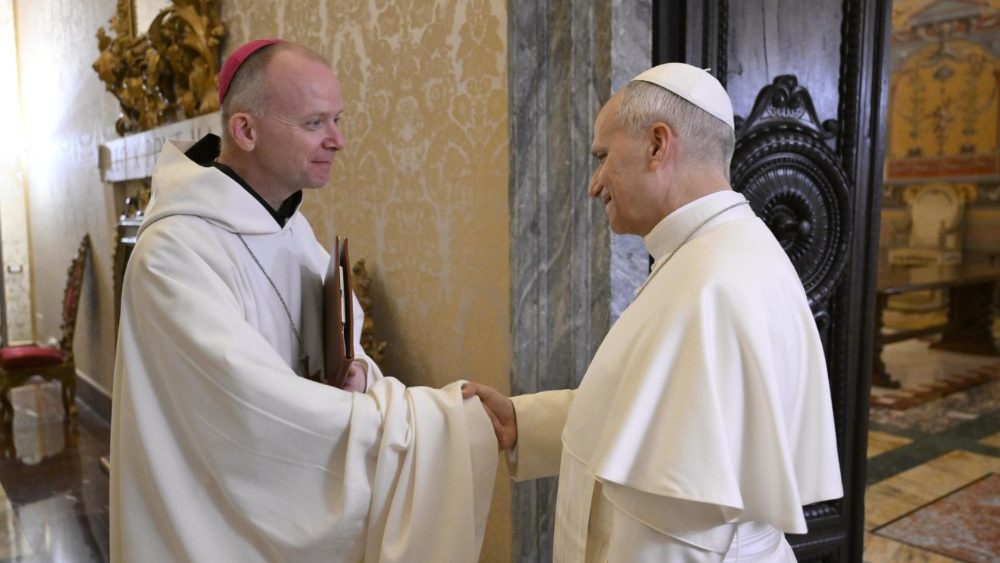
The small but growing Catholic Church in Norway is blessed to have two bishops now, native Norwegians, under fifty-two years old. Bishop Frederik Hansen, appointed the Bishop of Oslo in July 2025, joins the Cistercian Bishop Erik Varden, appointed Bishop of Trondheim, in October 2019.
Plans are currently underway to celebrate the millennium of the martyrdom of St. Olaf, the canonized King of Norway, spearheaded by Bishop Varden. It would not be inaccurate to say that the Catholic Church in Norway, with 2030 in sight, is being reinvigorated by the leadership of these two comparatively youthful bishops.
Bishop Erik, or Erik of Trondheim, to give him an accurate, though more medieval title, is a gentle Viking, although that moniker might sound warlike. The former Abbot of the Cistercian Monastery of Mount St. Bernard in England, he is also a former professor of Syriac, a man already highly regarded as a spiritual writer, teacher, and exemplary bishop.
Yet now, after having been chosen by Pope Leo to give the annual Spiritual Exercises for the Pope and the Roman Curia in the Vatican during the first week of Lent, his stature, principally because of the wisdom and depth of his short reflections, has risen considerably. There is much conjecture that he may be called to lead a dicastery in Rome, something that he would undoubtedly not wish for, and would be a great loss for the Church in Norway.
Almost any line or paragraph of Bishop Erik’s words would make an excellent subject for Lenten reflection. But there were one or two phrases that speak strongly to a theme that has been much discussed recently in the media, both religious and secular: namely, the appearance of a religious revival, albeit still small, in the West.
One of the questions that has yet to be answered is that, despite evidence that attendance has been much higher at celebrations such as Ash Wednesday in many countries, and that baptisms will be up this year at Easter, how many of these people, predominantly young, are returning to regular practice?
It’s unlikely that a young seeker, quite possibly unbaptized and with little, if any, knowledge of the Christian faith, is crossing the portal of the local Church to hear of either synodality, immigration, or debate over altar rails.

Still less will they be seeking music, or something very like it, that was popular when their parents were teenagers, but as Bishop Erik put it sharply, is now distinctly “sounding last-season.”
More likely, if they are initially searching for beauty to lead them to the experience of the divine, the season they seek will be one long before the advent of bell-bottoms.
Varden rightly and perceptively focuses on the reality that, in a highly confused and technocratic age, people are echoing the question of Pilate: “What is truth?”
The Church, and ancient wisdom, has long taught that, along with truth, beauty and goodness are paths to God. Bishop Erik warned his audience, with Pope Leo prominently seated in front, that the Church, or certainly many churchmen, imagine that they must ape fashion in order to be ‘relevant’ and “attract the youth.”
But this is a great danger for any religious revival. And Bishop Varden echoed, in a sense, Chesterton’s belief – which is probably shared by many seekers: “We do not want a Church that will move with the world, we want a Church that will move the world.”
Bishop Erik, a profoundly cultured man, knows well of which he speaks, both as a university professor and Abbot. Is there anything more embarrassing than a Churchman who is trying to be fashionable? One thinks of Dean Inge’s line that a Church that “marries the spirit of this age will be a widow in the next.” Bishop Varden gives the Church and, I would argue, every parish, a program for the seeker.
In the first place, he argues that those seeking the truth are asking the “question [What is truth?] earnestly – we cannot let it go unanswered.” This is the function, not only of the teaching office of the Church, whether in the clarity of papal statements and doctrinal fidelity, but also, at the “first point of contact,” the preaching and teaching in the parish.
There is no place for objections, as a friend recounted that he experienced on the Feast of the Assumption, that the Assumption “was invented in 1950.” Instead, Bishop Erik says, “We need our best resources to uphold substantial, essential, freeing truth against more or less plausibly shining, more or less fiendish substitutes.”
Best resources – in the Seminary, continuing education of clergy, and, as Fr. Richard John Neuhaus used to say, “fidelity, fidelity, fidelity.”
Along with the “freeing truth” substantially proclaimed, Varden’s renewal program identifies the fact that the Church has Her own language; a language, it must be said, that will be new to many who come to Her.
This language consists of the liturgy and Scripture, which, if spoken well, will make the Church “original and fresh, ready to express crucial truths in new ways, standing a chance of orienting culture.”
These new ways have nothing to do with novelty; they are the ways that are “ever ancient, ever new.” This is, in its essence, what the phrase “new evangelization” really means: It means, once again, the “best resources” – music, art, and the experience of the transcendent within the walls of the Church. Restoring all that will cost money, but perhaps less than the endless conferences and synods on synodality.
Finally, there’s the way of goodness, the “beauty of holiness,” the evidence of saintly lives, transformed by the presence of Christ. These, the bishop says, make the claim to truth “compelling.”
All this is to proclaim that the “Church reminds women and men of the glory secretly alive in them.” That is a program that will keep a seeker enthusiastically coming back.



![Hegseth Demands Fitness Requirements, Says 'Fat Troops' 'Not Who We Are' [WATCH]](https://teamredvictory.com/wp-content/uploads/2025/09/Hegseth-Demands-Fitness-Requirements-Says-Fat-Troops-Not-Who-We-350x250.jpg)