If you want to learn about the creative process of the greatest genius of English literature and arguably his greatest tragedy, stay away from this film. If you want to learn about pagan superstition with a feminist inflection, well…
Chloé Zhao received four nominations and won two Oscars, Best Director and Best Picture, for Nomadland (2020) and has since become the major female director in the English-speaking world. Her new movie, Hamnet, about William Shakespeare losing his son and (ostensibly) writing his most famous tragedy, has been nominated for eight awards. Two for her, six for other women, which is probably a record, and one for composer Max Richter (one of the few jobs in the industry that’s still overwhelmingly male).
Hamnet, however, is not a movie about Shakespeare or Tudor England. It would be deeply injurious to the movie if we compared it to a civilized era or an artist of great genius. Hamnet opens with unhappy domestic scenes: Will Shakespeare (Paul Mescal) is insulted for his education, then slapped by his ornery failure of a father (David Wilmot); later Will threatens his father with violence. His mother (Emily Watson) spouts superstitions and behaves even more cruelly—she’s the only Christian in the movie. It’s a story written by and for 21st-century feminists (Irish novelist Maggie O’Farrell cowrote the script).
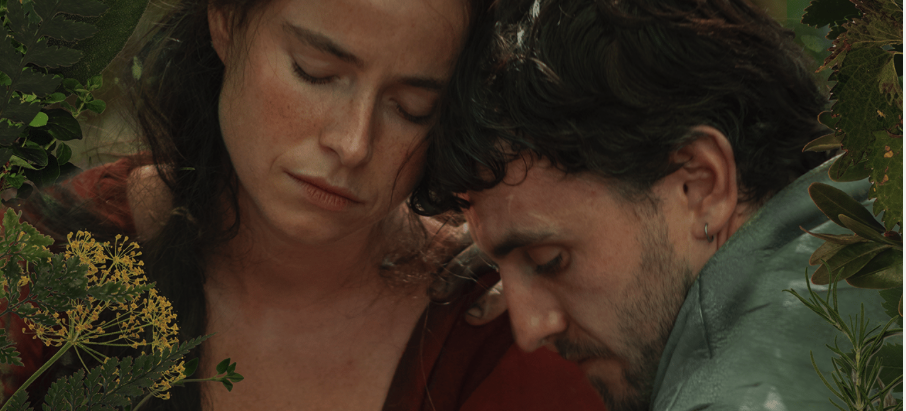
Will falls in love with a young lady falconer, Agnes (Jessie Buckley). She likes to sleep in the bark of dead trees in her favorite red dress, by a forest cave, and acts like she may belong in an asylum. This redounds to her authenticity. Meanwhile, Will is not good with words, despite being a tutor—this also redounds to his. Agnes is a witch, in short, not just a strong, independent woman. She has mystical knowledge that somehow is connected to the wilderness—that’s where she goes to give birth, by herself, needless to add.
Will is comparatively resourceless. He deals with his difficulties as a writer by shouting and banging his table—he’s had too much to drink, which wakes the child, who also starts screaming. You see the point: He’s afraid he might turn into his father while also proving his father right about the worthlessness of learning. Agnes, who nurses him as well as the child, knows what to do and does it—she has him go to London to make a career.
The interest of the movie lies not in their marriage or his career, which we do not see, but in the vision it offers of the life of the family in the 21st century. Will is an attentive and loving father who plays with his children but also worries about their education. A sensitive male. The movie makes every effort to prevent his looking or sounding intelligent. The home is run by the wife who teaches such things as gardening and religion. The religion consists in burying the dead raptor in the forest and imagining it has a soul that persists after death—since one can imitate the bird’s cry in a whistle, and the bird, when alive, did attend to the whistle.
Art then is the human imagining of what we want or hold dear, over against the painful realities of life—eventually, that’s death. Of course, one cannot wish away terrible things; one can only pretend that they’re really not so terrible. Life must be wrapped up in certain kinds of lies. Art doesn’t have anything in common with what we call artisanship or craft—the knowledge of making things that helps us live and make sense of the world. Art is instead, like religion, properly at home not in the city but the forest, as it concerns sentiment unmitigated by society.
The script makes this particularly obvious in the one scene that has nothing to do with Shakespeare’s life or work or family or Stratford. He watches a puppet play about the plague killing people. Art and religion meet there, in dealing with death. Civilization cannot make it up to people that they are mortal, much less protect them from death. They must find comfort elsewhere. They return therefore, as in a ritual, to an uncivilized state through the theater, through tragedy. They must suffer together. This is one vision of the virtue of tragedy, according to Aristotle, arousing fear and pity to purge them.
The story attempts to divert attention from Shakespeare and to the neglected (not to say excluded or oppressed): his wife and his son, Hamnet. The ideology of our times demands it. No more great men. What does it achieve thereby? Will tells his boy to be brave. His mother teaches him about the spirits. There is also the paternal grandmother, who says permanent fear is the lot of the parent—a child could die at any moment—though it’s not obvious if that has any influence on the boy. The boy puts all this together in one idea, to be willing to sacrifice his life for his sick twin sister.
This may be irrelevant to the plot. Obviously, the boy doesn’t sacrifice his life, it’s only a wish. His sister survives while he dies irrespective of that wish. Perhaps the boy did get sick by sticking close to his sick sister; in that case the teachings of his parents drove him mad, far from curing or managing his fear of death. The story doesn’t commit to the interpretation. I will let the readers judge whether the depiction of the grief of the family is adequate—more hangs on this question than whether one enjoys the story. It may reveal the limits of the ability of modern people to deal with death.
But as art attempting to achieve any reconciliation, it is a failure. Hamnet has a lot going for it; a good cast, rather good cinematography by Polish photographer Łukasz Żal, who was nominated for Oscars for Ida and Cold War and who excels at shooting outdoors. The indoor attempt at naturalism, however, is comparatively unhelpful. Also, Max Richter’s score is also quite good—the continuous tension of the movie, the feminine anxiety suggesting the story is a lot more important than you might otherwise think, goes a long way to give Hamnet a unity of mood.
The problem is that the basic idea is contemptible: Shakespeare lost a boy called Hamnet and wrote a play called Hamlet, in which he played the ghost of the father—it’s a tribute to his son, it’s somehow about him. What really is the connection between the tragedy and his private life? Well, nothing obvious. You will have learned nothing about Hamlet or Shakespeare by the time you’re done with the movie. That’s the point. Attention from now on should be paid to women and their drama, not to great artists who are intolerably male. Illiterate feminists who mime passion can affirm their supremacy over our culture. And apparently we let them.