
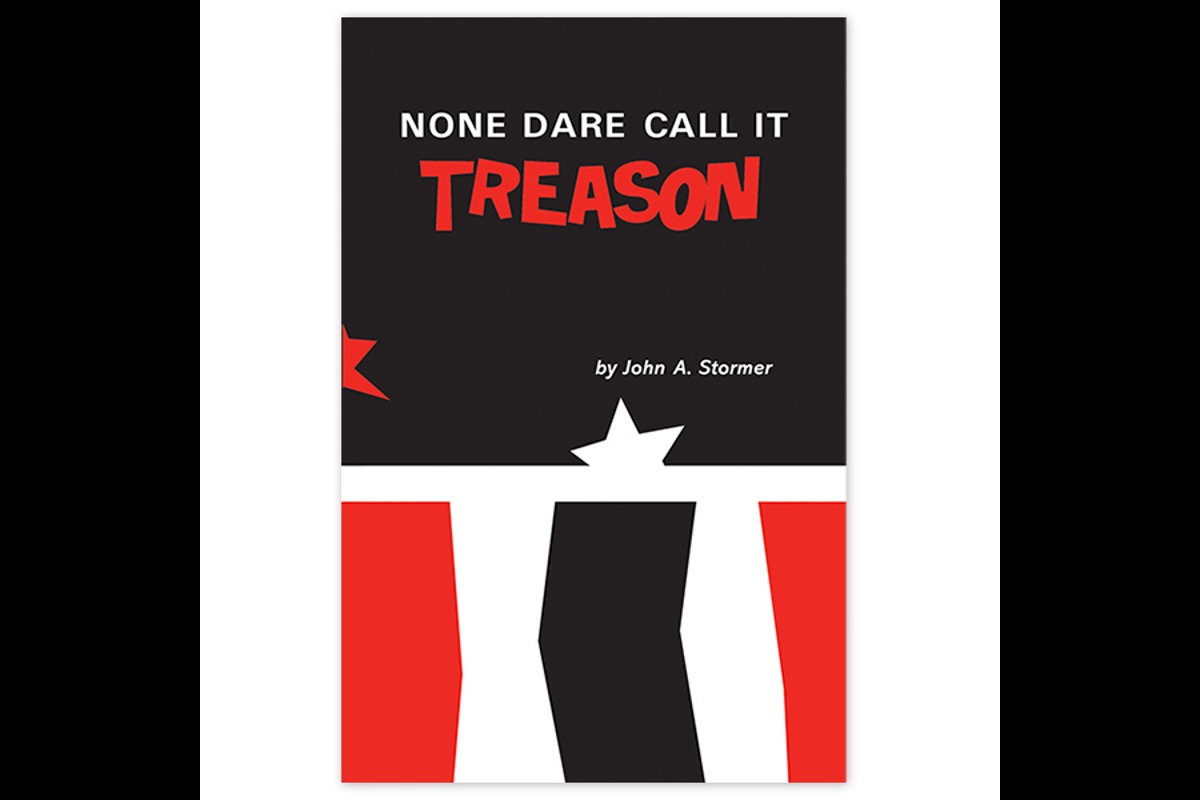
There are books that describe events. There are books that interpret movements. And then there are books that detonate illusions.
None Dare Call It Treason belongs to the last category.
First published in 1964 and now reissued in a handsome and timely edition by Western Islands, this work by John A. Stormer stands as one of the most consequential political books of the 20th century. Its influence on the conservative movement was seismic; its indictment of the bipartisan political establishment was unsparing; and its thesis — that America’s internal subversion posed a more existential threat than any foreign foe — was, at the time, dismissed by the guardians of “respectability” as paranoid exaggeration.
History has rendered a different verdict.
Stormer’s book was written at the height of the Cold War, when the menace of international communism was undeniable yet its domestic facilitators were treated as figments of overheated imaginations. The author catalogued, with names, dates, votes, and verifiable citations, the pattern of concessions, compromises, and calculated retreats that characterized U.S. foreign and domestic policy from the Roosevelt era forward. He did not traffic in rumor. He did not rely on anonymous whispers. He relied on the Congressional Record, on public statements, on documented affiliations, and on the ideological commitments openly professed by policymakers and intellectuals.
For this, he was ridiculed.
Constitutional Warning
But ridicule is often the last refuge of those unwilling to engage facts.
The genius of None Dare Call It Treason lies not merely in its exposure of communist penetration of institutions, but in its larger constitutional warning. Stormer understood that the true battlefield was not Moscow versus Washington, but constitutional government versus concentrated power. He recognized that the erosion of American liberty was being accomplished not primarily by Red Army divisions, but by the steady centralization of authority in Washington, D.C., the abdication of congressional responsibility, and the progressive normalization of executive overreach.
In this sense, Stormer was less a partisan polemicist than a constitutional diagnostician.
He demonstrated that policies advancing collectivism — whether in agriculture, labor, education, or foreign aid — did not arise in a vacuum. They were the domestic expression of a philosophy fundamentally at odds with the principles of limited government enshrined in the Constitution. The Framers designed a federal system of enumerated powers, jealously guarded by separation of powers and checked by federalism. Stormer showed how both parties — through cowardice, ambition, or ideological sympathy — participated in dismantling those safeguards.
That diagnosis resonates today with unnerving clarity.
The reissue of this book is not an exercise in nostalgia. It is an act of civic urgency.
Consider the present condition of our Republic. The administrative state now governs vast swaths of American life through unelected bureaucracies issuing regulations with the force of law. International entanglements continue to erode national sovereignty. Trade agreements, multilateral institutions, and executive agreements often circumvent the clear constitutional processes for treaty-making. Congress, increasingly timid, delegates its legislative authority while posturing for cameras. Meanwhile, public discourse is shaped by media institutions that function less as watchdogs of power and more as its amplifiers.
Stormer would not be surprised.
Timely — Not Obsolete
Indeed, much of what he documented has matured into the permanent architecture of governance. The cultural Marxism once confined to university departments now animates corporate boardrooms and federal agencies. The suspicion toward American exceptionalism he described has metastasized into open hostility toward the nation’s founding principles. The moral relativism he warned against has become orthodoxy.
And yet, for all this, the book does not read as dated. It reads as prophetic.
Critics will attempt the predictable maneuver: They will insist that the Cold War context renders Stormer’s concerns obsolete. Communism, they will say, collapsed with the Soviet Union. The threat is gone.
Such assertions betray either ignorance or deliberate obfuscation.
Communism as a geopolitical superpower may have suffered institutional collapse, but collectivist ideology did not evaporate. It adapted. It embedded itself in academia, in international organizations, in “nongovernmental” networks, and in the rhetoric of social justice divorced from constitutional constraints. The instruments changed; the objectives — centralization of power, subordination of individual liberty to the state, erosion of national sovereignty — did not.
Informing New Generations
The importance of this new edition lies partly in its accessibility to a generation that has been systematically shielded from dissenting interpretations of modern American history. Young Americans are routinely taught that skepticism toward centralized authority is extremism, that constitutional originalism is antiquated, and that global governance is enlightened inevitability. They are rarely exposed to serious critiques grounded in documentary evidence.
Stormer provides precisely that.
Western Islands’ republication of this important treatise restores to circulation a work that was instrumental in shaping the grassroots awakening of the 1960s. It sold in the millions — not because it was marketed by establishment publishers, but because ordinary Americans passed it from hand to hand. It energized citizens who refused to accept the comforting platitudes of bipartisan accommodation. It challenged them to examine primary sources, to question narratives, and to measure policy against constitutional principle.
That spirit is desperately needed today.
Exposing
To read None Dare Call It Treason is to confront an uncomfortable reality: Subversion does not always announce itself with banners and slogans. It often proceeds under the cover of pragmatism, bipartisanship, and incremental reform. Liberty is rarely surrendered in a single dramatic act. It is bartered away through compromise after compromise, until the constitutional framework is hollowed out.
Stormer’s warning was not merely about communists in high places. It was about complacency among the governed.
Demanding Courage
The book demands intellectual courage. It invites readers to test its claims against the historical record. It does not ask for blind acceptance; it insists on verification. That alone distinguishes it from much of contemporary political commentary, which trades in emotion untethered from evidence.
Does the book reflect the Cold War vocabulary of its time? Certainly. Does it occasionally adopt a tone that modern readers will find stark? Without question. But such features should not obscure its core achievement: a meticulously documented case that the trajectory of American governance was diverging from constitutional limits long before most citizens recognized the danger.
The Republic cannot be preserved by ignorance of its past.
The Republic cannot be defended by those unaware of the mechanisms by which it is eroded.
And the Republic cannot be restored without the moral fortitude to call treason what is, in fact, betrayal of constitutional duty.
This new Western Islands edition arrives at a moment when Americans are again grappling with questions of sovereignty, executive power, congressional abdication, and the proper scope of government. It offers not easy answers, but a bracing reminder that vigilance is the price of liberty — and that the gravest threats often arise not from declared enemies abroad, but from ideological commitments embraced at home.
Half a century ago, John A. Stormer dared to call it treason.
Today, the greater danger may be that too many dare not.
For readers of The New American — and for all who cherish the Constitution as the supreme law of the land — this reissue is not merely recommended. It is required reading.









![WHAT POLICY? Crockett Trips Through MS NOW Softball Question on Her Agenda if Elected to Senate [WATCH]](https://teamredvictory.com/wp-content/uploads/2025/12/WHAT-POLICY-Crockett-Trips-Through-MS-NOW-Softball-Question-on-350x250.png)