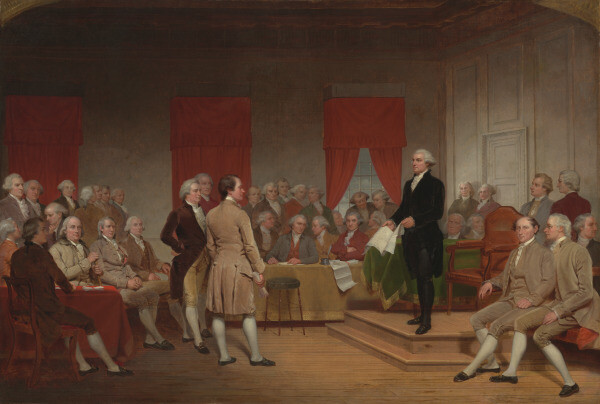
The 250th birthday of the United States is a good time to remember that 1776 was the year of a new nation, not a new government. It would take another eleven years for the Founders to formulate what the government would look like, and two more to elect the first president.
This sequence of events reminds us that it is not a government that makes a nation, but a nation that makes a government. Even peoples who lack a sovereign territory, such as the Kurds or Basques, conceptualize themselves in some way as a nation before devising some sort of governing apparatus. You need something to govern before you can figure out how to govern it. The Vichy regime in France is an example of what can happen if one attempts to establish a government with no true nation behind it.
Having been around long enough to celebrate both, I can’t help but feel concern about the disquietude surrounding this year’s Semiquincentennial celebration in comparison with the Bicentennial fifty years ago. Last summer, a White House task force appointed to plan and to implement the celebrations was already butting heads with a congressional commission established for the same purpose.
John Dichtl, president of the American Association for State and Local History, has a point when, referring to plans to host an Ultimate Fighting Championship (UFC) at the White House, asks, “What does a (UFC) fight have to do with America’s greatness?” Writing in The Hill, Myra Adams confesses that she feels “less pride” in this Semiquincentennial year, lamenting that “dangerous trends threaten what our Founding Fathers envisioned.”
Back in 1976, virtually no one hesitated to wave a flag, march in a parade, and join in singing “My Country, ‘Tis of Thee.” And all this not even two years after an American President voluntarily stepped aside for the first time. Fifty years later, students no longer recite the Pledge of Allegiance at the elementary school I attended.
That said – and especially in light of recent chaos in Minneapolis – I do understand how people could lack enthusiasm for the event if they forget we are celebrating the founding of a nation and not a government. The former is much more worthy of celebration if we take it as the primary locus of the shared values and ideals inspiring a diverse people to form a Union.
Chief among those is obviously freedom, including the freedom to vote Republican, Democrat, Libertarian, Independent, or even Communist or Socialist, if you like. If you want to know what a one-party celebration looks like, look no further than the Tian’anmen and Kim II Sung Squares.
The need to revisit the distinction between a nation and a government became clearer to me when, while interviewing political theorist Patrick Deneen, Bishop Robert Barron asserted that, according to the classical view, the purpose of “government” is to cultivate virtue in its citizens. He claimed to have learned this from philosopher Robert Sokolowski at the Catholic University of America.
Msgr. Sokolowski was my professor too, and I don’t remember him saying this. I do remember him saying that, according to the classical view, the purpose of the polis was to make citizens virtuous and good. That’s not to say government has no role, but the polis is a richer and more expansive concept than “government,” even though the extent to which the ancient Greek polis resembles the modern state is debatable.
In any case, a polis, according to Aristotle, is a natural community where individuals come together to pursue the good life. The politeia is the way a polis is organized, including – but not limited to – its system of government. Politeia also encompasses the values and practices that make a polis possible.
Though much more can be said about the distinction, it is enough to draw attention to the myopic view of “politics” we have today. If we limit politics to what happens inside the D.C. beltway, we easily fall into the trap of thinking that it is primarily the government’s role to cultivate virtue in its citizens. Without denying government such a role, the Founders were convinced that the rest of the polis did a much better job at the task. Just as a nation precedes a government, so the virtues necessary for self-government precede the governing apparatus.
“Of all the dispositions and habits which lead to political prosperity,” said George Washington in his Farewell Address, “religion and morality are indispensable supports,” calling them the “great pillars of human happiness, the firmest props of the duties of men and citizens.” Hence, our first president cautioned against the supposition that “morality can be maintained without religion,” but never once did he entertain the idea that the non-establishment clause was a mistake.
I’ve lost count of the recommendation letters I’ve written for students applying to think tanks, congressional offices, and NGOs in Washington. I can count on one hand the number who have applied for internships at a city hall or county seat. Weekend field trips to the National Mall are a wonderful idea, but so are afternoon visits to the mayor’s office or state capitol building.
“In so far as government exercises paternal authority,” wrote Yves Simon (one of the great Catholic thinkers of the previous century) – by which he meant the authority of government to rule in matters where citizens are deficient but potentially proficient – “it is plainly true that the best government is that which governs least.”
If we forget that this 250th anniversary celebrates a nation and not a government, we would have every reason to look around and conclude that our government is governing too little. Such an attitude now transcends the political divide. But if we look around and consider how we might better govern ourselves – how we might better check our bloated desires for money, prestige, power, sex, and self-indulgence – we just might recover the idea of a nation – a polis – that made this “more perfect Union” possible in the first place.