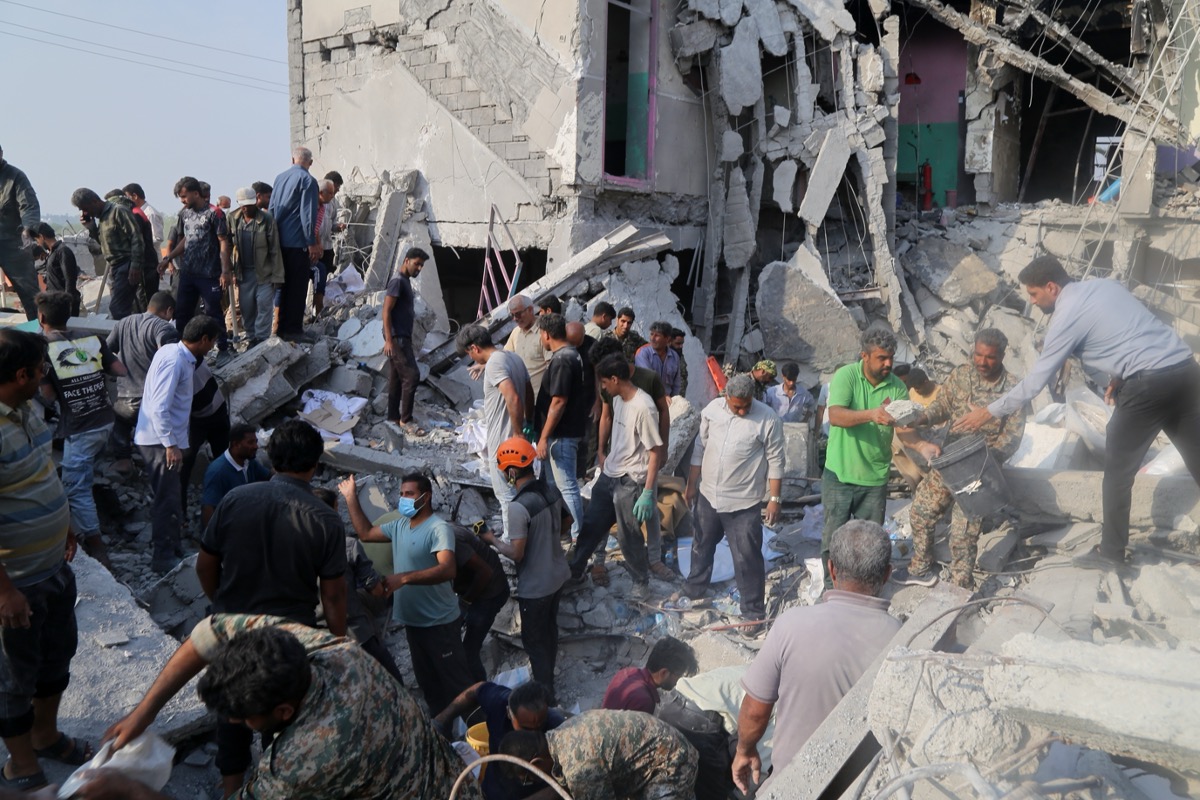
A preliminary U.S. military investigation has reportedly found that the United States was responsible for the February 28 strike on the Shajarah Tayyebeh Elementary School in Minab, Iran, carried out on the first day of the war and killing at least 175 people, most of them children. Emerging reports point to outdated intelligence as the likely cause. If those findings hold, the strike will stand as one of the gravest U.S. battlefield errors in recent decades.
The broader unconstitutional U.S. assault on Iran has also been shadowed by other legally questionable strikes, including an alleged hit on a desalination plant on Qeshm island, which Iranian officials say disrupted water supplies to 30 villages, and reported attacks on healthcare infrastructure. On Wednesday, Iran said over 1,348 civilians have been killed and over 17,000 injured since the beginning of the U.S.-Israeli attacks. At the same time, the war on Iran has been accompanied by rhetoric from the U.S. administration that rejects restraint, including vows of “no mercy” and “death, fire, and fury.”
The School
The core finding is simple and devastating. According to The New York Times, Reuters, and other outlets that cited officials familiar with the inquiry, the school was struck because U.S. Central Command (CENTCOM) used outdated targeting data supplied by the Defense Intelligence Agency (DIA). The building that was hit had once formed part of a nearby Islamic Revolutionary Guard Corps (IRGC) naval compound. But years ago it had been separated from the base and converted into a school. Investigators reportedly concluded that the targeting process failed to account for that change, even though it was clearly visible.
The Times reported:
Watchtowers that once stood near the building had been removed, three public entrances were opened to the school, ground was cleared and play areas including a sports field were painted on asphalt, and walls were painted blue and pink.
In other words, the site bore visible signs of civilian use that should have triggered far more rigorous verification before the strike.
CNN, reviewing the satellite imagery, reached a similar conclusion. The network reported that images from 2013 showed the school and the IRGC base as part of the same compound. But by 2016, “a fence had been erected to separate the school from the rest of the base, and … a separate entrance to the school had been built.” CNN also noted that imagery from December 2025 showed “dozens of people in the school’s courtyard, apparently playing in what appears to be a court for ballgames.”
Reported Double Strike
What followed, if confirmed, would place the attack in even darker territory.
Middle East Eye reported that the school was hit by two separate strikes, and that the second one struck children who were sheltering in a prayer hall after the first attack. “When the first bomb hit the school, one of the teachers and the principal moved a group of students to the prayer hall to protect them,” an Iranian Red Crescent medic told the outlet. He added:
The principal called the parents and told them to come and pick up their children. But the second bomb hit that area as well. Only a small number of those who had taken shelter survived.
So far, U.S. officials have not confirmed that the school itself was struck twice. There has been no public acknowledgment of a second strike on the school building or the prayer hall. Still, the Times reported that, based on its analysis, the nearby IRGC base was struck again within two hours of the initial attack.
The Evidence Outside the Pentagon
Even before details of the Pentagon’s preliminary inquiry began to leak, the public record was already moving toward U.S. responsibility. Reuters reported on March 6 that a U.S. investigation was pointing to American culpability in the school strike. By March 10, Reuters video coverage said experts believed newly surfaced footage showed a U.S. Tomahawk striking near the Minab girls’ school. The Associated Press then reported that a U.S. official familiar with internal deliberations also believed the strike was likely American.
In a March 8 analysis, the open-source investigative group Bellingcat reported:
New video footage shows a US Tomahawk missile hitting an Islamic Revolutionary Guard Corps (IRGC) facility in Minab, Iran, on Feb 28, showing for the first time that the US struck the area.
The video, said the group, “shows smoke already rising from the vicinity of the girls’ school.”
AP’s follow-up reporting reinforced that picture. It independently geolocated the video and matched visible markers in the footage. It added:
U.S. Central Command has acknowledged using Tomahawk missiles in this war and even released a photo of the USS Spruance, part of the USS Abraham Lincoln aircraft carrier group located within range of the school, firing a Tomahawk missile on Feb. 28.
Experts interviewed by the outlet said “the school was probably struck amid a quick succession of bombs dropped on the [IRGC] compound.”
Trump Blames Iran
The political response deepened the scandal.
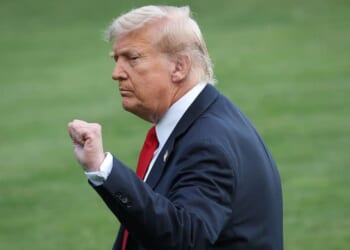
At first, President Donald Trump blamed Iran for the strike. On Saturday, aboard Air Force One, a reporter asked the president whether the United States had struck the school. Trump replied, “No, in my opinion, based on what I’ve seen, that was done by Iran.” The reporter then turned to Defense Secretary Pete Hegseth, who was standing next to the president, and asked, “It was Iran who did that?” Hegseth responded more cautiously: “We’re certainly investigating.” He added, “But the only side that targets civilians is Iran.” Trump then doubled down on his “opinion”:
We think it was done by Iran. Because they are very inaccurate, as you know, with their munitions. They have no accuracy whatsoever. It was done by Iran.
CENTCOM “refused to endorse” Trump’s claim, quoting the ongoing investigation, according to The Intercept.
Tomahawks
During the Monday press conference, Trump retreated from certainty to studied ambiguity. One reporter’s question was especially pointed:
You just suggested that Iran somehow got its hands on a Tomahawk and bombed its own elementary school on the first day of the war. … Why are you the only person [in the government] saying this?
The president responded:
Because I just don’t know enough about it. I think it’s something that I was told is under investigation, but Tomahawks are used by others, as you know. Numerous other nations have Tomahawks — they buy them from us.
“Whatever the report shows, I’m willing to live with that report,” he added.
Trump also said that Tomahawks were “very generic.” He suggested that it could have been “Iran or somebody else” firing them at the school.
Numerous outlets disputed the claim. Antiwar.com reported:
Iran has no Tomahawks, which are not “generic.” Originally developed by General Dynamics and now manufactured by Raytheon, the BGM‑109 Tomahawk is a specific long-range cruise missile designed and produced in the United States. Only two other countries — Australia and the United Kingdom — are known to have Tomahawks in their arsenals, although Japan and the Netherlands have also agreed to buy them.
On Wednesday, when asked about the findings of the military probe and his willingness to take responsibility, the president claimed ignorance, saying, “I don’t know about that.”
The reports stress that findings remain preliminary, and the investigation is ongoing. But the evidence already assembled, from satellite imagery and weapons analysis to the military’s own early inquiry, increasingly points in the same direction: The strike on the Minab school appears to have been carried out by the United States.
The Madness of King Trump: War Games, War Crimes and a Wrecking Ball Presidency