As the unconstitutional war against Iran enters its third week, President Donald Trump has declared that U.S. media outlets could face “charges for treason” for reporting what he called false information about the conflict. The threat came in a lengthy tirade on his Truth Social platform late Sunday. The president accused journalists of spreading fabricated stories about the conflict and amplifying Iranian propaganda.
The threat reflects a familiar wartime pattern, as truth is often the first casualty of war. Governments seek to control the narrative, and reporting that contradicts official claims quickly becomes suspect. In that environment, “fake news” can come to mean little more than news that challenges the government’s version of events.
Under U.S. law, treason carries the most severe penalties in the federal criminal code, including death. The Constitution narrowly defines the crime as levying war against the United States or aiding its enemies. Trump’s statement, therefore, placed his attack on the press within one of the gravest legal categories available to the government.
The president also praised his Federal Communications Commission (FCC) Chairman Brendan Carr for warning that he could pull the broadcasting licenses of media outlets he accused of “running hoaxes and news distortions” in their Iran coverage.
War Reporting
Trump’s threats followed reporting by several outlets about Iranian strikes on U.S. assets. Trump specifically singled out The Wall Street Journal reporting that five U.S. Air Force refueling tankers had been struck during an Iranian missile attack on Prince Sultan Air Base in Saudi Arabia.
Citing two unnamed U.S. officials, the newspaper reported that the aircraft were “struck and damaged,” but not destroyed, and were undergoing repairs.
Trump rejected the report, though he did not dispute its central claims. Instead, he accused the newspaper of spreading false information:
The five U.S. Refueling Planes that were supposedly struck down and badly damaged, according to The Wall Street Journal’s false reporting, and others, are all in service, with the exception of one, which will soon be flying the skies.
The president — who himself often shares AI-generated clips — also accused media organizations of circulating fabricated images and videos. He pointed specifically to a video that appeared to show the aircraft carrier USS Abraham Lincoln engulfed in flames.
“It’s FAKE NEWS, generated by A.I.,” Trump wrote.
He further claimed that Iran was “working in close coordination with the Fake News Media” to distribute such imagery.
The president did not identify any U.S. outlets that had published the video. Fact checkers, including AFP and Full Fact, traced the clip primarily to social media accounts circulating it in multiple languages.
Nevertheless, Trump directed his accusation squarely at the press:
Those Media Outlets that generated it should be brought up on Charges for TREASON for the dissemination of false information.
The president also insisted that the war was proceeding decisively in Washington’s favor:
The fact is, Iran is being decimated, and the only battles they “win” are those that they create through AI, and are distributed by Corrupt Media Outlets.
Notably, despite all the supposed victories, the president had so far declined to claim total victory.
FCC Pressure
Trump’s post then shifted from complaints about specific reports to a broader attack on the U.S. press.
The president praised Carr for suggesting that broadcasters could face regulatory scrutiny over their coverage of the war, writing:
I am so thrilled to see Brendan Carr, the Chairman of the Federal Communications Commission (FCC), looking at the licenses of some of these Corrupt and Highly Unpatriotic “News” Organizations.
Carr had issued a warning the previous day on social media. He argued that broadcasters spreading “hoaxes and news distortions” could face consequences when their licenses come up for renewal. He also invoked the long-standing regulatory standard that broadcasters must serve the “public interest”:
Broadcasters must operate in the public interest, and they will lose their licenses if they do not.
Trump echoed that message while accusing major media outlets of knowingly spreading false information about the war.
“The Radical Leftwing Press knows this full well, but continues to go forward with false stories and LIES,” Trump wrote.
He also argued that broadcasters benefit financially from access to the public airwaves.
“They get Billions of Dollars of FREE American Airwaves, and use it to perpetuate LIES,” the president wrote.
In practice, U.S. broadcast networks do not receive direct payments for using the airwaves. Rather, the FCC licenses portions of the public spectrum to private broadcasters under regulatory conditions, including the requirement that they operate in the “public interest.”
Trump also claimed that Iran has developed sophisticated information operations aimed at shaping Western media coverage of the conflict.
“Iran has long been known as a Master of Media Manipulation and Public Relations,” Trump wrote. “Now, A.I. has become another Disinformation weapon.”
The accusations about Iranian propaganda merged with broader attacks on the American press, reinforcing a clear message: Reporting that contradicts the administration’s narrative is increasingly viewed as disinformation.
Free-speech Concerns
Critics quickly warned that the administration’s language threatened fundamental press freedoms.
Senator Ron Johnson (R-Wis.), a Trump ally, publicly pushed back against the idea of using federal power to pressure broadcasters over their war coverage, risking clashing with constitutional protections. The Hill quotes:
“I am a big supporter of the First Amendment,” Johnson said on Fox News’s “The Sunday Briefing.” “I do not like the heavy-handed government, no matter who is wielding it. … I would rather the federal government stay out of the private sector as much as possible.”
Johnson added that the government’s proper role is not to police speech, but to protect rights.
“The federal government’s role is to protect our freedoms — protect our constitutional rights,” he said.
Democratic lawmakers also condemned the FCC threats, though, of course, their own professed commitment to free speech has been selective. Even so, several Democrats argued that threatening broadcasters during wartime reporting crosses a clear constitutional line.
Senator Ed Markey (D-Mass.) called on Carr to resign over his social media warning about broadcast licenses. In a statement accompanying a letter to the FCC chairman, Markey described the post as “an extraordinary abuse of FCC authority and a clear violation of the First Amendment,” adding that it reflected “the Trump administration’s latest authoritarian attempt to weaponize the FCC’s statutory authority to censor the media.”
Senator Elizabeth Warren (D-Mass.) delivered a similarly blunt response.
“Constitutional law 101: it’s illegal for the government to censor free speech it just doesn’t like about Trump’s Iran war,” Warren wrote. “This threat is straight out of the authoritarian playbook.”
FCC Authority
In his response to Warren, Carr defended his position by pointing to Supreme Court precedent governing broadcast licensing.
“Constitutional law 101: ‘No one has a First Amendment right to a license or to monopolize a radio frequency,’” Carr wrote, quoting the Supreme Court’s Red Lion Broadcasting Co. v. FCC decision, which cited the earlier case NBC v. United States (1943). The ruling held that denying a broadcast license when “the public interest” requires it does not necessarily violate free-speech protections.
Free-speech advocates argued that Carr was misapplying those precedents.
Aaron Terr, director of public advocacy at the Foundation for Individual Rights and Expression (FIRE), pushed back against Carr’s legal argument.
“Constitutional Law 102: The ‘public interest’ does not include retaliating against news outlets because the president doesn’t like their reporting,” he wrote, citing Supreme Court rulings that require broadcast regulation to remain consistent with First Amendment protections.
His organization also reminded of Carr’s own past stance that the FCC had no “roving mandate to police speech in the name of ‘public interest.’”
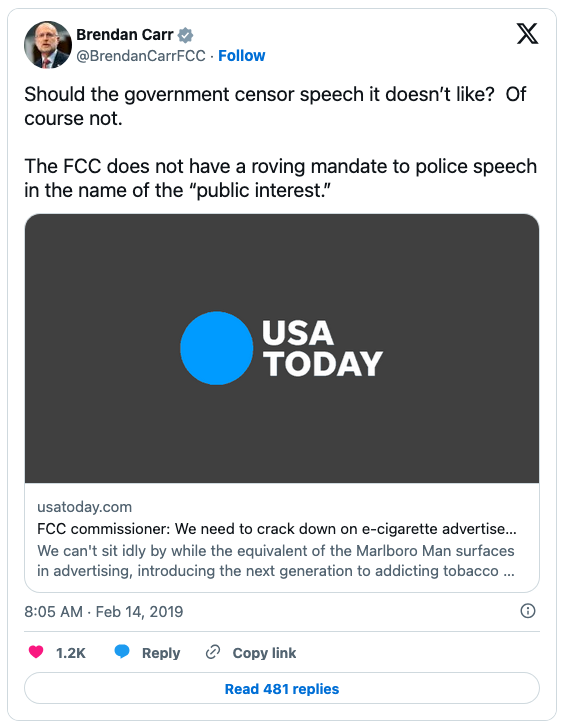
Free Press senior director Timothy Karr responded to Carr by posting the text of the First Amendment.
“Here it is — as it seems you’ve forgotten what you swore an oath to support and defend,” he wrote.
Messaging
The dispute reflects the increasingly volatile relationship between the Trump administration and the press as the Iran war continues to escalate.
At the same time, the president’s own messaging about the conflict has grown increasingly contradictory. He, along with other officials, has alternated between declaring Iran’s military effectively destroyed and warning about threats to the Strait of Hormuz, while also urging foreign governments to send ships to secure the waterway. Further, the administration depicts the operation as a decisive success even as troop deployments expand and economic risks to global energy markets mount. Meanwhile, the president has recently declined to address questions about the deployments and U.S. casualties. Finally, Trump’s account of the apparent U.S. strike on an Iranian school has also shifted. He first blamed Iran outright. But after reports that a preliminary U.S. military probe pointed to American culpability, the president refused to address the findings.
Last but not least, until recently, the administration had considered it “fake news” to “suggest” that Iranian nuclear sites were not “obliterated.”
Defense Secretary Pete Hegseth declared last June:
Based on everything we have seen — and I’ve seen it all — our bombing campaign obliterated Iran’s ability to create nuclear weapons.
Yet seven months later, Trump claimed Iran’s “attempt” to rebuild the program was one of the justifications for the new war.