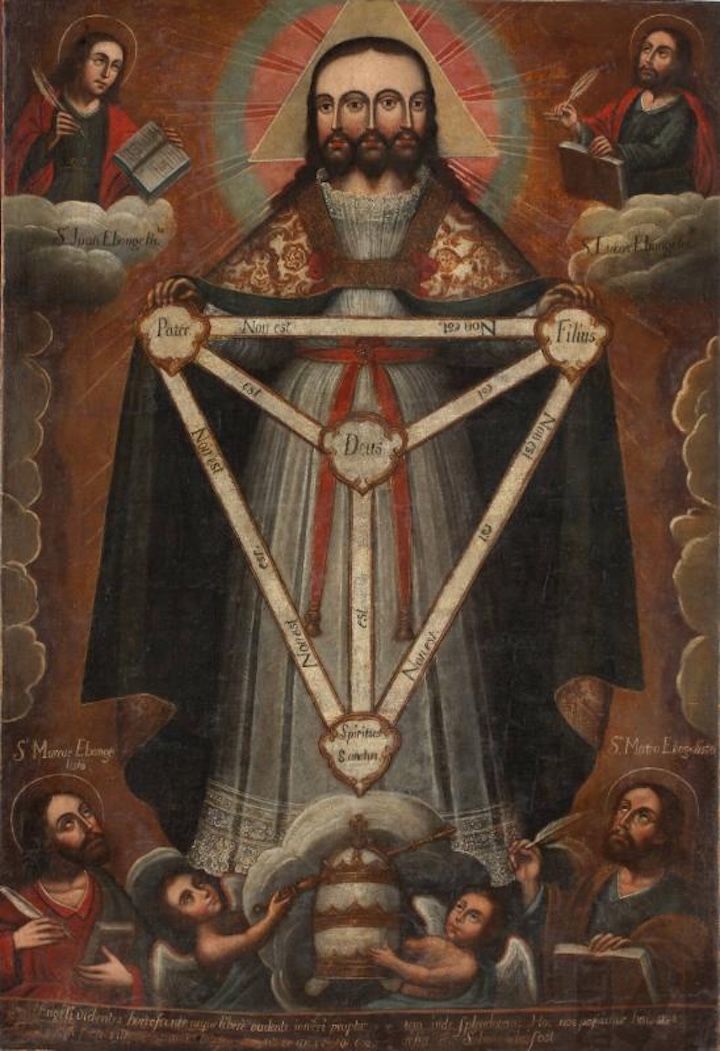
Augustine admits in Confessions that when he was young, he did not like the Scriptures; he found the language ugly and uninspiring. He preferred Cicero and Virgil. Worse yet, some things in the Scriptures caused him to think Christianity was ridiculous. Who would be so naïve as to think that God has a right hand? God doesn’t have a body! What a bunch of rubes Christians must be.
It was not until he got older that he realized that the Scriptures made use of figures of speech, metaphors, analogies, and other poetic devices. Christians don’t believe that God has a physical right hand; rather, this is an image suggesting the intimate union between the Father and the Son.
He had been laughing at Christians when he was the ignorant one whose pride had blinded him to the richness of Biblical language and imagery. “My inflated pride shunned their style,” he writes, “nor could the sharpness of my wit pierce their inner meaning. Yet, truly, were they such as would develop in little ones; but I scorned to be a little one, and, swollen with pride, I looked upon myself as a great one.”
It is not uncommon for people who pride themselves on their scientific sophistication to find the Church’s manner of speaking, especially in the liturgy, bizarre, perhaps even childish, something acceptable only to unsophisticated people who believe whatever they’re told, no matter how ridiculous.
I can imagine someone of this mindset asking: “Do you really think that there are choirs of angels ‘soaring aloft upon their wings,” singing ‘Holy, Holy, Holy’?” As an adult convert, I can understand how skeptics from outside the Church might view this sort of language. It seems like something out of a children’s book, like talking about Harry Potter’s “sorting hat” or flying on a Hippogriff. Fine for children, but not for serious adults.
Since we live in what is largely a dull, unpoetic “information age,” I understand why the Church’s language might seem this way. But perhaps there are things that simply can’t be said in ordinary speech of the sort one gets in the newspaper or the latest magazine article. Perhaps some things simply transcend our normal, everyday ways of speaking and require a different mode of discourse, one that communicates realities that transcend our usual ways of speaking and writing – as when Robert Frost says:
The land was ours before we were the land’s.
She was our land more than a hundred years
Before we were her people.
Or when T. S. Eliot writes that,
We shall not cease from exploration
And the end of all our exploring
Will be to arrive where we started
And know the place for the first time.
Or when the Psalmist proclaims:
The LORD is my shepherd; there is nothing I shall want.
In verdant pastures he gives me repose;
beside restful waters he leads me;
he refreshes my soul.

If you don’t “get” the many ways language signifies – if, for example, you don’t “get” poetic speech, and it seems like a bunch of meaningless twaddle – then you probably won’t “get” the language of the Scriptures and the liturgy. Much of it will likely seem as silly to you as it did to St. Augustine when he imagined that Christians thought God had a physical body.
I could say, the phrase “at the right hand of the Father” means that the Risen Christ is intimately united in the oneness of Being with the One from whom He, the second “person” of the Trinity, is eternally generated, being loved fully and eternally and loving fully and eternally in return. But that’s not better.
That language might have a useful role to play to help us better understand the language with which the faith has been expressed to us. But after we have used the more “scholarly” words to explain those Biblical and liturgical words, it’s usually best to return to the original words and phrases as clearer, more beautiful, and probably closer to the truth.
In poetry, it is not wrong to express the meaning of the words in your own words, to “unpack” them, as it were. But once the “unpacking” has gotten to a certain point, it is important to read the poem again and just let those words echo in your soul.
It is said that Robert Frost was once asked what one of his poems meant, to which he replied: “So you want me to tell you what the poem says in different and worse words.” If there had been a better way of expressing it, the poet would have expressed it that way. If there had been a better way of expressing it, God would have expressed it that way.
So, if someone asks me, “Do you think that there are really hosts of angels circling around God singing ‘Holy, holy, holy?” my response is: Yes.
But by this, I mean two things. First, my honest belief is that, if I am lucky enough to experience this reality, I will likely say, “Hmm, you know, I don’t think there was a better way of expressing what I’m seeing. I mean, it’s so far beyond anything that could be imagined, but if you had to put it into words, I suppose that’s probably about as good as you could do.” The second thing I can say is that I believe in the truth of whatever reality those words are pointing towards, though I have no doubt the reality goes far beyond what my mind can grasp.
Using images that we know and have experienced concretely in our earthly lives, this is a language meant to point us heavenward. Our challenge is to let it sweep us up and help propel us on that heavenward journey, so that, when we arrive, we can say: “Oh, it’s like this? But of course it is! This makes perfect sense of what we read and heard, but couldn’t yet see or understand.



![Hegseth Demands Fitness Requirements, Says 'Fat Troops' 'Not Who We Are' [WATCH]](https://teamredvictory.com/wp-content/uploads/2025/09/Hegseth-Demands-Fitness-Requirements-Says-Fat-Troops-Not-Who-We-350x250.jpg)