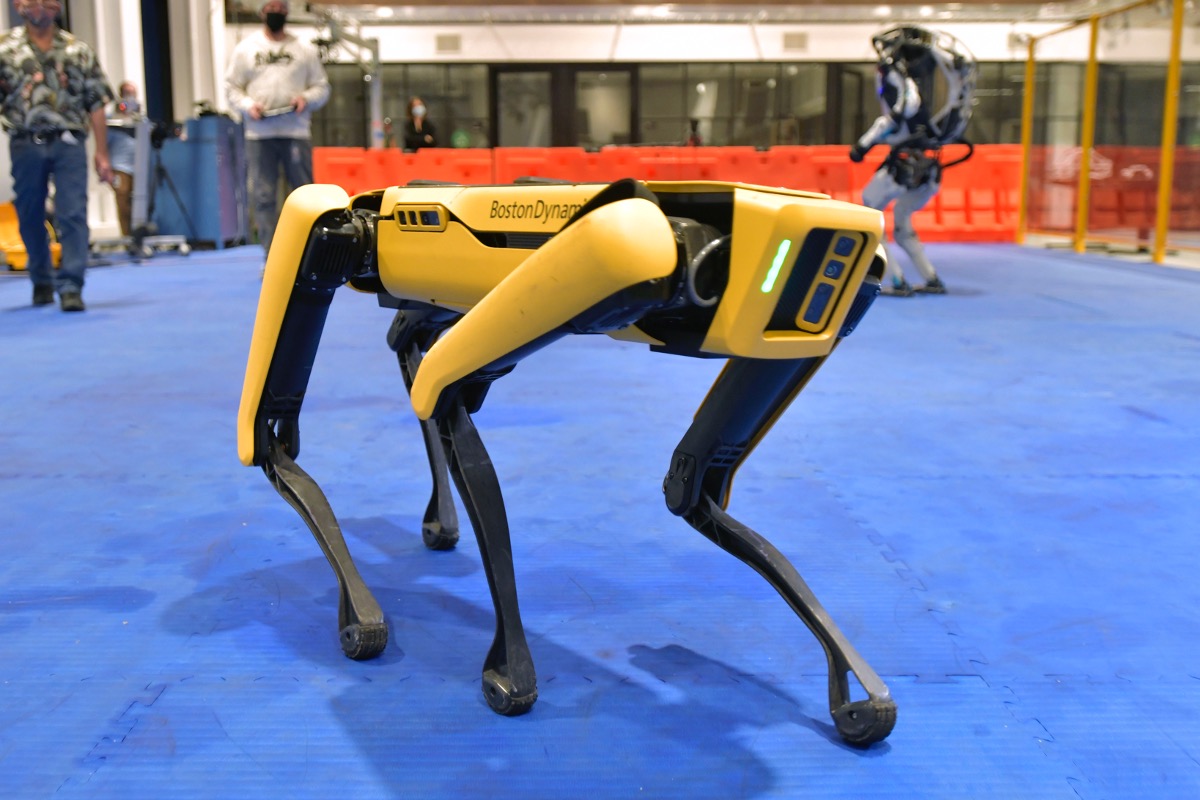
As Americans grow wary of rapidly expanding data centers, with grassroots protests and legislative and regulatory responses spreading from Northern Virginia to rural Oregon, operators are rolling out a distinctly dystopian fix: robot dogs, tireless metal sentries pacing the perimeters of sites that are quickly becoming the backbone of the digital economy, governance, and surveillance.
Guarding Data Centers
The AI boom has triggered one of the largest infrastructure expansions in modern tech history. Driving this surge are massive public and private investments. That includes the $500 billion Stargate Project unveiled by President Donald Trump at the start of his second term. Stargate is a joint venture backed by OpenAI, SoftBank, Microsoft, Oracle, and other companies to deploy AI-focused data-center infrastructure across the United States. The buildout was also accelerated by the One Big Beautiful Bill Act, which expanded federal support through funding, grants, and tax incentives for companies investing in data centers and related digital infrastructure.
And so, sprawling data-center campuses are mushrooming at a relentless pace. As local communities push back against the immediate harmful impacts of these behemoths (more on that later), operators are looking to ramp up security measures.
As reported by Business Insider, robot dogs, or quadrupeds, are emerging as security and monitoring systems that “can patrol fences, inspect equipment, and flag any issues before they turn into costly outages.”
Boston Dynamics, the company behind the robot known as “Spot,” has seen a sharp rise in interest. Merry Frayne, senior director of product management, told the outlet:
We’ve seen a huge, huge uptick in interest from data centers in the last year, I’d say, which is probably not surprising given the investment in that space.
The sheer scale of these facilities helps explain the shift. Modern hyperscale campuses swallow up hundreds of acres, draw hundreds of megawatts to over a gigawatt of power, and operate as sprawling, multi-building sites designed to run continuously. Monitoring every corner of these environments in real time is not just difficult. It is a persistent operational challenge that may be increasingly handed off to machines.
The Business Case Behind the Machines
The appeal is both technological and financial.
Boston Dynamics says its robots typically cost between $175,000 and $300,000, depending on the sensors and capabilities attached. Ghost Robotics, another major player, offers its Vision 60 model starting at around $165,000. At first glance, that price may seem steep. But operators increasingly compare it not to a single salary, but to the cost of maintaining continuous, around-the-clock security coverage.
Ghost Robotics executive Michael Subhan told Business Insider that a single guard can cost roughly $150,000 per year, adding,
So we look at that [return on investment] — instead of having two guards at $300,000, you can have one guard and a robot. And the robot obviously doesn’t get sick or go on vacation and things like that.
In reality, typical guard wages are far lower. According to ZipRecruiter, most data-center security roles fall between $35,500 and $38,000 annually, with an average around $48,000. And while wages tell one story, employment also anchors people within local economies and communities, something a machine cannot replicate. Nonetheless, cost-efficiency tends to drive decision making.
“Typically, our customers see a payoff within two years,” Frayne said, noting that some recover costs even faster when operational savings are factored in.
Indeed, robots can do more than patrol fences. Inside facilities, they can scan for heat anomalies, detect leaks, identify unusual sounds, and even spot doors left open.
Still, companies are careful to frame the technology as an “enhancement” rather than a replacement. Human operators remain in the loop (at least for now), monitoring live feeds and making decisions.
Deployment remains limited, but the direction is clear. Per Business Insider:
“There are 5,000 data centers in the US alone, 800 to a thousand new data centers being built currently,” Subhan said. “So we see that as a large market for us.”
The Growing Backlash
While the industry expands at breakneck speed, resistance is building just as quickly, especially in communities directly affected by large-scale data-center projects.
The protests now stretch from Virginia (the world’s largest concentration of data centers in the suburbs of Washington, D.C.,) to Oregon, Arizona, Texas, Georgia, and Nevada. Reports say that residents in Virginia, Pennsylvania, North Carolina, and other states have successfully delayed or shut down proposals for new sites, signaling that opposition is no longer fringe, but increasingly organized.
The concerns vary by region, but follow a familiar pattern. In Virginia, residents point to noise, land use, and the rapid industrialization of suburban communities. In Oregon and Arizona, water consumption has become a flashpoint. Strain on the power grid and zoning decisions dominate the debate in Texas and Georgia.
Across these states, the underlying tension remains the same. Data centers promise investment, employment, and digital infrastructure powering the “modern” economy. But they place heavy demands on land, water, and energy, often delivering little to no benefits in return. Adding to the concerns, at least 37 states offer incentives to attract these facilities, including sales-tax exemptions and property tax abatements, raising questions about who ultimately benefits from the buildout. For many, the issue cuts across political lines. Jennifer Corpus, an organizer of protests in Virginia, said:
It’s actually been a unifying issue that we haven’t really seen before in a long time, because regardless of whether you’re a Republican or a Democrat, you just don’t want it.
Local lawmakers are beginning to respond. Good Jobs First, a watchdog group focused on economic-development incentives, reports that lawmakers in at least 12 states have introduced legislation this session to temporarily restrict or pause new data-center development, while other states consider executive actions and many cities and counties weigh their own local limits.
Trump Unveils $500 Billion “Stargate” AI Project, in Line With WEF Agenda
Is Trump Building the North American Technate?
U.S. Robotics Firms Lobby Congress for National Robot Strategy
The Great Worker Replacement? Trump Admin Turns to Humanoid Robots for Productivity
We Must Stop the Growing AI Threat to Our Freedom
“Paw Patrol”: DHS Testing Robot Dogs to Guard Southern Border