The U.S. Supreme Court ruled unanimously in favor of a street preacher who argues a city ordinance unconstitutionally prevents him from sharing his Christian faith in public.
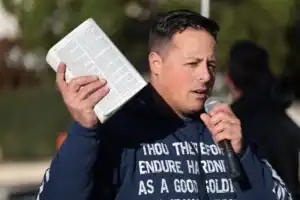
The Supreme Court ruled 9-0 in Olivier v. City of Brandon that Gabriel Olivier can challenge Brandon, Mississippi’s ordinance that restricts “expressive activity” – and therefore, Olivier’s evangelism – near a public amphitheater.
“This is not only a win for the right to share your faith in public, but also a win for every American’s right to have their day in court when their First Amendment rights are violated,” said Kelly Shackelford, president, CEO, and chief counsel for First Liberty Institute. Olivier is represented by First Liberty.
Olivier, an evangelical Christian, often stands outside of well-attended events and shares the gospel with as many people as he can. But the city of Brandon, Mississippi, adopted an ordinance that limits speech inside a small, designated “protest zone” that is far away from crowds, limiting his ability to communicate.
In one incident, Olivier disregarded the protest zone and moved closer to the crowds so he could reach more people. As a result, the city arrested him. He paid a $304 fine and was released, serving no prison time.
First Liberty published a video explaining more about Olivier’s story, which you can watch below:
Olivier subsequently challenged the law in federal court, alleging the city ordinance violates the First Amendment’s free speech clause. The district court, however, dismissed his case. The court agreed with the city’s argument that an individual previously convicted of violating a statute cannot challenge its constitutionality under federal civil rights law (§1983).
It relied on a Supreme Court decision in Heck v. Humphery that prohibits prisoners’ use of §1983 to challenge the validity of a prior conviction to obtain release from custody or monetary damages.
The U.S. Court of Appeals for the 5th Circuit affirmed the district court’s judgement.
In its decision, the Supreme Court reversed the lower court ruling and allowed Olivier’s suit challenging the city ordinance to proceed. The Court said its Heck precedent “has no bearing on Olivier’s suit seeking a purely prospective remedy.”
Justice Elena Kagan, who authored the Court’s opinion, said, “Olivier is seeking … ‘wholly prospective’ relief – ‘only to be free from prosecutions for future violations’ of the city ordinance.”
Olivier can “sue … to enjoin future prosecutions under the city ordinance, despite his prior conviction,” Kagan said. Otherwise, Olivier would be placed in a “dilemma” to either “flout the law and risk another prosecution, or else forego speech he believes is constitutionally protected.”
Olivier’s case will now go to trial in the district court where he will argue the ordinance violates the free speech clause.
“No American should be criminally charged for sharing their faith in public,” said Nate Kellum, senior counsel at First Liberty. “This is a wonderful day for Gabe and for the First Amendment.”
“My goal from the beginning was to be granted my rights as an American citizen under our great Constitution,” said Olivier. “Now all people with deeply held Christian religious beliefs who are called to share the good news can do so in the public arena.”
The case is Olivier v. City of Brandon.
Related articles and resources:
Supreme Court To Hear Evangelist’s Religious Freedom Case
U.S. Supreme Court Will Hear Case of Evangelist Banned From Sharing His Faith
Photo from First Liberty.