Science is an odd theme to choose on the brink of Holy Week. Or maybe not so odd. In a way, science is miraculous. It’s an expression of man’s dignity and genius. It offers our species two deep satisfactions: the joy of discovering how the world works, and the means of using what we learn to improve our lives and the lives of others. It also seems to answer the “why” of things. Why do colliding atoms produce energy? Why can enough of that energy, properly channeled, vaporize an entire city like Hiroshima? And why can we even wonder about such things?
The first two questions are really disguised versions of “how.” To the third question, science will likewise offer a very reasonable theory of evolution: the route from chemicals in a primordial soup to the contents of a Tiffany’s display window. It will explain why those chemicals might combine and morph; why some of them ended up as wildly expensive diamonds; and why those diamonds trigger favorable biological responses in the mating dance of a uniquely intelligent animal. But genuine science has the modesty to know its own limits; to acknowledge and respect other paths to truth and human fulfillment.
Thus, when it comes to questions of why, science won’t – because it can’t – answer the Big One: Why is there anything instead of nothing?
The above has already been said by others, many times. But it’s nonetheless worth noting a point made by the social scientist Christian Smith in Moral, Believing Animals. There are no “non-believers.” That includes hardcore atheists. We all believe in something. We all, first and often unconsciously, make a foundational assumption about the nature of the world based on our instincts, preferences, or experiences. We then build a rational framework on top of it to answer and engage the “whys” of life. As it happens, some choices are better, and some worse, than others.
Scientism, for example, is not science. It’s a materialist philosophy about nature dressed in scientific vestments. It’s animated by the belief – a confident leap of faith – that reality is purely material “stuff” and processes. It assumes that science, at least theoretically, can someday unlock all or most of what there is to know. Thus we can properly accept an implausible but very real thing like superposition in quantum physics: the fact that a quantum particle can be there and not there, in the same place, at the same time. Nature, after all, is mysterious. But a virgin birth? A resurrection from the dead? Biblical nonsense.
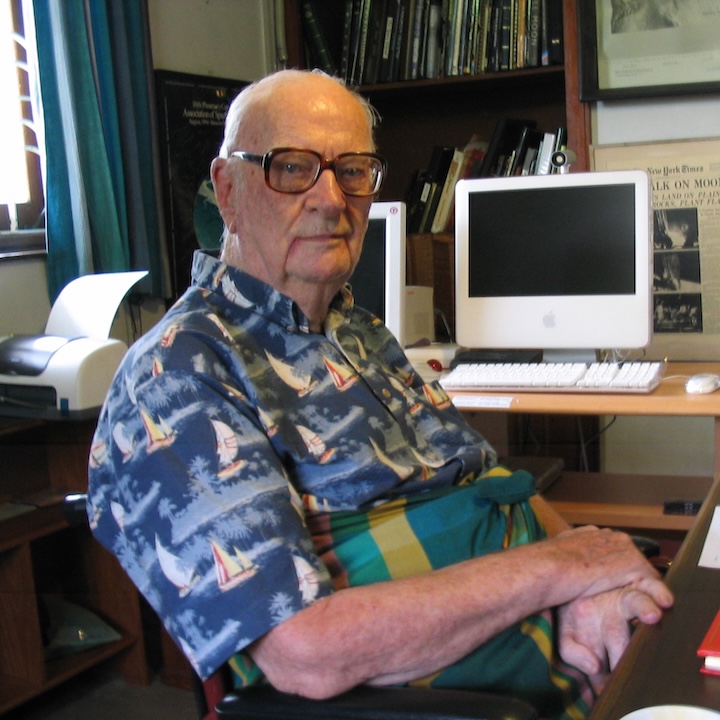
Here’s the irony. Intellectual vanity is good news for a gifted writer. It makes a great target. Which is why the work of Arthur C. Clarke, himself a committed atheist, could draw praise from the likes of C.S. Lewis. In the early 1950s, Clarke produced a story – “The Nine Billion Names of God” – that’s unforgettable and especially relevant to our reflections here.
The plot is simple. A Buddhist monastery high in the Himalayas contacts an American computing firm. The monks hire two of its engineers, who then travel to install and run a computer on site. This will drastically speed up a project the monastery has been working on for 300 years: listing the nine billion names (claim the monks) of God. The engineers think this foolish. But the pay and food are good, the monks welcoming, and the scenery stunning, By day the world is endless, astonishing mountains. By night the sky is a carpet of intensely beautiful stars.
The deeper “why” behind the project eventually becomes clear. When all of God’s names are collected and codified, man’s purpose (again, as the monks believe) will be completed, and Creation will end. The engineers suspect that when the world doesn’t helpfully disappear, the monks will be unhappy – very unhappy – with them. So on the night the project nears conclusion, they slip away on horseback for the long trek to an airfield far below, and the trip back to reality. They chat affably on the way down. Then one of them falls silent. And they look to the sky.
Above them, one by one and without any fuss, the stars go out.
So what’s the lesson for Holy Week? There are two.
First, in Job God asks, “Where were you when I laid the foundation of the earth?” (38:4 ) The answer is easy: nowhere. We’re the dust into which he breathed life. We owe him everything. Isaiah 55:8-9 reads, “For my thoughts are not your thoughts; neither are my ways your ways says the Lord. For as the heavens are higher than the earth, so are my ways higher than your ways, and my thoughts higher than your thoughts.” God owes us nothing, least of all an explanation for everything he does. We have five senses that together resemble a small glass: It’s precious in value, but can’t hold the ocean of the real. Yet God loves us and calls us back to him even when we pretend to be gods ourselves. He gives purpose to our lives and meaning to the world. He fills Creation with a symphony of beauty, glory, and harmony.
Second, John 3:16 reads ““For God so loved the world that he gave his only begotten son, that anyone who believes in him should not perish but have eternal life.” In John 11:25, Jesus says, “I am the resurrection and life.” And in John 14:6, Jesus says ,“I am the way, the truth and the life; no one comes to the Father but by me” No matter how many names humanity uses, there is finally only one God: the God of Israel and his only begotten son, our redeemer, Jesus Christ. Jesus is God’s Word made flesh, who died and rose again for our salvation.
The Hebrew root word for holy (kadosh) means “other than.” We’re meant to be other than the ways of the world and worthy witnesses to God’s love. May we remember and truly live that, next week and beyond.