The Terri Schiavo case was a tipping point in this country’s morality. Before her death, people couldn’t believe we dehydrate cognitively disabled people to death. Afterwards, majorities supported such actions. But that doesn’t remove the bite of injustice inflicted in the name of compassion on Terri and her blood family. If we are ever to a return to a more just society that cares for the most vulnerable among us rather than seeing their deaths as beneficent, it is important to keep the story straight.—Bioethicist Wesley J. Smith.
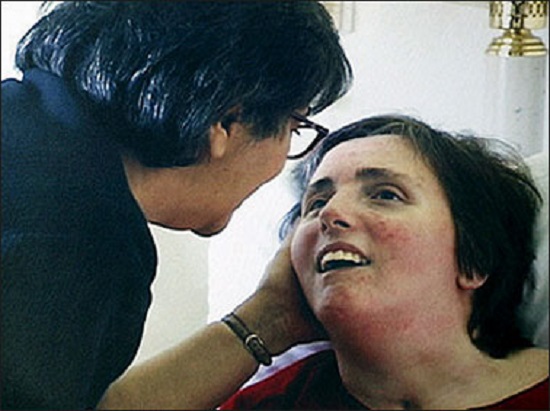
Terri has frequently been described as being in a “vegetative” state, but that is not accurate; she was known to show awareness of her surroundings and respond to the people around her. Videos of her being examined are still available on YouTube; you can see Terri following verbal commands and responding appropriately. Terri did need to be fed through a tube, but she was not sick or dying. She had no condition, beyond her disability, that would have caused a premature death. —Cassy Fiano-Chesser.
Follow LifeNews.com on Instagram for pro-life pictures and videos.
For a time Terri did receive rehabilitation. The whole fight between the estranged husband and the Schindler family kicked into overdrive when Michael Schiavo decided to stop the rehabilitation therapy.
And, for the record, the family adamantly insists Terri was not in a PVS.
Finally, as a perfect illustration of how [New York Times reporter Clyde] Haberman gets everything backwards, about Dylan Thomas’ great poem, “Do Not Go Gentle into That Good Night.” It is not about “going gently” into any night—good or otherwise—but fighting ferociously until the very end—exactly what Terri’s parents and siblings did on her behalf.
It would almost be impossible to misrepresent the “legacy” of Terri Schiavo any more completely than has Mr. Haberman.—Dave Andrusko
Tomorrow will mark the day exactly 21 years ago that the whole pro-life world witnessed the end to the excruciating death of Terri Schindler Schiavo. In person or through publications such as NRL News, it was like watching her slow, drawn out starvation death in slow motion.
It was horrible.
As I do every year, I reflect back at what I first wrote 21 years ago. I remember thinking at the time that whenever I looked at Terri wasting away, I could never, ever get another death by starvation out of my heart and mind.
You might think that when your life revolves around trying to stem the anti-life tide that has swept away over 65 million unborn lives, the power of individuals cases—instances where the fate of one human life hangs in the balance—would be diminished.
You could not be more wrong.
Let me take you back to 1982 and talk about a baby’s death that haunts me to this day.
I had been at National Right to Life only few months when the case of an Indiana baby— “Baby Doe”— became a topic of intense debate. As the 1983 letter to the Movement that we reprinted in NRL News from President Reagan explained, when this little boy was born, he needed only routine surgery to unblock his esophagus which would allow him to eat.
Except Baby Doe had Down syndrome.
“[A] doctor testified, and a judge concurred, that even with the physical problem corrected, Baby Doe would have a ‘non-existent’ possibility for a ‘minimally adequate life,’” the President wrote. “The judge let Baby Doe starve and die, and the Indiana Supreme Court sanctioned his decision.”
As I wrote at the time,
“Up until the time that tiny newborn baby died of starvation, I took my pro-life commitment very seriously but impersonally. Baby Doe’s unnecessary death forever changed that for me, and I’m sure for many others as well.”
I did not learn of Baby Doe’s plight until near the very end of his very brief life. It was the exact opposite with Terri Schindler Schiavo’s ghastly ordeal.
When Terri died on March 31, 2005, having been denied nourishment for 13 agonizing days, the 41-year-old’s starvation death brought to an end—in one sense, at least—a tumultuous, eleven-year battle between the Schindler family and Terri’s estranged husband, Michael.
The Schindler family waged their courageous fight in multiple courts, in the Florida legislature, in the halls of Congress, until January 24, 2005, when the United States Supreme Court rejected an appeal from Florida’s then Governor Jeb Bush to reinstate “Terri’s Law.”
The law had been passed by the Florida legislature in an emergency session in October of 2003, signed into law by Gov. Jeb Bush, and intended to protect Terri Schindler-Schiavo from a hideously painful death by starvation and dehydration.
It is enough to say that, as the saying goes, if truth is “the first casualty in war,” then long before the campaign to starve and dehydrate Terri to death succeeded, all the important details had been thoroughly distorted.
Virtually nothing—her true medical condition (Terri was falsely described as being a “persistent vegetative state” and/or “brain dead”); what she alleged would have “wanted” (to die this horrible death); her condition after 11 days (described by her estranged husband’s attorney as “peaceful,” “beautiful,” and/or “free of pain”)—was within hailing distance of the truth.
Her death unleashed a powerful tsunami of pseudo-scientific gobbledygook all with the same objective of starving helpless patients to death. But the path was first blazed by the likes of the late bioethicist Daniel Callahan who in 1983 was the director of the incredibly influential Hastings Center. In “On Feeding the Dying,” he wrote, “The denial of nutrition may become the only effective way to make certain that a large number of biologically tenacious patients actually die.’”
Let me repeat that last line: “The denial of nutrition may become the only effective way to make certain that a large number of biologically tenacious patients actually die.”
Maybe the best way to end these remarks is to quote from pro-life President George W. Bush who worked hard on behalf of the Schindler family:
“The essence of civilization,” he said, “is that the strong have a duty to protect the weak.”
LifeNews.com Note: Dave Andrusko is the editor of National Right to Life News and an author and editor of several books on abortion topics. He frequently writes Today’s News and Views — an online opinion column on pro-life issues.