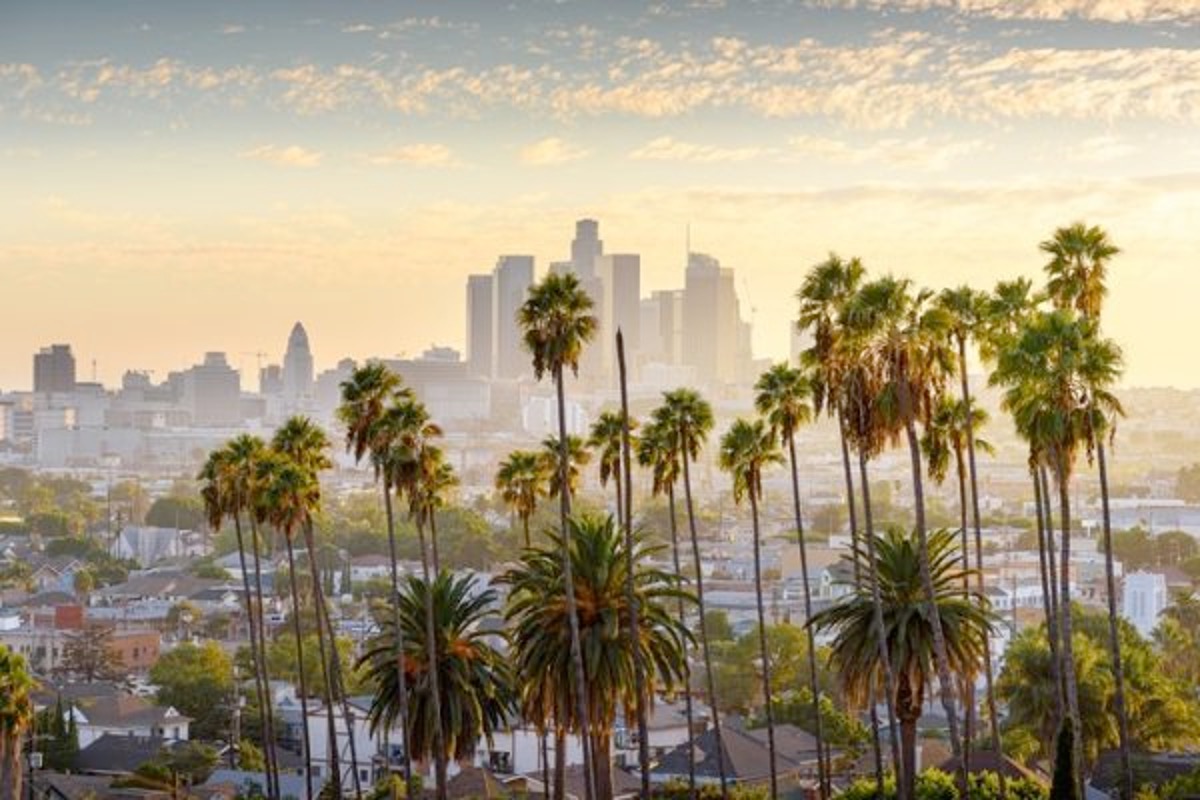
Will our second-largest city follow our largest in electing a socialist mayor? This may well be the case if a new poll is to be believed. It’s not just that it shows socialist Nithya Raman in the lead in Los Angeles’ mayoral race. It’s also, even more shockingly, that almost 50 percent of the metropolis’ residents want a “Democratic Socialist” leading the city.
Of course, what percentage of that percentage even knows what a socialist is was not reported.
The New York Post covered the story Tuesday, writing:
The poll, conducted by Loyola Marymount University [LMU] from February 11 to March 16, also puts incumbent Karen Bass second in the upcoming mayoral race at 17% of the vote, after progressive councilmember Nithya Raman, a member of the hard-left Democratic Socialists of America, listed at 32.5%.
About 47.7% of voters wanted a socialist in charge ahead of other listed types of candidates, such as a “moderate, business-oriented Democrat” and “conservative political outsider,” according to the poll.
A Little Knowledge?
Fernando Guerra, director of LMU’s Center for the Study of Los Angeles, told radio station KPCC that they took a different tack with this poll.
“‘Most polls, they just give the [candidate’s] name,’ Guerra said,” the Post also relates. “We kind of educated the voter before we asked, ‘Who would you support?’”
“‘All we’re trying to do is simulate what would happen with a little bit of education about these candidates,’ he added.”
The operative words, however, are “a little bit.” And what is said about “a little bit of knowledge”?
It’s dangerous.
This is never truer than in this case, too. As the Post further tells us:
Even the question asking about having a democratic socialist mayor is shaky, Morris Levy, a [University of Southern California] political science professor, told the Post. Labels such as “Democratic Socialist” are still likely unfamiliar to many voters, he said, while wordings of the alternatives, such as “establishment,” lessen their appeal.
Yet this understates the case. The reality is that the label “socialist” is very familiar to many voters.
The problem is that what it actually means is very unfamiliar to them.
To illustrate the point, consider a 2025 CATO Institute/YouGov poll. It found that among older Zoomers (Gen Zers aged 18-29), 62 percent have a favorable view of socialism. The kicker:
Thirty-four percent have a positive view of communism.
(You can bet, too, that an inordinate percentage of the socialism-craving Angelenos are Gen Zers.)
Branding
This sounds bad — and it is — yet there’s more to consider.
Approximately 47 percent of these Zoomers also voted for President Donald Trump. Explanation?
In polls such as LMU’s and CATO/YouGov’s, “socialism” is not defined. (Hence, a little knowledge.)
The respondents could imagine the ideology is whatever their fantasies dictate. So when they say they support it, they’re not thinking of failed socialist states, such as Venezuela. They don’t know that communists generally call themselves socialists. (And when they do support communism, they usually don’t know about its trail of dead bodies and killed economies.)
They just know that socialism seems social and communism sounds communal. “It’s about helping people, right?” Yeah, branding matters — a lot.
In keeping with this, imagine there were the following candidate option in the LMU poll. “I’m a Democratic outsider who believes in ‘economic freedom,’” the latter being a more electorate-palatable synonym for “capitalism.” (I know, trying to find such a Dem in California is like finally locating Bigfoot.) I suspect such a candidate might poll fairly well.
The bottom line, however, states the aforementioned Professor Levy, is that polls “show that ‘socialism’ has not only lost its stigma but in fact has a positive valence among many Democratic voters.” There’s a problem here, too:
This does reflect a deeper reality — something beyond branding.
More Than Skin Deep
No, most of these socialism-affinity voters wouldn’t knowingly visit a Soviet-style government upon themselves. (Heck, the Russians didn’t knowingly choose it in 1917.) Yet it’s not just that they could ignorantly stumble into horrid governance via ill-informed ballot decisions. It’s that as the Post points out, Los Angeles really has moved “left” in recent decades. Many Angelenos do want uber-big government and oodles of freebies. How did this happen? It’s multifaceted.
In 1993, LA (and New York City) elected a Republican mayor. But the city has changed markedly — starting well before then.
Just consider demographics, a significant factor because race and ethnicity are good proxies for voting patterns. For example, Republicans still derive approximately 84 percent of their votes from non-Hispanic whites. (Note: Trump’s elections are not included in this analysis because he’s an unusual figure who draws inordinate minority support.) Insofar as non-whites/Hispanics go, about 60-65 percent vote for Democrats.
Now, Los Angeles was 60-percent-plus non-Hispanic white in 1970; this number stands at around 29 percent today. So LA is now a “majority-minority city,” with the largest group being Hispanics (47 percent).
Related to this, immigrants constituted 14.6 percent of LA’s population in 1970; the current figure is approximately 36.3 percent. And immigrants, especially the non-white ones numerous in LA, break Democratic. Remember here, too, that many of these people hail from socialism-leaning nations (e.g., Mexico). And people don’t magically relinquish their ideology upon stepping on U.S. terra firma.
Put simply the city’s demographics over the last many decades have changed in a decidedly Democratic/left-wing direction. (NYC has likewise transformed — ergo Mamdani.) Why do you think it’s said that “demography is destiny”?
Then There’s This…
“It is ordained in the eternal constitution of things that men of intemperate minds cannot be free,” warned philosopher Edmund Burke. “Their passions forge their fetters.”
It’s well known that most voters aren’t exactly conversant with the issues. Consequently, they’re casting ballots based on what — or who — “feels right.” But what pleases them emotionally, viscerally, is determined by their sense of virtue (of goodness).
And this sense, forged during formative years, can change in a population. In our case it has, too.
As I explained in February and previously (click and see page 25), there’s a link between being a low-virtue person (LVP) and leftism’s embrace. And our corrupt, and corruptive, popular culture, media, and education (abetted by permissive parenting) breed LVPs. They are heavily represented among both immigrants and legacy Americans, too.
The bottom line is that today’s leftism is not truly an ideology. Rather, it represents movement toward moral disorder — it’s enabled, too, by those with disordered thinking. And the City of Lost Angels may just become Exhibit B in this tragic process.



![Hegseth Demands Fitness Requirements, Says 'Fat Troops' 'Not Who We Are' [WATCH]](https://teamredvictory.com/wp-content/uploads/2025/09/Hegseth-Demands-Fitness-Requirements-Says-Fat-Troops-Not-Who-We-350x250.jpg)