
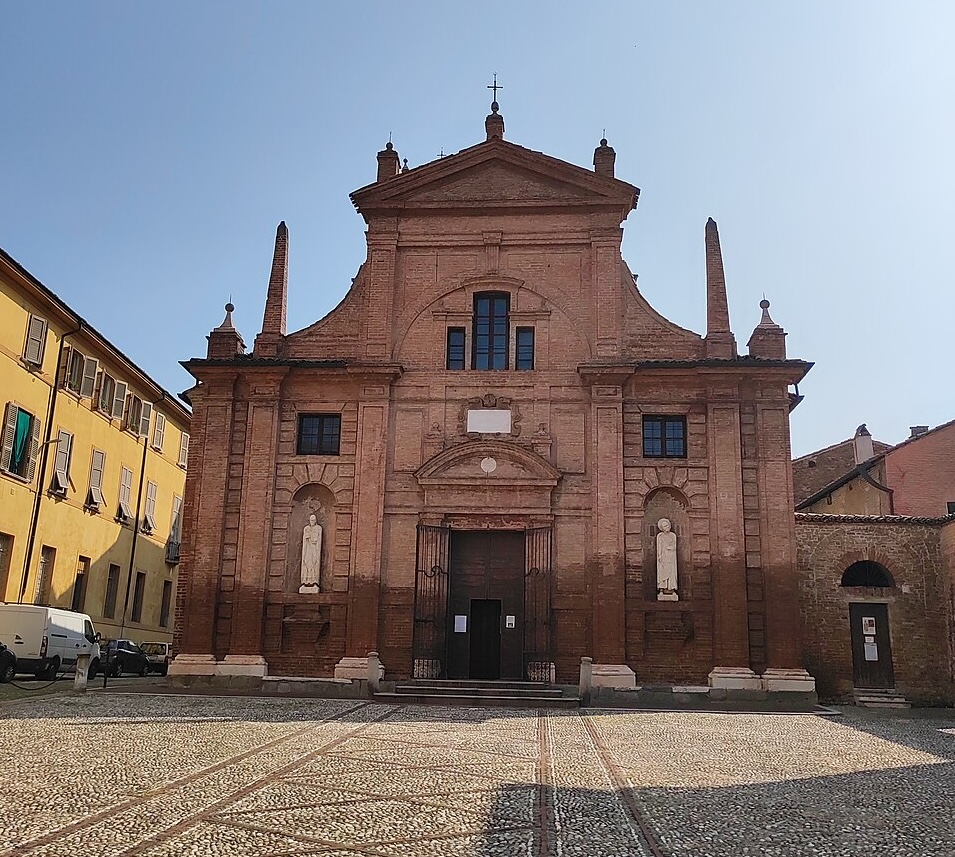
The figure of Omobono of Cremona occupies a peculiar place in Catholic history and Christian moral imagination. He is neither a monk nor a prince, neither a martyr nor a theologian, but a working merchant in a city whose life was already shaped by money, exchange, and competition. That he should have been canonized by Pope Innocent III at the close of the 12th century is not incidental. It represents a deliberate intervention into a longstanding tension within Christian thought: the uneasy relationship between commerce and the moral life.
That tension had deep roots. Western Christian tradition had long been aware that economic exchange, while necessary, was morally perilous. The merchant stood at a crossroads where legitimate gain and illicit advantage could easily blur. The simple logic of buying low and selling high was not in itself condemned, but it raised questions about justice: What is a fair price, and how is it determined? How does one guard against deception when exchange becomes impersonal? How does one resist the gradual habituation to self-interest that commercial life can cultivate?
These concerns were not merely theoretical. They were sharpened in the High Middle Ages by the revival of cities and the increasing centrality of money in social life. Canonists, preachers, and moralists repeatedly returned to the dangers associated with trade. Some formulations—striking to modern ears—suggested that merchants “rarely or never” please God, not as a blanket condemnation but as a recognition that the conditions of commercial life exert a persistent moral pressure on the soul (Pseudo-Chrysostom, Opus imperfectum in Matthaeum, on Matt. 21:12–13: “mercator vix aut numquam potest Deo placer”).
And yet this suspicion never amounted to a rejection of economic life as such. It couldn’t; the economic is part and parcel of life, and while it takes different shapes throughout history, no civilization can be conceived without some kind of economic exchange. The same tradition insisted on the dignity of work and the universality of the call to holiness. The problem, then, was not whether one should participate in commerce, but how one might do so without being deformed by it. It is precisely here that Omobono becomes intelligible—not as an anomaly, but as a test case.
The contours of Omobono’s life are, by hagiographical standards, strikingly concrete. He was a cloth merchant in Cremona, married, active in the life of his parish and city. He died on November 13, 1197, reportedly during Mass, and was canonized little more than a year later, an unusually rapid process that itself signals the clarity with which his contemporaries perceived his sanctity.
The language of the canonization bull Quia pietas is revealing. Omobono is described as “father of the poor,” “consoler of the afflicted,” “assiduous in prayer,” and “a man of peace.” These titles are not ornamental. They point to a pattern of life in which charity, worship, and civic engagement form a coherent whole.
Later reflection, especially in a 1997 letter of Pope John Paul II, emphasizes this unity. Omobono’s sanctity is not localized in a single domain. It extends across family life, liturgical participation, economic activity, and the resolution of civic conflicts. He appears as a man who does not divide his life into compartments governed by distinct principles, but orders the whole of it toward a single end.
This unity is theologically significant. It resists the temptation to treat commerce as a morally neutral sphere, governed by its own internal logic and only externally corrected by acts of charity. In Omobono’s case, charity does not supplement economic life; it shapes it from within. In fact, the sources insist that Omobono “combined justice and charity.” This formulation deserves attention, not least because the two are often separated in both theory and practice.
Justice concerns the right ordering of relationships, including those mediated by exchange. It requires honesty in weights and measures, fairness in pricing, and fidelity to agreements. Charity, by contrast, exceeds strict obligation. It introduces a gratuitous dimension into human interaction, one not reducible to contract.
In commercial life, these two can appear to pull in different directions. Justice demands that one not cheat; charity asks that one give beyond what is required. Justice sets limits; charity expands them. Omobono’s life suggests that the two are not alternatives but mutually implicating. His generosity does not arise from a disregard for justice, nor does his justice exhaust his obligations. The merchant who deals honestly is already engaged in a form of moral practice; the merchant who gives freely extends that practice into a deeper register. What emerges is not a rejection of economic rationality but its reorientation. Profit is not abolished but relativized. It is permitted as a sign of successful exchange, yet constrained by considerations that lie beyond the calculus of gain.
Yet Omobono’s significance cannot be reduced to his personal virtue. The sources consistently portray him as a figure of civic importance, one who “did his utmost to settle controversies” and to foster peace among factions. This dimension is often overlooked, yet it bears directly on the functioning of markets. Economic exchange presupposes a certain level of social trust. Contracts are meaningful only where there is confidence that they will be honored. Prices reflect more than scarcity; they presuppose a shared understanding of fairness. Where such trust erodes, the costs of exchange rise. Enforcement becomes more complex, transactions more guarded, relationships more fragile. In modern terms, the “transaction costs” of economic life increase.
Omobono’s activity as a peacemaker can be understood within this framework. By working to reconcile disputes and to restore civic harmony, he contributes to the conditions under which economic life can proceed without constant friction. His virtue is not merely private; it has structural effects. This insight aligns, in a different register, with the concerns of contemporary discussions about the relationship between morality and markets. Institutions can regulate behavior, but they cannot generate trust ex nihilo. That requires habits, dispositions, and forms of life that precede and sustain formal structures.
From the perspective of a contemporary readership concerned with the relation between religion and liberty, Omobono’s life can be read as an instance of what might be called “moral capital.”
Markets depend on certain preconditions: trust, honesty, reliability, and a willingness to cooperate beyond immediate self-interest. These are not generated by the market mechanism itself. They arise from cultural, religious, and moral formations that precede and sustain economic activity.
Lord Acton’s emphasis on a “free and virtuous society” captures this interdependence. Freedom, in the economic sense, expands the scope of human action. It allows for innovation, exchange, and growth. At the same time, it amplifies the consequences of vice. Where virtue is lacking, freedom can become destructive.
Omobono’s life illustrates how this tension can be negotiated. His freedom as a merchant is not constrained externally by an elaborate regulatory apparatus; it is internally ordered by a moral framework that directs his actions. This does not eliminate risk but provides a basis for responsible action.
The abovementioned 1997 letter of John Paul II introduces a further dimension by reflecting on the relationship between personal charity and institutional structures. As societies become more complex, the management of social needs increasingly passes through bureaucratic systems. These systems can be effective, yet they risk becoming impersonal, governed by procedures rather than by direct concern for persons.
John Paul II warns of “impersonal functionalism” and “overgrown bureaucracy,” not as a rejection of institutional life, but as a recognition of its limits. Charity, in this context, becomes “increasingly necessary,” precisely because it preserves a dimension of personal responsibility that cannot be fully absorbed into systems.
Omobono’s life exemplifies this. His works of mercy are not mediated through institutions alone. They involve direct engagement, personal knowledge, and a responsiveness that exceeds formal obligation.
This raises a question for modern economic life: How can large-scale systems be structured in such a way that they do not eliminate the space for personal moral action? The answer is not obvious, but the problem is real.
Canonization, in the medieval Church, was not merely the recognition of sanctity: It functioned as a public statement about the forms that holiness could take. In the case of Omobono, the act of canonization addresses a cultural question: Can a life embedded in commerce attain heroic virtue?
The answer, in this instance, is affirmative, but it is carefully qualified. Omobono is not presented as a successful merchant who happens to be pious. He is presented as a man whose economic activity is ordered by a commitment to justice and charity that permeates his entire life. Historians have noted that the reception of this model was not immediate or universal. Omobono’s cult remained, for a time, relatively localized. This suggests that the integration he represents was not easily assimilated. The tension between commerce and the moral life persisted. What the canonization offers, then, is not a resolution of the problem but a demonstration that it can be lived through.
Omobono’s relevance does not lie in providing a blueprint for economic policy. It lies in posing a question that precedes such considerations: What kind of person must one become in order to participate in economic life without being diminished by it?
This question cannot be answered at the level of systems alone. It requires attention to the formation of character, to the habits that shape action, and to the ends that give those actions meaning.
For those engaged in commerce today, the challenge is not fundamentally different from that faced in a medieval Italian city. The scale has changed, the instruments have evolved, but the underlying tensions remain.
One must decide whether profit is to be treated as an ultimate end or as a subordinate good; whether relationships are to be governed by utility or by a more robust conception of justice; whether success is measured solely by accumulation or by the capacity to contribute to a more humane form of life.
The figure of Omobono stands as an instance of a more demanding possibility: that commerce can be a site of moral and spiritual formation, provided it is ordered by virtues that are not reducible to economic rationality. This possibility is neither guaranteed nor easily realized. It depends on the formation of persons capable of sustaining it. It requires a coherence of life that resists fragmentation and a willingness to act justly even when it is costly. In that sense, Omobono does not offer reassurance. He offers a measure.








![WHAT POLICY? Crockett Trips Through MS NOW Softball Question on Her Agenda if Elected to Senate [WATCH]](https://teamredvictory.com/wp-content/uploads/2025/12/WHAT-POLICY-Crockett-Trips-Through-MS-NOW-Softball-Question-on-350x250.png)