
John Paul II died on the night of April 2, 2005. It was Easter Saturday and thus the vigil of Divine Mercy Sunday. One could hardly imagine a more fitting moment for him to go to the house of the Father.
Almost five years earlier, on April 30, 2000, after Mass on the Second Sunday of Easter, John Paul told Dr. Valentin Fuster, “This is the happiest day of my life.” He had just canonized St. Faustina Kowalska as the first saint of the new millennium. Dr. Fuster, an accomplished cardiologist and the pope’s friend, had verified the second miracle required for Faustina’s canonization: the healing of a diocesan priest of congestive heart failure.
(Sidenote: Can you think of a better image of becoming truly merciful – truly misericors or “pity-hearted” – than being healed of congestive heart failure?)
Always attentive to the historical significance of events, John Paul said this during his homily:
Today my joy is truly great in presenting the life and witness of Sr. Faustina Kowalska to the whole Church as a gift of God for our time. By divine Providence, the life of this humble daughter of Poland was completely linked with the history of the 20th century, the century we have just left behind. In fact, it was between the First and Second World Wars that Christ entrusted his message of mercy to her. . . .Jesus told Sr. Faustina: “Humanity will not find peace until it turns trustfully to divine mercy.”. . .[T]he light of divine mercy, which the Lord in a way wished to return to the world through Sr. Faustina’s charism, will illumine the way for the men and women of the third millennium.
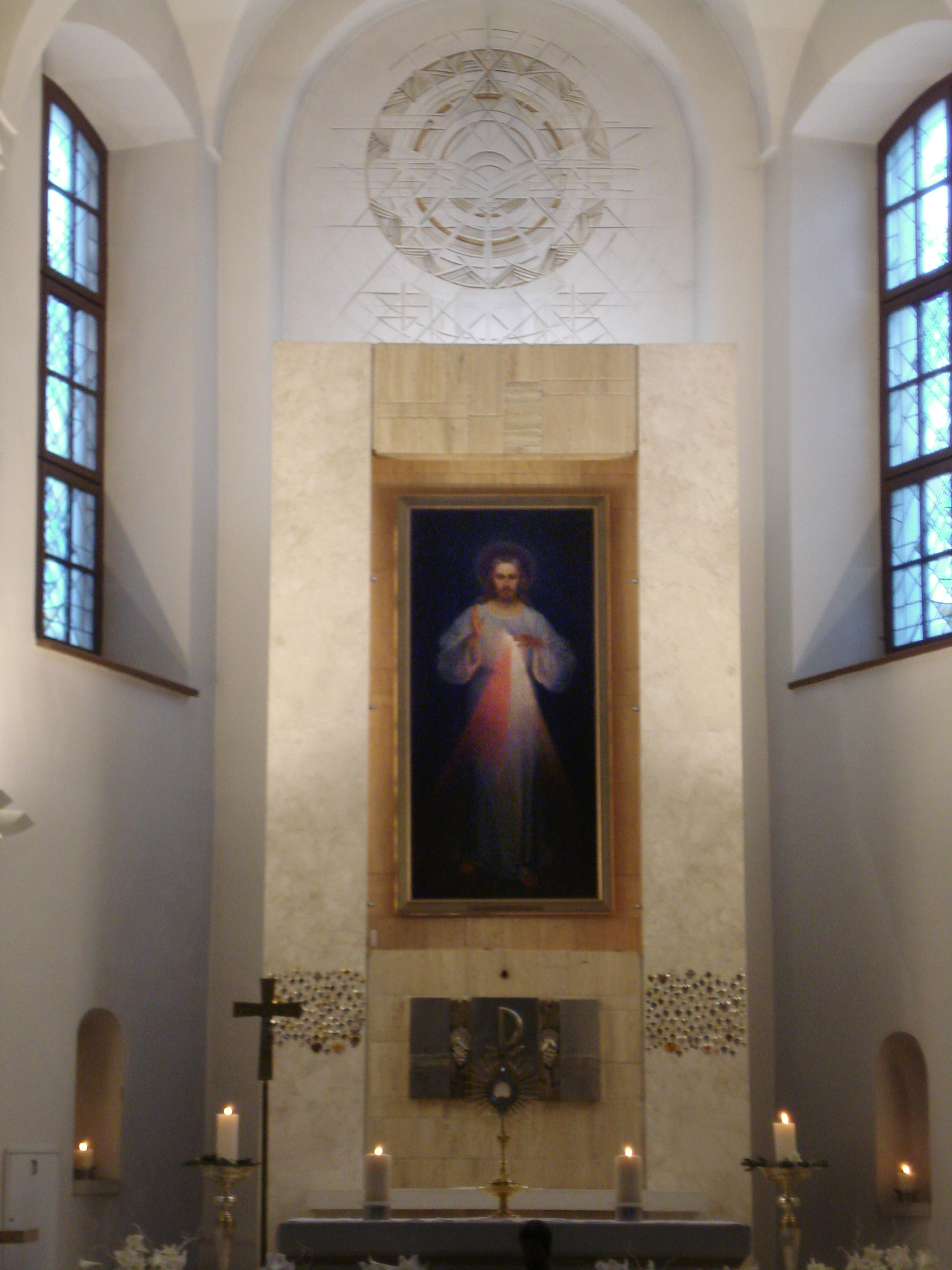
Initially, as a young Polish priest and then as Archbishop of Krakow, Karol Wojtyla familiarized himself with Sr. Faustina’s teaching on Divine Mercy in her diary. He also knew well the image of Jesus that she was told to have painted: Christ with red and white beams of light radiating from his heart, reminding us of the blood and water that gushed forth from his side as a fountain of mercy for us, signifying the Church’s life-giving sacraments. For John Paul II, a man of exceptional pity-heartedness matured through suffering, it’s unsurprising that canonizing Sr. Faustina brought such happiness.
St. Faustina had no greater promoter than John Paul II. Not only did he raise her to the altars, but he also ensured the endurance of her message by establishing Divine Mercy Sunday. Lex orandi, lex credendi: annually, this feast reminds us that the Father’s mercy stands at the heart of all reality.
John Paul anticipated this almost 20 years earlier in his second encyclical, Dives in misericordia, whose title derives from St. Paul’s description of the Father as “rich in mercy.” (Ephesians 2:4) Dives in misericordia complemented his first encyclical, Redemptor hominis: the latter highlighted the human dimension of Christ’s work of redemption, while Dives in misericordia highlighted its Divine dimension, i.e., the prevenient mercy-love of the Father, revealed first in the work of creation and then in the redemptive offering of his Son on the Cross.
Among the myriad insights to be gleaned from Dives in misericordia, it’s worth highlighting three.

First: As a devoted friend of the Bridegoom, John Paul pored over the Gospels in order to uncover what informed the conscientia (the “consciousness” or “conscience”) of Christ while carrying out his mission on earth. John Paul longed to know Christ “from within,” to grasp the interior source of his salvific action. Early in the encyclical John Paul sums up what he has learned: “Rendering the Father present as love and mercy constitutes in the consciousness of Christ himself the chief touchstone of his task and mission as the Messiah.”(§3)
What an illuminating insight! When Christ acted in the world, John Paul teaches us, the question he continually posed to himself was this: In this particular situation, how do I best render the Father present as love and mercy? Wouldn’t we – adopted sons and daughters of the Father – having put on the mind of Christ, do well to inform our consciences likewise?
Second: Two sections stand at the center of Dives in misericordia: one on the parable of the prodigal son, another on the Paschal Mystery. The well-known parable reveals God’s immeasurable, inimitable mercy, which suffuses our relationship with him. Yet the Paschal Mystery reveals an even greater depth of mercy; for by choosing freely to enter into human suffering and death, Christ enables us not only to receive mercy, but also to show mercy to God himself. In fact, year after year during the Triduum the Church invites us to experience again Christ’s passion so as to “mercy” Him, to pity and console Him, from his first sigh of agony to His last breath of life. Hence the Paschal Mystery reveals the greatest mercy shown to us: the unfathomable mercy of allowing us to “mercy” God Himself.
Third: This wondrous exchange of mercy in the Paschal Mystery provides a paradigm for all mercy, which the fifth beatitude captures concisely: “Blessed those who ‘mercy’; for they ‘shall-be-mercied’.” (Matthew 5:7) Action and reward coincide in mercy, and from this we learn a profound practical truth to inform our consciences. As John Paul puts it: “There is truly an act of merciful love only when, in carrying it out, we are altogether convinced that we too are receiving mercy from the very ones receiving mercy from us.”(§14) If we try to act mercifully with full conviction about the mutuality of mercy, then “conversion has not yet been fully accomplished in us. . .nor are we yet fully partaking of that magnificent font of merciful love opened to us by Christ.”
On this Divine Mercy Sunday, in our dealings with each other, let us remember the mutuality of mercy that stands at the heart of the Christian life, mercy’s wondrous exchange that Christ Himself taught in the Sermon on the Mount and exemplified in the Paschal Mystery.









![WHAT POLICY? Crockett Trips Through MS NOW Softball Question on Her Agenda if Elected to Senate [WATCH]](https://teamredvictory.com/wp-content/uploads/2025/12/WHAT-POLICY-Crockett-Trips-Through-MS-NOW-Softball-Question-on-350x250.png)