Many readers here likely witnessed Baptisms recently, especially if they went to the Easter Vigil Mass. By the grace of the Holy Spirit, we seem to have been blessed with a good number of Baptisms this year. Let’s pray that this undeserved gift continues and grows like the proverbial mustard seed.
That prayer is one we must make for ourselves too, of course, for our own Baptism is like the weeding and preparation of “good soil” into which the seeds of grace are planted. But we must cooperate with that grace for the new growth to flourish. The cleansing of Baptism is only a first step – and in an important sense, a first step toward the Cross. Baptism gives us the grace to take up the Cross.
It has long been a tradition in the Church to connect Baptism and the Cross. As St. Paul writes in Romans 6, “all of us who have been baptized into Christ Jesus were baptized into his death,” so that “as Christ was raised from the dead by the glory of the Father, we too might walk in newness of life.”
We must put to death “the old man” says Paul in Ephesians 4 – the “old man” with its pride, greed, and lust for domination – and rise to put on the “new man,” re-made in the image of Christ. But Paul is not making things up on his own authority. He is proclaiming “what had been handed on to him.” Let me explain.
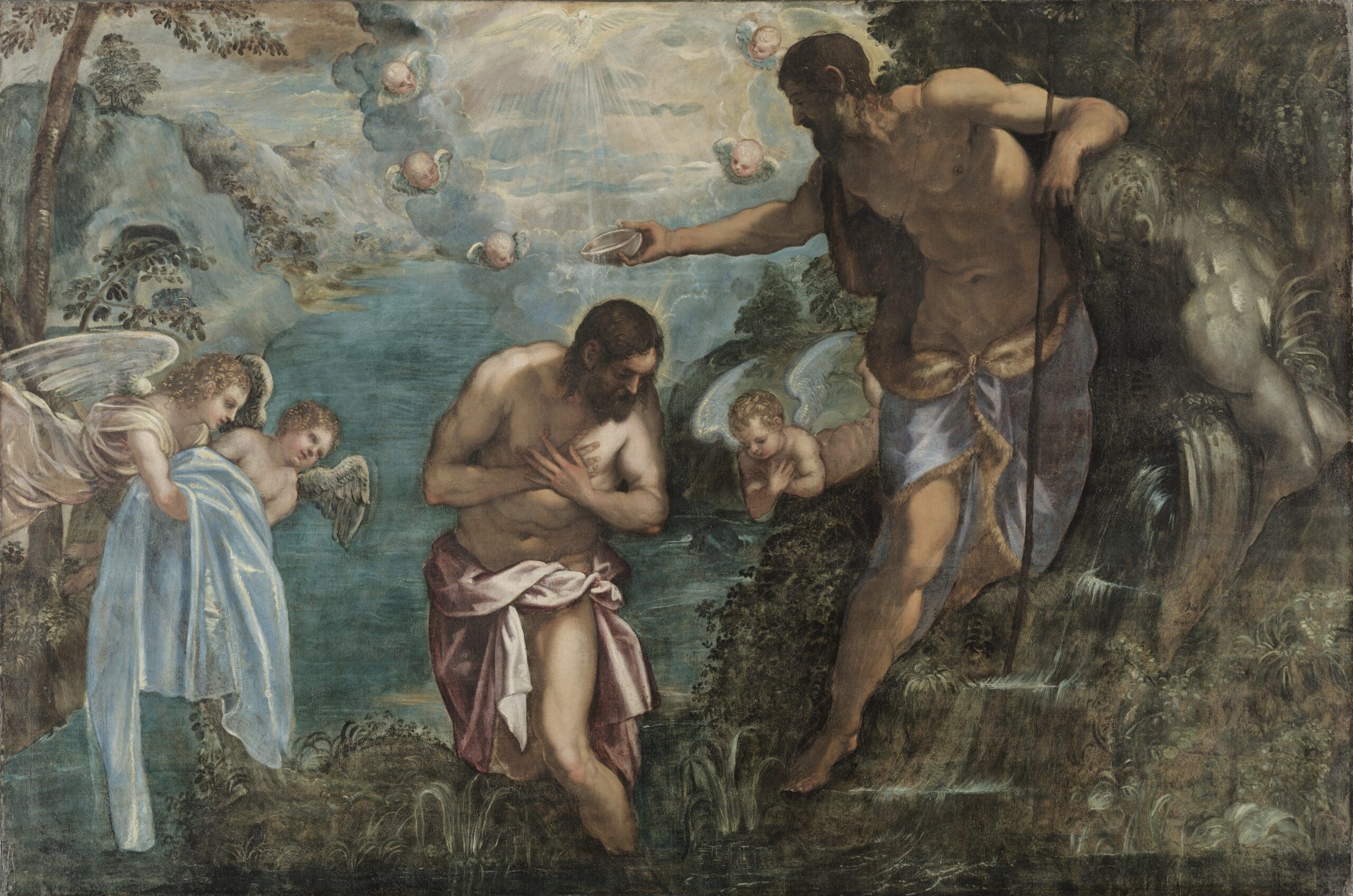
Pope Benedict, in his wonderful exposition of the Baptism of Jesus in Jesus of Nazareth, asks the question which many have asked: If Baptism is a confession of sins and a putting off of the old, sinful life to receive a new one, is this something Jesus could do? If Jesus was sinless (and He was), why does he get baptized? Indeed, John the Baptist says: “I need to be baptized by you, and do you come to me?” But Jesus replies: “Let it be so now; for thus it is fitting for us to fulfill all righteousness.”
“Looking at the events in light of the Cross and Resurrection,” wrote Benedict, “the Christian people realized what happened: Jesus loaded the burden of all mankind’s guilt upon his shoulders; he bore it down into the depths of the Jordan. He inaugurated his public activity by stepping into the place of sinners. His inaugural gesture is an anticipation of the Cross.” He “fulfill all righteousness” with His complete yes to God’s will, even to death on the Cross.
Pope Benedict notes three aspects of Jesus’s Baptism.

The first is that, as Jesus rises from the waters: “Heaven stands open above Jesus. His communion of will with the Father, his fulfillment of ‘all righteousness,’ opens heaven, which is essentially the place where God’s will is perfectly fulfilled.”
The second aspect is “the proclamation of Jesus’ mission by God the Father: not only in what He does but by who He is. He is “the beloved Son” who does the will of the Father.
The third aspect of the scene, finally, is the descent of the Holy Spirit. With this, writes Benedict, we find the mystery of the Trinitarian God “beginning to emerge.”
To some people, the doctrine of the Trinity is a confusing jumble. Why bother with “three persons in one Being?” Can’t we just talk about “God”? We can, and we do, but then we lose something of the inner dynamic character of God.
It is important to understand that God is a threefold communion of love being shared for all eternity between the Father, Son, and Holy Spirit. That divine love has been extended to us by the Son who takes on our humanity, “becomes flesh,” and dwells among us. This is a transformative love so great that it can transcend even sin and death.
“It is to your benefit that I go away,” Jesus tells his disciples. How could that be better? Because if He does not go, then everyone would constantly be going to Him for more bread, more healing, more miracles.
But then we would not be transformed. We are to be the “members” of Christ’s Body in the world. We are to be Christ’s hands and feet and eyes now.
We do not do this alone. Christ’s promise is that, when He has gone, he will send the Holy Spirit to “spread charity abroad in our hearts” so that we, like Him, “can fulfill all righteousness”; we too can be instruments of God’s will and God’s love.
But we cannot be those instruments of love if we hold onto the “old man” of selfishness and greed and the lust for domination. Those things must be cleansed away. And yet, if it were easy, everyone would be doing it. If it were easy, God wouldn’t have had to sacrifice Himself on a Cross.
The thing about that surrender of our selfishness, however – taking that heavy burden of the Cross on ourselves – is that, although at first, we feel its weight, in time, the Cross we think we are bearing is actually lifting us up.
So, when you dip your finger in that holy water font going into the church, you remember we are a baptized people, baptized into Christ’s death and resurrection.
Then you make the Sign of the Cross and say, “In the name of the Father, Son, and Holy Spirit.” When you do this, whether you think consciously about it or not, you have proclaimed in that gesture the essence of the Christian faith – Baptism, the Cross, the Triune God – even though you’ve barely crossed the threshold of the church.
You’ve repeated the essential things, now you’re ready to go in and listen and enter more fully into that communion into which we are being invited by a God whose love can reach even into the depths of the most sinful soul.



![Hegseth Demands Fitness Requirements, Says 'Fat Troops' 'Not Who We Are' [WATCH]](https://teamredvictory.com/wp-content/uploads/2025/09/Hegseth-Demands-Fitness-Requirements-Says-Fat-Troops-Not-Who-We-350x250.jpg)