
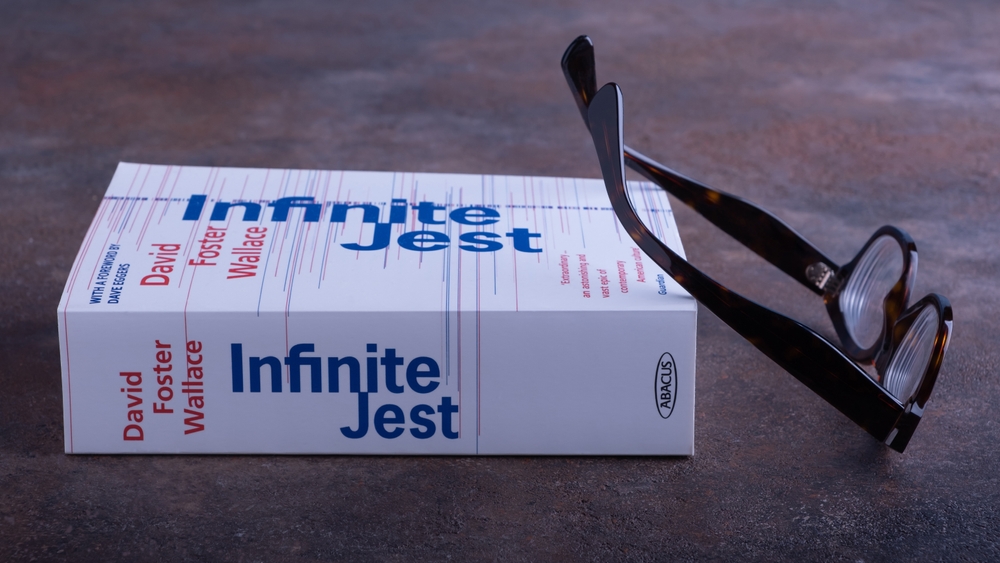
“If he had lived!” Impossible as it seems to conceive, he would have turned 64 just two months ago, on February 21. He is forever fixed in our minds as a young genius who catapulted to fame in his mid-20s and took the American literary world by storm in his early 30s with the publication of a 1,079-page novelistic tour de force (complete with 388 endnotes), followed by a national book tour that witnessed bookstores and halls in several cities packed beyond capacity. “You couldn’t get anywhere near the front door,” wrote Rolling Stone’s David Lipsky. “There was no standing room.”
The writer was David Foster Wallace (1962–2008). And the novel was Infinite Jest.
For an entire generation—mine—Wallace (whom readers commonly referred to as “David,” and fans as “Dave”) was a literary hero. “Will you still be sending me a valentine,” sang the Beatles, “when I’m sixty-four?” Dave’s mailbox is still full. Tens of thousands of readers still grieve over how much we have lost by his premature exit. What might he have said? Better: What might he have written?! So much has happened since September 12, 2008: that tragic afternoon when David Foster Wallace wrote a two-page suicide note to his wife, neatly arranged the completed sections of his work-in-progress novel (posthumously published as The Pale King), and hanged himself from a patio rafter at his home in Claremont, California.
He was 46 years, 5 months, and 12 days old.
If one imagines him midway into his seventh decade, it is challenging to wonder how Wallace would have developed as a writer and thinker. Given the tidal waves of intervening events, the era that he portrayed and parodied has receded so far into the remembered past that it already seems a lifetime ago.
How would Wallace have engaged the exigencies of the past two decades? How would his style, his themes, and his ideas have evolved? Where might his political allegiances have lain?
First heralded as a successor to William Gaddis, John Barth, Thomas Pynchon and Don DeLillo, Wallace began as a postmodern purveyor of irony and self-reflexive narration (a “pomo formalist”), publishing several virtuoso stories and the novel-cum-Wittgensteinian-treatise The Broom of the System (1987) in his 20s. He then did a volte-face in his 30s and 40s, proselytizing for “sincerity.” He called for a cadre of “new literary ‘rebels’” acting as “some weird bunch of anti-rebels” with the “childish gall” to champion “single-entendre principles” and be “willing to risk … accusations of sentimentality, melodrama, credulity.” (Even before Wallace’s death, critics spotted his influence on the tone and mood of fiction everywhere, calling him the progenitor of a new post-postmodern movement in fiction, the anti-ironic “New Sincerity.”)
Politically, he was all over the place. Twice he voted for Ronald Reagan, later he supported Ross Perot, sat out the Clinton years, enthused briefly about Bill Bradley, derided George W. Bush (and filed a hilarious yet heart-filled and enthusiastic report of John McCain’s presidential run (“The guy feels real”), and felt so inspired by Barack Obama’s candidacy that he pondered the possibility of becoming a campaign speechwriter. (Unfathomable as that prospect was—and remains—imagine nevertheless a Wallace-authored Obama oration à la DFW’s famous “This Is Water” commencement speech at Kenyon College in 2005: “Because if you cannot or will not exercise this kind of choice in life, you will be totally hosed.” Yes we can? No, you can’t!)
And today? One can imagine Wallace the Endlessly Restless Seeker doing a sharp turn away from his embrace of “sincerity,” perhaps ironizing it on behalf of some more excruciatingly torturous self-consciousness, going beyond Lionel Trilling’s famous opposition between sincerity and authenticity to some third mode of inter- and inner subjectivity. Like Trilling, Wallace valued sincerity as a social virtue, yet both men were wary of authenticity as a narcissist’s rationalization for emotional promiscuity, confessional harangues, and endless self-absorption. Nonetheless, it warrants emphasis that the anti-rebel Rebel Wallace was not opposed to irony per se; he was opposed to compulsive, haughty irony, what could be termed “aesthetically correct” irony for irony’s sake.
Likewise, one can imagine Wallace the Inveterate Contrarian defending Donald Trump and skewering the “fake news” of the Legacy Media and challenging the so-called Party line about January 6, “the stolen election,” and countless (“infinite”?) alleged Trumpian vulgarities. Or would he rather have seen “President” Trump, the erstwhile reality TV show host now in the Oval Office, as the uncanny incarnation of James Incandenza, inventor of a lethally addictive film he titles Infinite Jest that mesmerizes and debilitates viewers like a technocratic Medusa.
Or one can imagine Wallace variously rewinding the historical reel on Trump’s predecessor and ricocheting from welcoming Joe Biden, bewailing his daily “senior moments,” celebrating his executive order to forgive student debt, then mocking him as the Puppet with the Autopen and satirizing him as a comatose zombie worthy of residing with the halfway-house addicts from his chef d’oeuvre, the incomparable Infinite Jest.
Who—or what—was Wallace after all? Pacifist, quietist, militarist, liberal, conservative, left-wing radical, or right-wing libertarian?
Are we really separated from him by the historical chasm of Obamacare, Beltway political gridlock, Occupy Wall Street, Brexit, Black Lives Matter, #MeToo, Harvey Weinstein and Bill Cosby and Charlie Rose (his most famous TV interviewer), the 1619 Project, Brett Kavanaugh, COVID-19, the endless pandemic lockdowns and masks and social distancing, Elon Musk and DOGE, Kamala’s “107 Days,” Donald’s reelection victory, ICE (follies?), and the Jeffrey Epstein files?
Hard to imagine that he would not have had harsh words for Vladimir Putin and his invasion of Ukraine. Or Iran’s ayatollahs. And yet … might he have turned quietist again? (Hard at work on Infinite Jest in the mid-1990s, he spared little time to comment on the last major war in Europe, namely the fate of Bosnia at the hands of Croatia’s Slobadan Milošević. Neither did he expend any energy deploring the “ethnic cleansing,” the siege of Sarajevo, and other developments that eerily echo the condition of Central Europe since 2022.)
Scarcely a major issue has gone by since September 2008 that does not provoke reflection about what he might have said or written, and that does not in turn stir the lament: “If DFW Were Alive Today!” What positions and pronouncements would he have issued? I have no idea. I’m only certain he would have swum against the main currents. I’m only sure he would have challenged our ephemeral verities and shaken our unexamined assumptions (“This is water!”).
Infinite Jest (1996)—its title is owed to Hamlet’s soliloquy to his tutor Yorick (“A man of infinite jest!”)—may be the greatest American novel of the past three decades. Or even the last four, since Toni Morrison’s Beloved (1987). And certainly the greatest maximalist novel since Thomas Pynchon’s Gravity’s Rainbow (1973).
Are such superlatives truly warranted? Each reader must decide for himself, and perhaps it is still too early to make categorical critical pronouncements about recent American literary history. And yet, after serious reflection, I believe that a serious case can be made for him and Infinite Jest. Unlike its main rivals for Greatest American Novel since its publication—Don DeLillo’s Underworld (1997), Jonathan Franzen’s The Corrections (2001), and Cormac McCarthy’s The Road (2006)—it is distinguished by encyclopedic ambition, informal innovation (endnotes, structural complexity), an ingenious portrait of media addiction and entertainment culture, and a legacy marked by a unique generational influence on writers and MFA culture. Even more importantly, it is the only comic novel among them. It possesses a levity and a nose-tweaking defiance that the others lack. Indeed, it possesses the monumental character of a Moby-Dickand the sharp satire of a Huckleberry Finn, both of them long-standing nominees for Greatest American Novel. Its contender status is based, therefore, not only on its front rank in postmodern fiction but also on its secure place in the grand tradition of both the American epic and he American comic novel.
What is Infinite Jest about? What isn’t it about? An attempted coup to free Quebec from a superstate, drug-abuse rehabilitation, the Enfield Tennis Academy, and of course the Incandenza family and their pretensions—all of which merge in a mysterious cartridge film (usually referred to as The Entertainment and occasionally as “the samizdat”) so compelling that viewers lose all interest in doing anything else with their lives but watch it over and over. Until they die. Literally. Social media addiction anyone?
Certainly Wallace’s publisher, Little Brown, is willing to expend resources to make the case for Infinite Jest as the Great (if not “the Greatest”) American Novel and to keep “Dave” culturally fashionable. The new “thirtieth anniversary edition,” released in February, was heavily promoted and accorded a lengthy, respectful reappraisal in The New Yorkerlast month. In my opinion, the new edition represents a veiled attempt to overcome charges of misogyny and stalking behavior that exploded after his death and gained traction just as the 20th-anniversary edition came out a decade ago, when Wallace became the target of numerous #MeToo attacks as the movement gained steam. This time around, Little Brown recruited a sympathetic reader far from the prototypical “fanboy” profile that worshiped “Dave” in the 1990s: The foreword was written by Michelle Zauner, the 36-year-old queer Korean American frontwoman of the Indie pop band Japanese Breakfast.
Wallace remains since his death, in my estimate, the most unusual and wide-ranging American writer at least since the standouts of the 1950s and ’60s. He is the most intellectually enlivening since the heyday of Nobel laureate Saul Bellow, the most controversial since Norman Mailer, the most entertaining since Joseph Heller, and the most beloved since J.D. Salinger. Recalled his first book editor, Colin Harrison: “The one thing that really should be said about David Foster Wallace is that this was a once-in-a-century talent. We may never see a guy like this again in our lifetimes—that I will shout out. He was like a comet flying by at ground level.”
Although Wallace’s writing career spanned little more than two decades, the scale of his achievement as a man of letters stakes a claim to making him a major American literary figure. If Infinite Jest was Wallace’s entry in the derby for Great American Novel, it is also both the last and first in another respect: the last addition to the American canon of the 20th century and the first of the newly inaugurated post-ironic, post-postmodern, anti-rebel age.
Already by the century’s end, pronounced one German critic, Wallace was “probably the most important, and certainly the most influential writer of the Western Hemisphere.” Whether exaggerated or not, that assessment after Infinite Jestseemed validated by the lavish homage to DFW in literary academe as well as in internet list-servs. Within little more than three years of his death, not only had a full biography appeared, along with The David Foster Wallace Reader and several critical studies and collections of his interviews, but also a series of DFW academic conferences and a festival-award-winning movie (The End of the Tour, a five-day docudrama recounting his Infinite Jest book tour accompanied by Rolling Stone reporter David Lipsky), along with two other films.
As the adulatory response to The End of the Tour from both the critics and Wallace’s enormous fan base attest, DFW’s books alone do not fully account for the reverence that many readers feel toward him, an enthusiasm that borders on cult status. Not since J.D. Salinger and Catcher in the Rye in the 1950s had a book and author so excited—and enthralled—the American imagination. Not since Joseph Heller’s Catch-22 had readers laughed so uncontrollably and taken a novel to their hearts so completely. Infinite Jest became the signature expression of a generation, conveying the sensibility of Generation X and the mood of the fin de siècle, and exerting an immense influence not just on American literature but also on film, television, and other arts.
More could be written here, say, about Wallace’s little-known preoccupation with religion in general and serious interest in Catholicism in particular. But that’s for another time, perhaps his 65th birthday. Infinite Jest is more than enough for now—and offers more than enough for a lifetime to ponder.








![WHAT POLICY? Crockett Trips Through MS NOW Softball Question on Her Agenda if Elected to Senate [WATCH]](https://teamredvictory.com/wp-content/uploads/2025/12/WHAT-POLICY-Crockett-Trips-Through-MS-NOW-Softball-Question-on-350x250.png)