
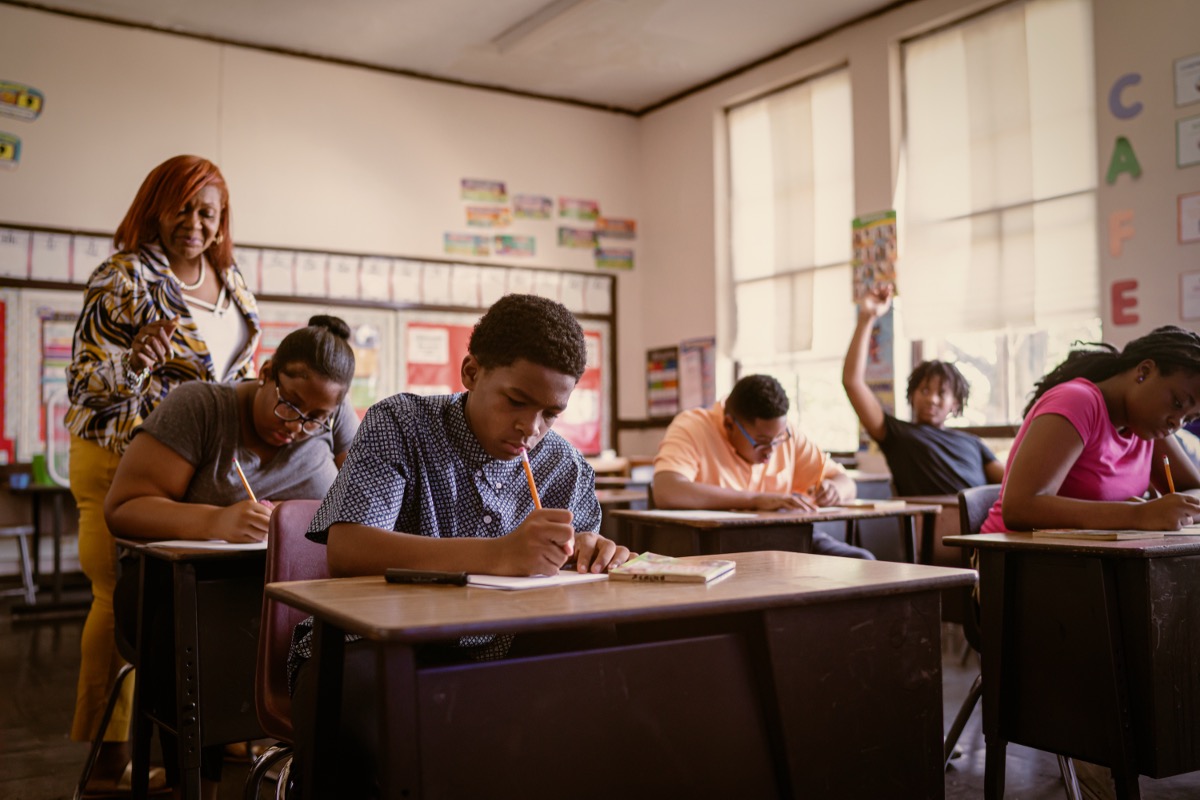
“The Ku Klux Klan couldn’t sabotage chances for black academic excellence more effectively than the public school system in most cities,” noted the late Professor Walter E. Williams. Apropos to this, Williams also stated that whatever you say about “civil-rights” activist Malcolm X, he was right about something. To wit:
The greatest enemy black Americans have is the liberal who claims to be their benefactor.
And nowhere is that liberal control greater than in the government school system.
One man who may agree — though he avoids an ideological framing — is New York middle-school teacher Dennis Richmond, Jr. Writing at the New York Post recently, he issues a warning about today’s education. “Black male students are hurt the most,” he writes, “by lowered academic expectations.” And, boy, they’ve gotten so low they could adroitly pass under a limbo bar.
As Richmond writes, introducing the problem:
Education is supposed to be about reading, writing, history, discipline and accountability. Instead, in too many schools, academics are being pushed aside while politics, ideology and lowered expectations take their place. The students who can least afford to fall behind — particularly young Black boys — are the ones being hurt the most.
Richmond then cites some statistics from the National Assessment of Educational Progress (NAEP) to illustrate the point. For example (figures for children in New York City government schools):
Grade 4 Reading:
- Asian students: 51 percent
- White students: 44 percent
- Black students: 17 percent
Grade 4 Math:
- Asian students: ~58 percent
- White students: 53 percent
- Black students: 16 percent
As is evident, whites and Asian-descent students aren’t exactly budding Einsteins, either. (For more perspective, however, note that approximately 50-52 percent of white NYC students — generally the high-performing ones — attend private institutions.) Yet the numbers for black students reflect a population in crisis. This pattern persists through high school, too, Richmond emphasizes.
So What’s the Diagnosis?
Why this is happening will now sound all too familiar. As Richmond informs:
Across many schools, the focus has slowly shifted away from academic mastery and toward comfort, messaging and politics. Instead of asking, “Can this student read at grade level?” the conversation often becomes, “How can we make the work easier?” or “How can we adjust the assignment so everyone passes?”
… Teachers are frequently encouraged to modify lessons, reduce rigor or avoid failure rates that look bad on paper. But when expectations go down, learning usually goes down with them.
It’s even worse than that, however. Consider the experiences of a great friend of mine who taught English for five years in a majority-black NYC school. Beating his own path, he began having the kids play a certain kind of on-paper “word games” in class. This may sound frivolous, but the results were anything but:
His class surpassed the others in standardized testing.
His reward?
He was removed from the classroom. The problem, you see, was that he wasn’t implementing the school’s “official,” politically correct (read: liberal) teaching paradigm. Dogma mattered more than results.
This mentality’s consequences are plain, too. As Richmond writes, some students
struggle to write a full paragraph. Others have difficulty explaining basic history, government or literature. These are not political problems — they are academic problems. And they require discipline, repetition, structure and high expectations to fix.
“Today, too often, the focus has shifted from scholarship to messaging,” Richmond later adds. “Students need facts before opinions. They need grammar before slogans. They need discipline before comfort.”
This is all true and amounts to a wonderful pep talk. Nonetheless, Richmond is mistaken on one matter: These are “political problems.” They’re also ideological, cultural, philosophical and, some would say, spiritual ones. They are, to use a word leftists go gaga over today, systemic.
It Runs Deep
Just consider the politics-driven messages activists (many black) have disgorged into the black community. They’ve claimed that “rugged individualism,” “a can-do attitude,” “hard work,” and “striving towards success” reflect “white male culture.” This is in schools, too, where teachers have been told hard work, planning for the future, and punctuality are “white norms.” And what’s a black norm?
According to activist Glenn Singleton, “collectivism” is one example.
Then there’s the disgraced organization Black Lives Matter, which wouldn’t just be likely to subscribe to the above. It also has openly embraced the goal of “disrupt[ing] the Western-prescribed nuclear family structure requirement.” Of course, already bedeviled by a 73-percent illegitimacy rate, the black community needs this like a hole in the head.
Even all this, however, doesn’t really cut to the problem’s heart.
The Crux of the Matter
I’ll introduce this with a story. A wonderful African clergyman whom I used to know pretty well once related to me an interesting anecdote. His grandfather back in Kenya, he said, used to be a witch doctor. (This clergyman also had a nephew who’d been killed by an elephant. I didn’t hear stories like that growing up in the Bronx.) But his granddad later became a Christian and then confessed something to him. In his witch doctoring days, he admitted, he used to lie to his “patients.” He apparently knew his remedies weren’t exactly efficacious.
You can bet, however, they were delivered with impressive costumes, dancing, and gesticulating. As the saying goes (expurgated), “If you can’t dazzle ’em with brilliance, baffle ’em with bushwa.”
And in a way, education today is a type of witch doctoring. Oh, not every teacher is willfully lying. Many are just trapped in a system they’re powerless to change; others believe the bushwa. But collectively, they’re doing their own meant-to-be-impressive dance. It goes like this:
We can’t, won’t, or don’t know how to actually achieve results. So we’ll talk about other things.
We’ll say the schools need more money (even though New York spends more per pupil than virtually any other state).
We’ll boast of the technology the students enjoy and maybe claim we need more. (In reality, technology is part of the problem.)
We’ll talk about how the school buildings are too old.
We’ll boast of having the “latest pedagogies” born of cutting-edge research.
Talk about this and other pseudo-intellectual distractions enough, and you may convince parents you’ve got the bull by the horns. You may even convince yourself.
New Ideas? Try Eternal Truths
In reality, black kids need the same things all kids do. They need to learn Truth, objective reality, inclusive of fact-based history and civics. They need to be inculcated with those good moral habits, the virtues. And they require an environment of — and these are two dirty words now — discipline and obedience. These are prerequisites for learning. Why? Because someone can’t learn from you unless he’s first willing to listen to you. Listening is a condition for learning.
That is, too, one of the main problems today: Many schools, inner-city ones especially, are madhouses. Mayhem reigns, and teachers don’t have the authority to restore order.
So, put simply regarding education, we talk about what has nothing to do with the solution because what does is now politically and culturally impossible to talk about.








![WHAT POLICY? Crockett Trips Through MS NOW Softball Question on Her Agenda if Elected to Senate [WATCH]](https://teamredvictory.com/wp-content/uploads/2025/12/WHAT-POLICY-Crockett-Trips-Through-MS-NOW-Softball-Question-on-350x250.png)