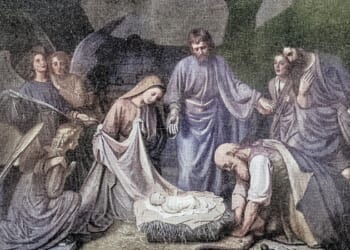
And Simeon blessed them, and said to Mary his mother: Behold this child is set for the fall, and for the resurrection of many in Israel, and for a sign which shall be contradicted. (Luke 2:34)
By 1973, there’d been one papal trip to the U.S. – by Paul VI in 1965, and that was for all of 15 hours. And before that visit, no pope had even left Italy since Pius VII was forcibly removed to France by Napoleon’s troops in 1812. Yet Catholicism managed to encourage converts.
I would never argue against evangelization. In one way or another, evangelizing is what The Catholic Thing’s contributors do daily. We proclaim, “Jesus Christ and him crucified.” (1 Corinthians 2:2) But clerics daily diving into the media scrum or popes having wings (John Paul II made 104 pastoral trips outside of Italy) may not be as conducive to conversions as are the Faith’s doctrines and rituals.
Besides, not every pope has been as grounded and charismatic as St. John Paul. In any case, when we remember him, we don’t think of the comments he made about conflicts in Africa, the Middle East, or South Asia. And this is because, as a rule, he didn’t make them. He was more catechist than commentator.
At its heart, the Catholic Church is (and must be) opposed to “the world” because Jesus is.
When Cardinal Karol Wojtyla gave the Lenten meditations to Paul VI and the Roman Curia in 1976, he welded “a sign of contradiction” onto the Catholic imagination. Jesus is that sign: either you are for Him, or you are against Him. Everything about Jesus Christ flies in the face of all worldly ambition that seeks to see life in terms other than the Cross.
Yet the Church, by which I mean official Vatican “voices,” now inserts itself into every imaginable secular issue, reducing – to greater and lesser degrees – the message of Christ to a mere alternative to the various Timeses (New York, London, India, Israel), and TASS, BBC, NBC, Xinhua, et cetera, and ad nauseam. The Church seems determined to root us in every imaginable finite business when it ought to be leading us towards the ineffable infinite.
And this attention to “the world” inevitably makes the Church seem increasingly worldly. Trump. Putin, Xi. . .Leo? Take your pick. They all seem to be in the same business. Well, I’m not, though, meaning to suggest the end of Animal Farm: “The creatures outside looked from pig to man, and from man to pig, and from pig to man again; but already it was impossible to say which was which.”
In that, Leo XIV surely stands apart. And yet, I believe he has, so far, allowed himself to step too close to the secular abyss. For example: Trump.
One might wonder if the pope’s decision not to come to the U.S. for the 250th anniversary of the founding of the nation of his birth had something to do with the current occupant of the White House. I don’t know. But a pope’s visit to the White House is simply a matter of protocol: one head of state welcoming another. It is in no sense an endorsement of that president any more than a president, by meeting with a pope, is confirming the Holy Father’s authority.
No pope has slept in the White House, and the only pope-president liaison that became more than mere protocol was the one between John Paul II and Ronald Reagan. Before he became president, Reagan had been inspired by John Paul’s visit to still-communist Poland, which became the Reagan Era’s template for U.S.-U.S.S.R, relations. And, of course, they bonded over their shared experiences of nearly being killed by assassins. More than that, they liked and admired one another.
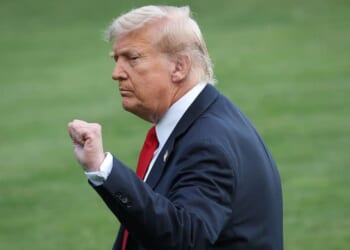
IF Leo believes he, too, must be a peripatetic pope, he should have made July 2026 to the United States of America among his first journeys. Yes, there’d have to be the obligatory July 3rd photo op with DJT (without expectation of apology from the “leader of the free world” for his anti-Catholic Truth Social rants), but then (the same day, it seems to me) off to Philadelphia for the Fourth, after which off to Chicago for a true homecoming (White Sox v. Red Sox on July 7), and then back to his day job in Rome.
Am I being facetious? Yes. Well, sort of. But the main point of my sarcasm is the problem of papal travel and endless papal and Vatican commentating.
When St. John Paul II went to Poland, he made no direct criticisms of the communist government. The closest he came was when he told the crowd in Warsaw’s Victory Square that “at any longitude or latitude of geography, the exclusion of Christ from the history of man is an act against man.” I imagined Edward Gierek turning to Wojciech Jaruzelski and asking, “Are we to believe in Christ now?” It’s like the familiar Catholic quip about a recently deceased person:
“He wasn’t Catholic, was he?”
“No. But he is now.”
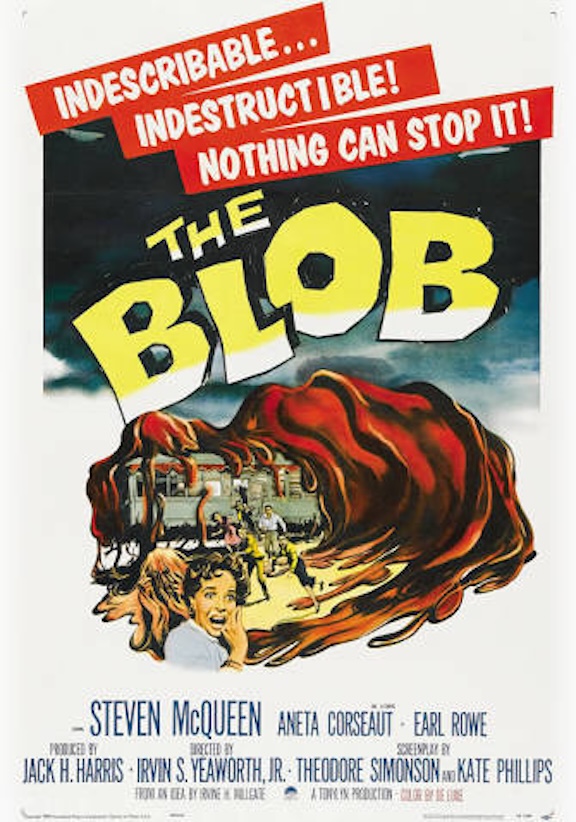
My point, which – agree or disagree – you have surely grasped, is that the best way to further grow an already growing faith is to profess that faith. Wedging Jesus into the conflict in Iran or border enforcement in the U.S., while hardly a fool’s errand, risks sinking Roman Catholicism into the very worst version of synodality: as an ongoing, transformational whatsis equal to The Blob.
Anyway, let me almost end by inviting His Holiness to change his plans and come to America. We are a divided people just now, and, Holy Father, your presence among us can only remind Americans of what “In God We Trust” really means. Be a sign of contradiction.
By the way, Steve McQueen, star of The Blob (1958), came to Christ at the end of his life as he was dying of cancer.
“But, Brad, McQueen became a born-again Protestant. He wasn’t a Catholic.”
“No. But he is now.”