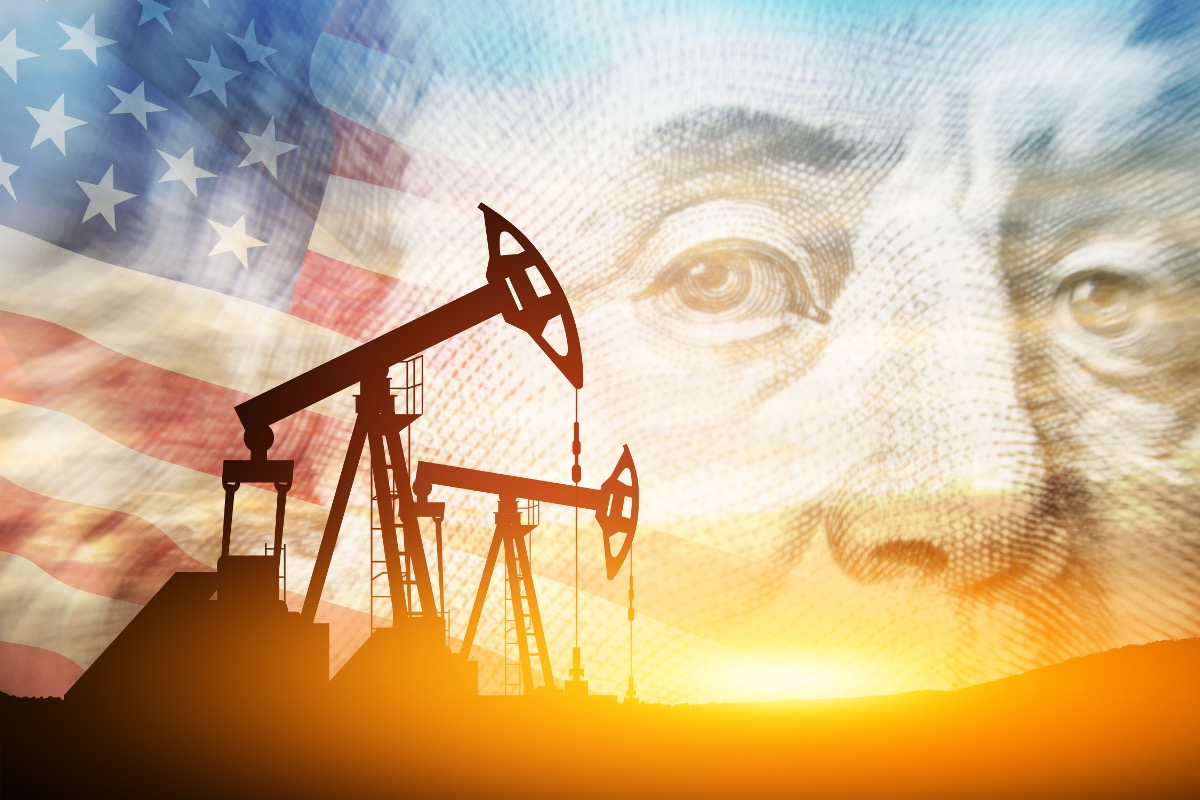
The United States is facing the collapse of the petrodollar that has propped up the American economy for the last half-century.
Former Navy SEAL and podcaster Shawn Ryan warned that the war in Iran and ensuing closure of the Strait of Hormuz is a coming debacle for American finance. China’s currency, he said, will supplant that of the United States and become the global standard.
And Ryan isn’t the only Cassandra portending doom for the dollar as the world’s reserve currency.
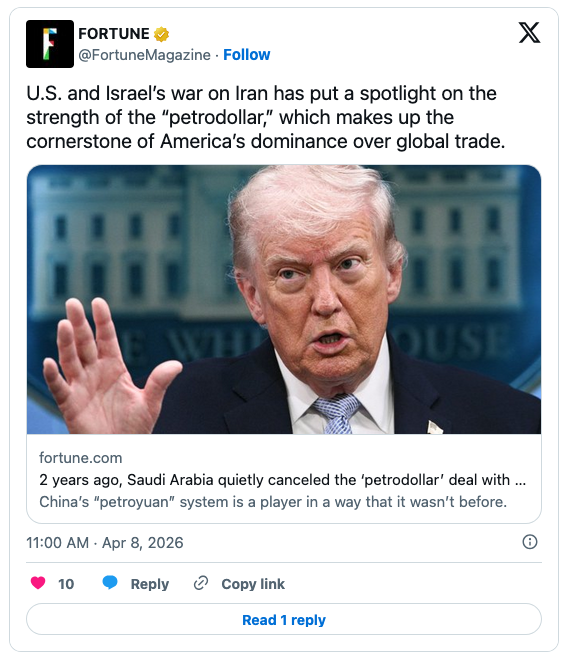
Fortune magazine explained that war has exposed the weakness of the petrodollar. And the Independent Institute observed that the U.S. seems to wage war on any nation that attempts to move away from using the dollar as the world’s oil-trading currency.
And the war in Iran, Deutsche Bank warned in March, has created “a perfect storm for the petrodollar.” Ahead might be the era of the petroyuan.
Rise of the Petrodollar
As Fortune scribe Sasha Rogelberg explained, the Nixon administration created the petrodollar in 1974, when Saudi Arabia agreed to sell oil only in dollars in return for security and military aid.
“The U.S., then under President Richard Nixon, was looking to secure global demand for the U.S. dollar following the end of the gold standard in 1971,” Rogelberg explained:
In the wake of the 1973 oil crisis, the U.S. was motivated to solidify its own oil supply chain.
Because oil was and is so fundamental to nearly every industry, the “petrodollar” became ubiquitous, and the dollar became the cornerstone of the global economy: Oil-rich countries needed a place to put their growing reserves of dollars and turned to U.S. Treasuries. Countries buying oil did so in greenbacks.
This cycle has created a currency architecture heavily favoring the U.S. dollar that has persisted for more than 50 years. Saudi Arabia, as well as Qatar, Oman, Bahrain, and the United Arab Emirates, require an estimated $800 billion in supporting reserves as a result of having their currencies pegged to the U.S. dollar. The Gulf Cooperation Council sovereign wealth funds have more than $2 trillion invested in U.S. assets.
Now, however, the U.S. attack on Iran, which closed the Strait of Hormuz, has upended that arrangement. The war has exposed “the weakness of the petrodollar” because “some ships are able to pass through the choke point by paying in Chinese yuan.” Some 20 million barrels of oil — 20 percent of the world’s supply — pass through the strait every day.
For years, Rogelberg explained, Gulf countries have been “trading oil outside the U.S. dollar and therefore definitionally destroying the principle of the petrodollar as the exclusive currency for trading oil.”
Problem is, the U.S. depends upon the petrodollar to dominate global trade and markets.
Petrodollar Wars
The day before Trump ordered an attack on Iran, the Independent Institute’s Scott Beyer offered a serendipitously timed review of the petrodollar war theory.
Though some countries, including Russia and Saudi Arabia, now accept the “other currencies in bilateral deals,” the dollar still rules global trade “because of habit, liquidity, switching costs, and the depth of U.S. financial markets.”
“Even today, roughly 80% of global oil transactions are denominated in dollars,” Beyer wrote:
The currency’s integration with the global banking system — particularly the SWIFT payments network — reinforces that dominance.
Beyer also reviewed what some believe is the reason the United States has repeatedly gone to war in the Middle East: to ensure the petrodollar remains the world reserve currency.
“In 2000, Saddam Hussein announced that Iraq would switch its oil sales from dollars to euros under the UN Oil-for-Food program,” Beyer wrote:
In 2003, the U.S. invaded Iraq and removed his regime. Afterward, Iraqi oil sales reverted to dollar denomination.
Muammar Gaddafi later advocated for a pan-African gold-backed dinar for trade, including oil. In 2011, NATO forces — including the U.S. — intervened in Libya’s civil war and Gaddafi was killed.
Nicolás Maduro has promoted oil trade outside the dollar and strengthened ties with China and Russia. U.S. sanctions and pressure intensified over time, before the Trump administration captured him in January of 2026.
Since the 2000s, Iran has explored selling oil in euros or yuan and proposed alternative exchanges. Yet tensions between the U.S. and Iran date back to the 1979 revolution, hostage crisis, and nuclear disputes — predating most currency shifts.
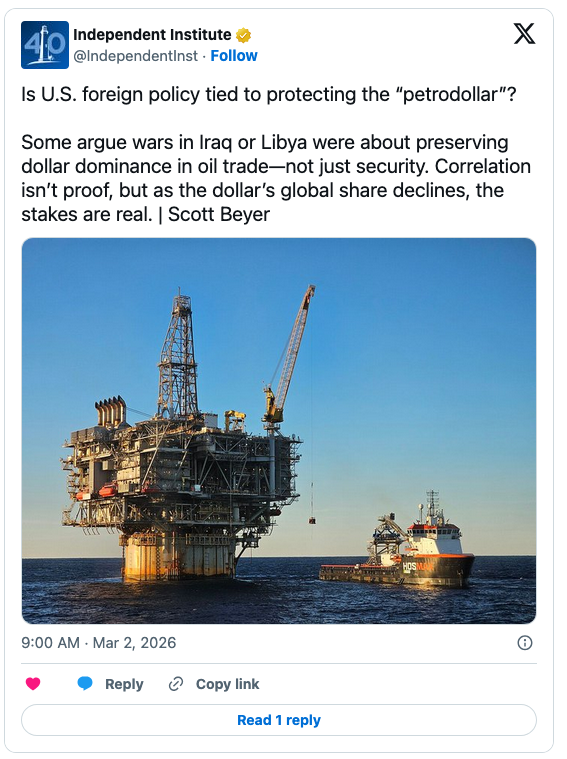
Yet even if the petrodollar war theory is a stretch given that recent conflicts haven’t concerned it, the petrodollar is collapsing. Twenty-five years ago, the majority of global foreign exchange reserves, some 71 percent, “were held in dollars.”
“[T]oday that number sits closer to 59%,” Beyer explained:
The euro, yuan, and other currencies have modestly expanded their roles, helped by emerging markets alliances that aim to spearhead precisely this shift.
If the shift occurs, due to petro or other factors, the consequences for the U.S. could be significant. A weaker dollar would likely mean inflation, higher borrowing costs, and reduced geopolitical leverage.
China Wins Without “Pulling a Trigger”
The petrodollar is sliding. The Strait of Hormuz is closed. The price of benchmark Brent Crude is more than $104 per barrel. The question now is, What’s ahead for U.S. hegemony over global markets? Answer: America’s global dominance is over.
“The petrodollar is the foundation of American power,” Shawn Ryan wrote on X:
Since the 1970s, oil has only been sold in dollars, forcing every nation on earth to hold dollars, fund our debt, and keep us dominant.
But now, Iran has “systematically dismantled that” by shutting down Hormuz. Ships must pay in the yuan for passage. Now, “Gulf states are dumping US treasuries, bond markets are selling off, inflation is surging, [and] Deutsche Bank is warning of a petroyuan era.”
Continued Ryan:
Every link in the petrodollar chain is snapping at once. When it’s gone, your borrowing costs explode, your savings erode, and America loses the financial weapon that has kept us dominant for 50 years. China wins without ever pulling a trigger.
In March, again, Deutsche Bank warned that the U.S-Israeli attack “tests the foundations of the petrodollar regime.”
“[T]here could be significant downstream effects to the dollar’s use in global trade and savings, and the dollar’s role as the world’s reserve currency,” the bank warned:
The world saves in dollars in large part because it pays in dollars. The dollar’s dominance in cross-border trade is arguably built on the petrodollar: globally traded oil is priced and invoiced in USD. … The foundations of the petrodollar regime have been under pressure even before this conflict. Most Middle East oil is now sold to Asia not the US; sanctioned oil from Russia and Iran has already been trading off dollar rails; Saudi Arabia has been localizing defence, and experimenting with forms of non-dollar payment infrastructure such as Project mBridge.
The current conflict may expose further fault lines, by challenging the US security umbrella for Gulf infrastructure and the maritime security for global trade in oil. Damage to Gulf economies could encourage an unwind in their foreign asset savings held largely in dollars. In this context, reports that the passage for ships through the Strait of Hormuz may be granted in exchange for oil payments in yuan should be closely followed. The conflict could be remembered as a key catalyst for erosion in petrodollar dominance, and the beginnings of the petroyuan.
Fortune’s Rogelberg noted that China accounts for at least 15 percent of global oil consumption, some 15 to 16.6 million barrels per day.
Fadhel Kaboub, an associate professor of economics at Denison University and president of the Global Institute for Sustainable Prosperity, told Rogelberg that trading in the yuan “is not a geopolitical deal,” for the Gulf nations. “This is not a security deal. This is just logical commonsense business transactions,” he told the magazine:
From a Chinese perspective, this is the building block to where China wants to be in 50 years.
Indeed, Kaboub said, China is aping Nixon’s move in 1974 by telling the Gulf nations it will offer a “security umbrella” and alternative to the dollar.


![Hegseth Demands Fitness Requirements, Says 'Fat Troops' 'Not Who We Are' [WATCH]](https://teamredvictory.com/wp-content/uploads/2025/09/Hegseth-Demands-Fitness-Requirements-Says-Fat-Troops-Not-Who-We-350x250.jpg)