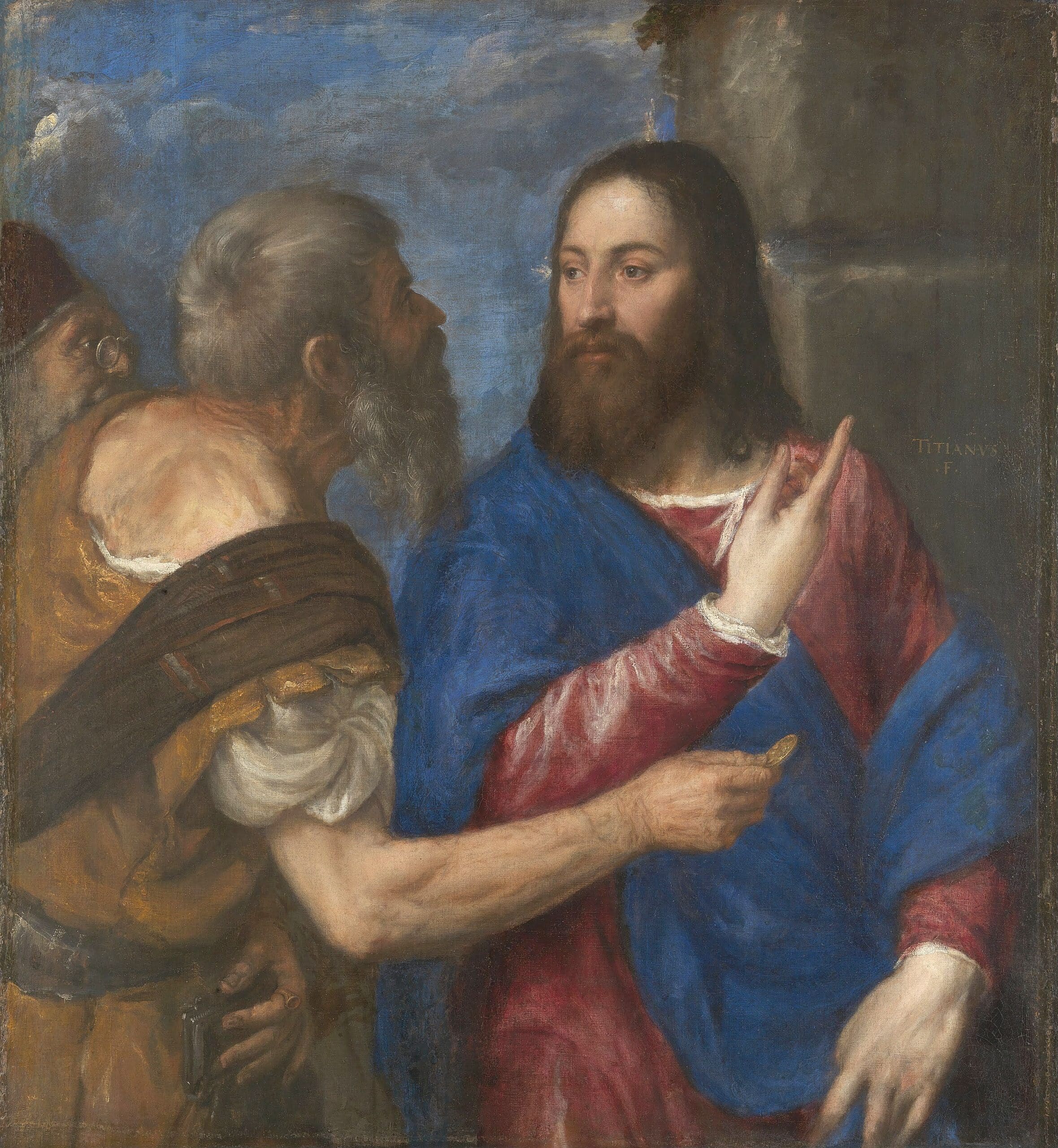
The feud between Pope Leo and President Trump over U.S. immigration policy and military action in Iran raises important questions about the propriety of observing boundaries and not crossing certain lines.
Little needs to be said about the president’s behavior on this score, except to recall Hilaire Belloc’s description of Henry VIII, whose chief characteristic “was an inability to withstand impulse.” Belloc astutely observes that the sixteenth-century monarch “was passionate for having his own way – which is almost the opposite of having strength of the will.” It was this lack of self-restraint, he notes, that prevented Henry from understanding when “this lack of self-control passed the bounds of common decency.”
More critical for Catholics is the question of whether Pope Leo, some U.S. bishops, and other Church officials might themselves have crossed important lines, not in their personal demeanor, but in the substance of their pronouncements.
As Pope Leo has encouraged us to do, I have been revisiting the documents of Vatican II. One major takeaway from that treasure trove of Christian teaching is the clear distinction modern Catholic social thought draws between doctrines and principles, on the one hand, and their prudential application in particular cases, on the other.
It’s clear from the documents that when our pastors articulate and defend foundational social principles, they do so with the full authority of their office. Catholics are placed in a difficult situation, however, when our spiritual leaders publicly voice their views regarding the specific applications of those principles. Should the faithful consider these pronouncements as authoritative or simply as personal opinions, with which they might legitimately disagree?
The tradition of Catholic social thought has always recognized that there are many contingent factors involved in applying the Church’s social teachings in specific contexts. It requires those responsible for such decision to wade into the messiness and uncertainty of things, to weigh potential consequences. Immigration policy and the use of military force in Iran are prime examples.
It’s for this reason that the virtue of prudence plays such a prominent role in these decisions. It’s also why the Church emphasizes the indispensable role of the laity, especially those with the requisite knowledge and skills, in making these determinations. Which brings me back to the magisterial documents of Vatican II.
In the Decree on the Apostolate of the Laity (Apostolicam actuositatem), the Council Fathers affirmed that it is especially incumbent on the laity to learn the moral and social teachings of the Church so that they might be capable of “rightly applying these same principles and conclusions to individual cases.” Another Council document (Ad Gentes) gives us the flip side of this when it declares that “the Church has no desire at all to intrude itself into the government of the earthly city.”

Church leaders will always, and appropriately, call for the peaceful resolution of conflicts. But we should not assume that calls for continued dialogue and negotiations in every instance occupy the moral high ground. Dragging out diplomatic talks may, in fact, only allow bad actors to continue killing more innocents and, even more alarmingly, afford them more time to acquire greater lethality with which to kill countless others.
The Catholic tradition of social thought has always recognized that, as long as we live in a sinful world, resort to force – through police power or military means – will sometimes be necessary. That is why just war teaching articulates criteria for judging the justice of going to war (jus ad bellum) as well as for ensuring that even just wars are carried out only through licit means (jus in bello).
Sometimes moral principles bear directly on the social order, and in those instances, pastoral pronouncements can proceed straightforwardly. Abortion, genocide, and other intrinsically evil acts, such as the wanton killing of civilians, fall into that category. Thus, our pastors were well within their right to condemn the president’s ill-considered (even if not seriously intended) threats to wipe out Iran.
But unless one accepts the proposition that waging war is inherently immoral, as pacifists do, then determining whether a specific instance of the use of force is just will inevitably involve making difficult prudential judgments. This requires, among other things, having access to sensitive information that the general population often does not (and arguably should not) have. Add that to the reasons the tradition wisely places the burden of waging war on legitimate public authorities.
In his typically thoughtful way, Bishop Robert Barron has defended Pope Leo against President Trump’s criticisms this way: “It is the pope’s prerogative to articulate Catholic doctrine and the principles that govern the moral life. In regard to the concrete application of those principles, people of goodwill can and do disagree.”
Exactly right. Which is why we must respectfully ask whether our Church leaders have not at times crossed the line between principles and prudence. On that question, too, I suspect people of goodwill will disagree.
C. S. Lewis exhibited a strong Catholic sensibility on this topic when he affirmed that the clergy have a responsibility to vigorously articulate basic Christian principles. But also that the concrete application of general principles in the public sphere is beyond their competence: “The clergy are those particular people within the whole Church who have been especially trained to look after what concerns us as creatures who are going to live forever: and we are asking them to do a quite different job for which they have not been trained.”
Lewis urges us instead to look to Christian laymen “who happen to have the right talents” to provide guidance in temporal affairs:
The application of Christian principles, say, to trade unionism or education, must come from Christian trade unionists and Christian schoolmasters: just as Christian literature comes from Christian novelists and dramatists – not from the bench of bishops getting together and trying to write plays and novels in their spare time.
Or, we might add, issuing pronouncements on complex public policy issues, whether foreign or domestic.
The post Respecting Boundaries, Papal and Political appeared first on The Catholic Thing.