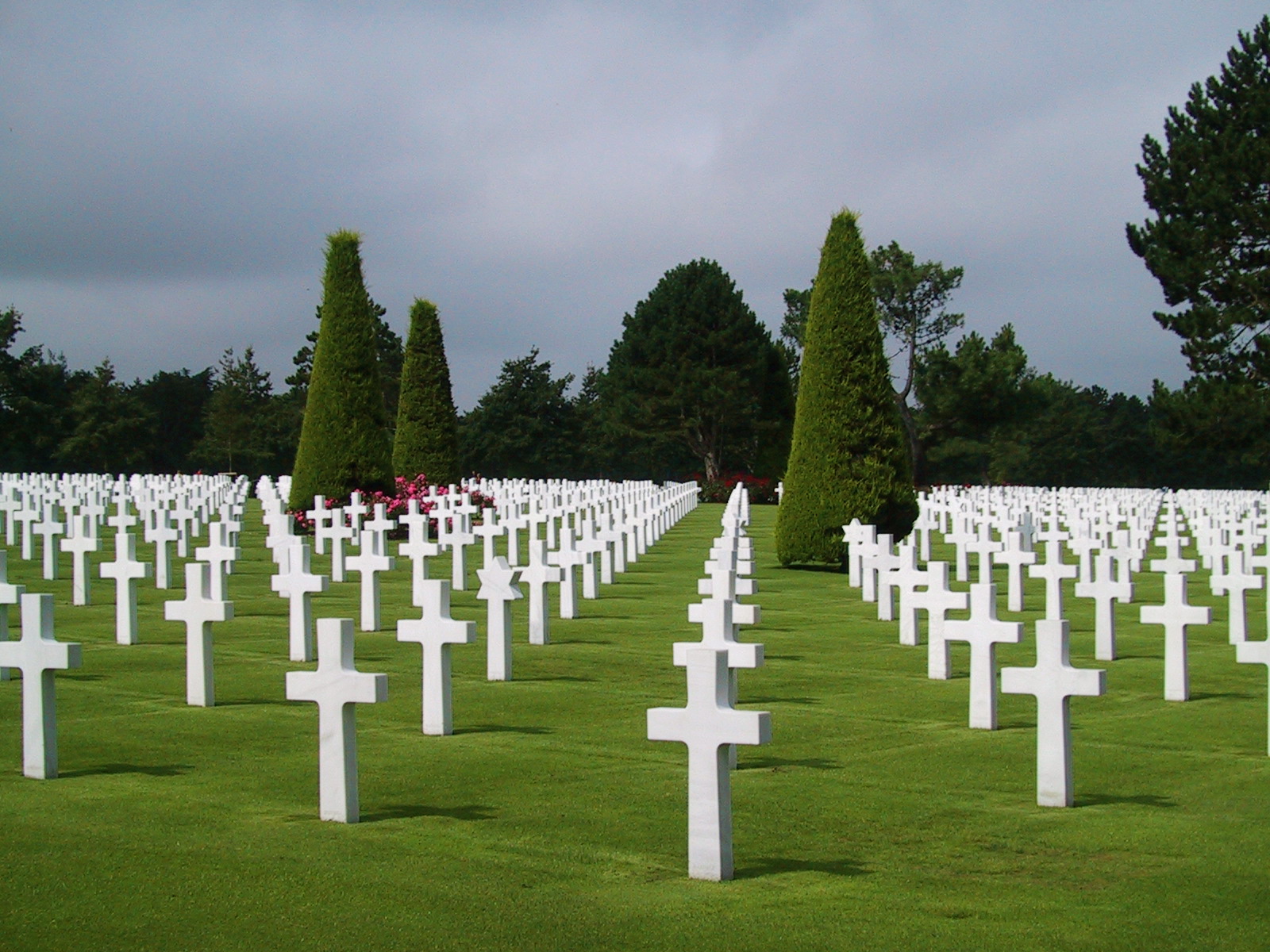
The great French preacher Lacordaire once said the vocation of a soldier is next in dignity to the priesthood, not only because it commissioned him to defend justice on the field of battle and order on the field of peace, but also because it called him to the spirit and intention of sacrifice.
Generally, respect for groups varies with their number; the more numerous they are, the less they are esteemed. But it is not so with the fighting forces. No group equally large is so revered. It is their high calling to the defense of justice and freedom that makes them loved.
It was a soldier who first uttered the words recalled by the Church at Communion: “Lord, I am not worthy to have Thee come under my roof, but only say the word, and my servant will be healed.” (Matthew 8:8) The Breviary, which priests read daily, praises Judas Maccabeus, who refused to surrender to superior enemy forces and died saying: “Far be it from us to do such a thing as to flee from them. If our time has come, let us die bravely for our brethren, and leave no cause to question our honor.” (I Maccabees 9:10)
Isaiah heard the Seraphim around the throne of God address Him as the Lord of Armies. “Holy, holy, holy is the Lord God of hosts; the whole earth is full of His glory.” (Isaiah 6:3) Life is a battle. St. Paul himself said: “I have fought the good fight, I have finished the race, I have kept the faith.” (II Timothy 4:7)
In a similar spirit, he enjoined Timothy: “This charge I commit to you, Timothy, my son, in accordance with the prophetic utterances which pointed to you, that inspired by them you may wage the good warfare.” (I Timothy 1:18) “Share in suffering as a good soldier of Christ Jesus.” (II Timothy 2:3)
The soldier’s armor in the great battle of life is as follows: “Stand therefore, having girded your loins with truth, and having put on the breastplate of righteousness, and having shod your feet with the equipment of the gospel of peace; besides all these, taking the shield of faith, with which you can quench all the flaming darts of the evil one. And take also the helmet of salvation, and the sword of the Spirit, which is the word of God.” (Ephesians 6:14-17)
There is a war inside me: the flesh against the spirit. “I see in my members another law at war with the law of my mind and making me captive to the law of sin which dwells in my members.” (Romans 7:23) If He who valued life more than anyone else did not consider death too great a price for Him to pay to defeat evil, why should I not be prepared in His name to suffer the hardships of armed service so that evil may be conquered?

If the Cross of our Savior was a proof that there was something wrong in man that could be righted only by a sacrificial death, why should not this war be to me a proof that there is something so wrong with the modern world that it can be righted only by my sacrificial life? I am not fighting for a freedom that means the right to do whatever I please but for a freedom that means the right to do whatever I ought.
Oughtness implies Law; Law implies Intelligence; and Intelligence implies God. I am not fighting merely to make the world safe for democracy; I am fighting to preserve the roots of democracy – the moral law rooted not in Power, but in God. I am not fighting for freedom from something; but for freedom for something: the glorious freedom to call my soul my own and then to save it in cooperation with God’s grace.
I am not fighting to preserve the kind of world we had just before this war. If I were, I would be fighting to preserve a world that produced tyrants and dictators. The new world must be a better world than that, or it is not worth fighting for.
Sergeants are proverbially believed to be hard and tough. It is not likely that they were any different on Calvary. It was a Roman sergeant, so used to scenes of blood, who ran a spear into the side of Christ. But he was converted on that battlefield, and in that very hour he declared his faith: “Indeed, this is the Son of God.”
Maybe I can find Christ on the battlefield, too. I must not be ashamed if I am fearful and if my whole being shrinks in dread, for the Lord in the Garden before going to the Battle of Calvary prayed: “If it be possible, let this cup pass from me; nevertheless, not as I will, but as Thou wilt.” (Matthew 26:39) What I must fear is my unwillingness to fulfill the will of God as revealed by the present circumstances of life.
Not my will but Thine be done. Though a battlefield is confusion worse confounded, though bullets may be as thick as the drops of rain, though I am one in a million in a vast cauldron of steel and fire, I am still in the eyes of God a person with an immortal destiny: “But even the hairs of your head are all numbered.”
“Teach us, good Lord, to serve Thee as Thou deservest; to give and not to count the cost; to fight and not to heed the wounds; to toil and not to seek for rest; to labor and not to ask for any reward, save that of knowing that we do Thy will through Jesus Christ our Lord.” (St. Ignatius Loyola)
In war all an enemy can do is to attack my body. Do I ever fear when an enemy attacks my soul?
Excerpted from Archbishop Fulton J. Sheen’s Wartime Prayer Book.





![Hegseth Demands Fitness Requirements, Says 'Fat Troops' 'Not Who We Are' [WATCH]](https://teamredvictory.com/wp-content/uploads/2025/09/Hegseth-Demands-Fitness-Requirements-Says-Fat-Troops-Not-Who-We-350x250.jpg)