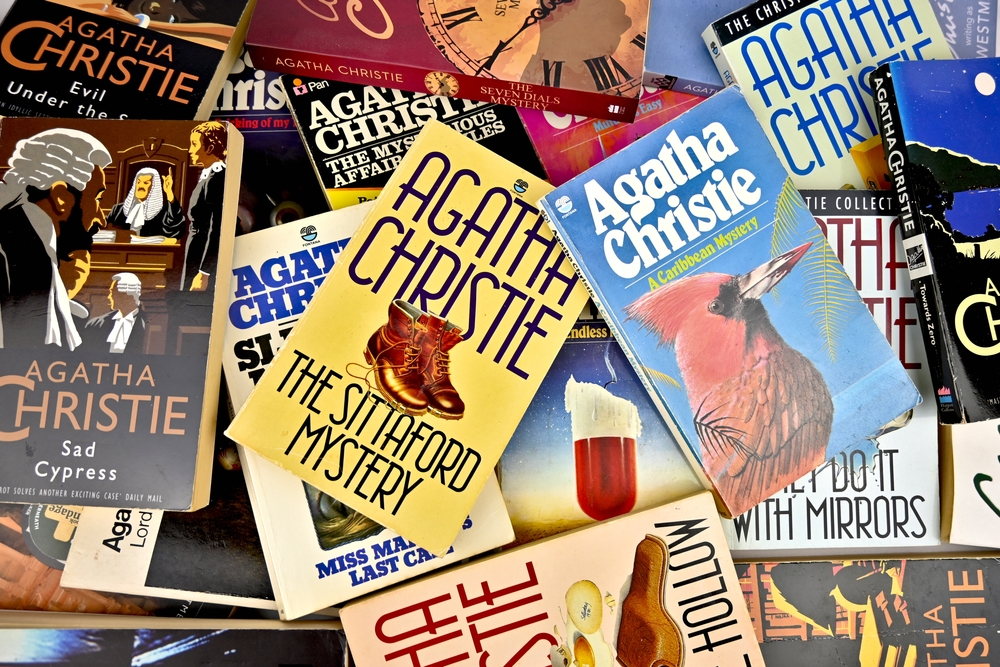
Anthony Malcolm Daniels, who writes under the pen name Theodore Dalrymple, is the most irritating kind of cultural critic; he stubbornly refuses to accommodate himself to the ever-shifting categorical boundaries of the times. Dalrymple is described as a conservative, and certainly holds many conservative positions, but his agnosticism puts him in a strange position vis-à-vis his religious comrades, and his background as a prison psychiatrist salts his writing with a distinctly left-tasting social awareness and psychological sensitivity. He struggles to mingle easily with progressives, however, because of his deep-seated skepticism about the efficacy of social programs and his basic belief in original sin.
In his newest book, a slim volume intriguingly titled Agatha Christie and the Metaphysics of Murder, Dalrymple goes out of his way to irritate another group that he is at least occasionally associated with: literary critics. In response to literary critical disdain for Christie’s writing, and for genre fiction as a whole, Dalrymple turns a close-reading lens on a single story by the Queen of Mystery to explore questions of human nature, the justice of imprisonment, and the existence or nonexistence of evil. The questions that arose from my reading of this little book are, however, more about Dalrymple himself than Agatha Christie: Does Christie’s work in fact raise these profound questions and offer an imaginative approach to answering them? Or is Dalrymple brilliantly turning Christie’s story into a vehicle for his own convictions, plumbing his own intellectual depths under the guise of a close reading of Christie?
Dalrymple explains in the first chapter that Agatha Christie and the Metaphysics of Murder is a direct response to the criticism that Christie’s books are “flat and unoriginal, her plots absurd, her outlook bourgeois and small-minded.” Here Dalrymple reveals his conservative bona fides, for rather than simply accepting the “expert” opinion of critics like Edmund Wilson, who declared Christie’s books “literally impossible to read,” Dalrymple finds “the fact that they were (and are) of such worldwide appeal … worth investigating.” This appeal to the authority of the populace over and against the opinion of highly educated elites is representative of a certain strain of conservativism. Dalrymple doubles down, asking,
How is it that books whose action takes place in a social milieu so completely alien to that of the vast majority of mankind were nevertheless able to capture their imaginations? Does this not suggestion some skill on the part of the author?
This in itself is an intriguing idea. Literary critics of the first order generally avoid so-called genre fiction (romance, mystery, horror, sci-fi) on principle. In one sense, this is a reasonable position; the vast majority of genre fiction is trash, written entirely as a television alternative, a less flashy way to kill time in a life that has not lived up to our expectations. It would be useful to have a word other than “writing” to designate such stuff, which in the heady advent of generative AI is proliferating in an appalling manner.
But in another sense, ignoring genre fiction in major criticism impoverishes literary discourse and relegates the exploration of truly fruitful literature (like Gene Wolfe’s incomparable Book of the New Sun or Tim Powers’s innovative Declare) to Reddit threads. How, asks Dalrymple, shall we approach genre masters like Christie from a literary perspective, and what might we gain from such an approach?
Dalrymple sets out to answer his own question via a curious method: Rather than pursuing a long-held scheme of a sweeping survey of all 66 of Christie’s detective novels, he selects a single novel as the “test subject” for his theory that Christie’s work merits close reading. The novel in question is the somewhat dubious They Do It with Mirrors, a less-than-flawless Miss Marple escapade from the back of the Christie catalog. On this somewhat shaky ground, Dalrymple promises to build his critical tower.
Dalrymple claims that he selected They Do It with Mirrors at random. If this is the case (as I believe it is), what a happy chance! It is difficult to imagine a Christie mystery more suited to his personal expertise. They Do It with Mirrors is one of the more psychologically fantastical Christie mysteries, involving all kinds of delinquents, mixed-up family lines, and buried secrets that metastasize horribly. Dalrymple gives a good plot summary and, as his purpose is to explore the book’s themes and writing critically, reveals the murderer. (Reader beware: If you want to read the novel for yourself, do it before reading Metaphysics of Murder, but I will not spoil the novel here.)
The plot unfolds on the grounds of an English mansion repurposed as a recovery home for juvenile delinquents, run by a feverishly altruistic millionaire who sees in these young hooligans vast creative and capitalist potential. When, however, a visitor to the mansion is murdered, the entire premise of the project comes under scrutiny. It is up to Miss Marple to find who among this festival of charity is a murderer.
This plot opens a whole tranche of questions that could adequately be described as a Dalrymple’s Box, so perfectly do they correspond with Dalrymple’s interests. His background as a prison psychiatrist shows through in his psychological analyses of the various characters’ stories, actions, and choices. When he considers a character, it is with a hard-won blend of charity and resignation; Dalrymple, unlike the hectic millionaire bankrolling the recovery home, is no slave to optimism. Taking the book one conversation at a time, Dalrymple exposes entire, and contradictory, understandings of human nature, original sin, social obligations, justice, and redemption at work in the novel. The twists and turns of the plot, he asserts, do not derive solely from Christie’s desire to produce an effect; they are (to some degree, at least) literary fissures radiating from the metaphysical clash at the heart of the novel—a clash that, according to Dalrymple, continues to rock English society.
Dalrymple anchors his ruminations in passages from Christie, but his wide-reaching examinations of human nature play just as great—or greater—a role here as Christie’s own. After introducing the major characters and the situation, he quotes a character named Mrs. Rydock, who insists, contra the more philanthropic figures in the novel, that “there is such a thing as evil.” From this line, Dalrymple briefly surveys the philosophical puzzle of the existence of evil, then gives us this passage:
For some years I worked in a prison where you might suppose that these questions, if anywhere, could be answered. Certainly, it was my impression that most of the prisoners had done bad knowingly, committing selfish, thoughtless, and sometimes cruel acts, but I did not think that they were irredeemably bad, let alone evil, but were instead weak or impulsive …. But there were a few prisoners who struck me differently. They had an almost physical emanation of menace and determined ill-will.
This is a thoughtful, readable, yet compelling piece of writing, in which Dalrymple moves easily from Christie’s novel to his own experience, which serves to validate a sense I think many of us have: that much of what we think of as wickedness is really weakness, but that also there remains, indisputably and inescapably, real evil in the world.
Metaphysics of Murder is riddled with fascinating digressions, such as when Dalrymple writes about how the worst offenders are the most sensitive to minor slights against themselves; the significance of hedgehogs for civilization; the possibility of congenital goodness as well as congenital wickedness; and the immeasurability of unhappiness. The book is full of profound wisdom on human nature, society, and reality itself, as when Dalrymple celebrates the diversity of human interests as against top-down institutional interests:
Civilization itself is a matter of many small things, none of them the most important by comparison with everything else. Except in times of dire emergency, it is better that there should be a thousand small things that are very important to a thousand people than that there should be one all-important thing to everyone.
In another section, he writes of a character in They Do It with Mirrors: “Her childhood gave her almost a talent for unhappiness, as if now to be happy were to be disloyal to her unhappiness as a child.” That is an observation well worth sitting with, and even turning against ourselves, for we all are tempted hold our little hurts quite dear.
Metaphysics of Murder is also unmerciful in its criticism of pop psychology, such as the notion that criminals and delinquents are suffering from a lack of self-esteem. “Anyone who has been to a holding prison,” he writes, “will be struck not by the downcastness of the prisoners, but by the almost arrogant self-assurance, pride, and self-esteem with which they conduct themselves.” The breakdown, he says, is that too many of the modern experts who call for social programs to boost self-esteem neglect to help young people be worthy, rather than help them feel that they were worthy “ex officio,” as he puts it. Scarcely a page goes by without some thoughtful observation like this, artfully expressed. Dalrymple’s searing conclusion, that “the less tangible good a man is trying to do, the greater the lengths he is prepared to go to secure it,” is a warning that is more urgent every day.
The book is not without its faults, however. There are a number of prominent typographical errors that disrupt the flow of the text; most irritatingly, there is a word missing in the final line of the book (either that or Dalrymple chose to conclude his book with an unusual and awkward construction, which seems unlikely for a writer who so clearly values readability). A few such errors are quirky; more than a few can be troublesome.
The intent of Agatha Christie and the Metaphysics of Murder is to demonstrate the worth of Christie’s fiction, middlebrow as it admittedly is (“there are worse things than to be middlebrow,” as Dalrymple explains). “Authors,” he writes, “can be deeper (or shallower) than they know.” Readers with a bred-in-the-bone disdain for genre fiction or for Christie in particular will probably not be convinced; they will likely argue that the best insights of Metaphysics of Murder are Dalrymple’s, not Christie’s. But that raises a question about the nature of literature itself: If a close reading of a middlebrow book like They Do It with Mirrors results in a volume as pleasant and wise as this, does that not imply that there is something worthwhile—something, perhaps, literary?—in the text under examination? How, after all, do we decide if something is worth reading? Dalrymple does not aspire to answer such lofty literary questions here, but he provides a refreshingly down-to-earth antidote to the sometimes off-putting erudition of professional critics: When a piece of writing appeals to one’s imagination (an imagination that, for the purposes of this argument, has been at least decently well-formed), it is worth asking why.